
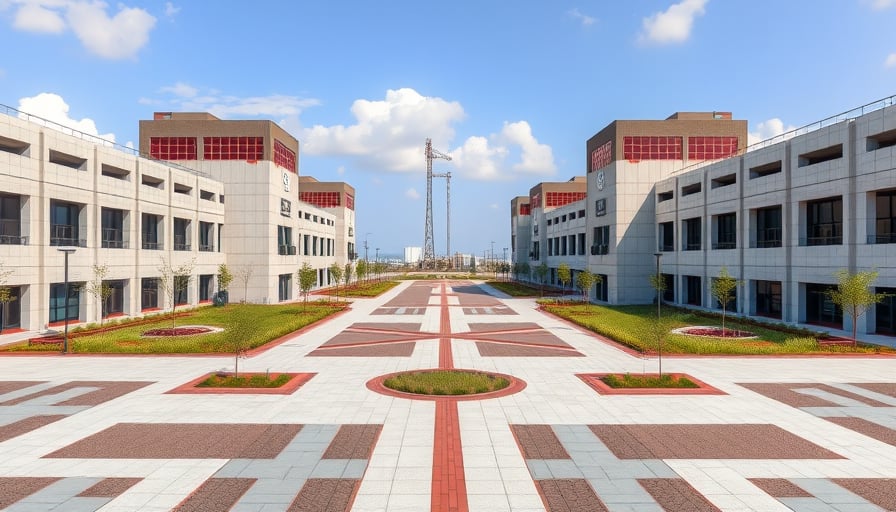
China Fortune Land Development Co., Ltd.: Navigating a Transforming Real‑Estate Landscape
China Fortune Land Development Co., Ltd. (CFLD), a Beijing‑based developer listed on the Shanghai Stock Exchange, continues to assert a strong presence in the industrial‑park segment of China’s real‑estate market. Recent trading activity revealed that the broader real‑estate sector opened higher, with peer companies such as Jinghe Investment Development and China Construction Development posting robust gains. Analysts interpret these movements as indicative of positive signals for the sector, suggesting that the most arduous phase for property developers may be receding as the underlying market bottom approaches.
Sectoral Context and Market Sentiment
The real‑estate market in China remains in a prolonged period of adjustment, characterized by tightening regulatory oversight, cooling demand, and an overall shift toward more sustainable, mixed‑use developments. In this environment, industrial‑park projects have gained prominence as a strategic response to evolving industrial policy, including the promotion of high‑tech manufacturing and logistics hubs. CFLD’s focus on industrial solutions and park development positions it within this emerging trend, potentially providing a buffer against the broader headwinds that are affecting conventional residential and commercial property developments.
Comparative Performance
- Jinghe Investment Development – Exhibited a notable surge in share price, reflecting investor optimism about its diversified portfolio that includes both industrial and residential assets.
- China Construction Development – Similarly benefited from sectoral lift, driven by its extensive pipeline of large‑scale infrastructure projects that align with national development priorities.
These peers’ performance underscores a sectoral shift toward assets that offer greater resilience in a tightening credit environment. The upward movement in the sector index suggests that market participants are recalibrating expectations for growth in the industrial‑park sub‑segment.
Financial Outlook and Valuation Dynamics
While real‑estate earnings across the sector are projected to face sustained pressure, CFLD’s strategic orientation toward industrial solutions may help mitigate some of the broader challenges. Analysts note that:
- Profitability – The company’s operating margins are expected to remain modest, reflecting the need to invest in infrastructure and technology to attract high‑value tenants.
- Capital Efficiency – CFLD’s focus on industrial parks allows for longer lease terms and higher occupancy rates compared to conventional office or retail spaces, potentially enhancing cash flow stability.
- Valuation – Despite these strategic advantages, the company’s current valuation remains low relative to its peers, evidenced by a negative price‑earnings ratio that mirrors the broader sectoral distress.
The negative price‑earnings ratio is not an isolated anomaly; many real‑estate firms in China exhibit similar metrics due to heightened uncertainty around future revenue streams, rising debt costs, and regulatory constraints. However, the lower valuation may represent a buying opportunity for long‑term investors who anticipate a market rebound as industrial demand continues to rise.
Cross‑Sector Implications and Economic Linkages
The emphasis on industrial‑park development aligns with several macro‑economic drivers:
- Industrial Policy – The Chinese government’s push toward high‑tech manufacturing and green energy sectors dovetails with the need for dedicated industrial spaces, thereby supporting CFLD’s business model.
- Supply Chain Resilience – Global supply chain disruptions have heightened demand for domestic logistics hubs, which industrial parks can supply, providing a potential upside to occupancy rates.
- Urbanization Dynamics – Continued urban migration fuels demand for integrated industrial‑commercial zones that can serve both production and service functions, expanding the target market for CFLD’s projects.
These cross‑sector linkages illustrate how a real‑estate developer’s strategic pivot can be informed by, and in turn influence, broader economic trends. By aligning its portfolio with these macro drivers, CFLD positions itself to capitalize on evolving market demands while maintaining operational resilience.
Conclusion
China Fortune Land Development Co., Ltd. exemplifies a real‑estate firm that is proactively adapting to a challenging environment by concentrating on industrial‑park development. While the sector remains under pressure, the company’s strategic focus aligns with national policy priorities and global economic shifts that favor industrial and logistics infrastructure. Its valuation, though low, reflects broader sectoral challenges; nevertheless, it may present a compelling proposition for investors seeking exposure to the industrial‑real estate niche in China.