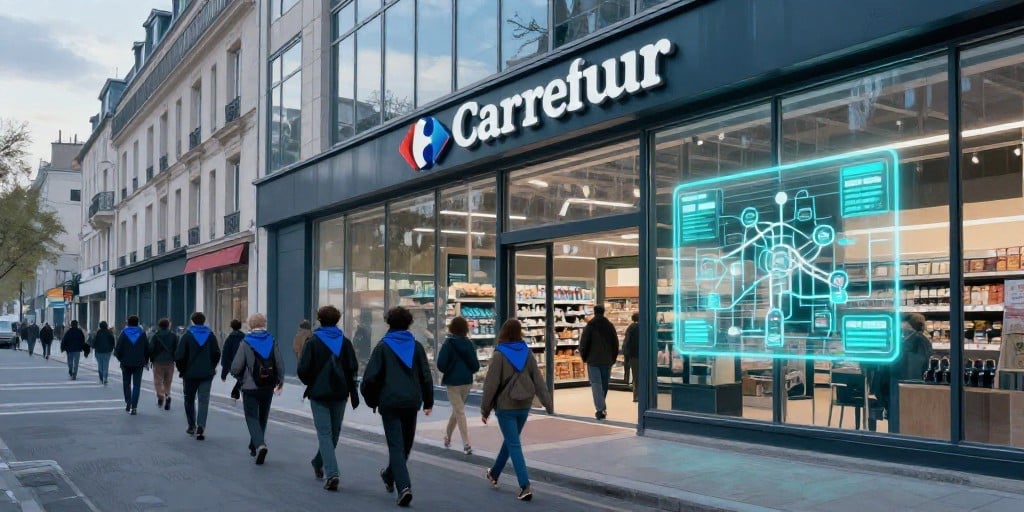
Carrefour SA Revises Earnings Guidance Amid Protracted Unrest
Carrefour SA, the French retail behemoth, has formally lowered its earnings forecast for the current fiscal year, citing the continued disruption caused by widespread protests across France. The company’s management announced the revised guidance during a press conference in Paris, noting that the unrest has adversely affected customer footfall and driven up operating costs. Consequently, the corporation expects its profit margins to remain stagnant or to improve only marginally. In addition to the earnings cut, Carrefour has dialed back its projected operating margin and free‑cash‑flow targets.
Dissecting the Economic Impact of Civil Disruptions
The protests have repeatedly shut down major shopping districts, forcing Carrefour to close certain outlets and reroute supply chains. While the company has attempted to mitigate losses through temporary closures and heightened security expenditures, the cumulative effect is a contraction in revenue and an increase in per‑unit operating expenses. Early analyses suggest that the net impact on the company’s gross margin could be on the order of 1–2 percentage points, a figure that aligns with the revised operating margin guidance.
Overlooked Supply‑Chain Vulnerabilities
Carrefour’s supply chain has historically relied on a high degree of centralization, with a network of distribution centers positioned near key urban markets. The protests have exposed the fragility of this model; disruptions at even a single hub can cascade across multiple retail locations. A comparative assessment of competitor logistics strategies reveals that some European retailers have diversified their distribution footprint, thereby cushioning the impact of localized disruptions. If Carrefour were to emulate this approach, it might reduce future vulnerability, albeit at the cost of short‑term capital outlays.
Regulatory Environment and Political Uncertainty
The French government’s handling of the protests remains a critical variable. While authorities have pledged to restore order, the persistence of strikes and demonstrations indicates that the regulatory landscape will stay fluid. The broader macro‑economic environment—characterized by a widening spread between French and German government bond yields—signals heightened risk sentiment among investors. In this climate, Carrefour’s ability to secure favorable financing terms could be compromised, further tightening cash‑flow projections.
Competitive Dynamics in a Post‑Protest Market
Carrefour operates in a highly consolidated sector, with rivals such as Auchan, Leclerc, and international players like Lidl and Aldi vying for market share. The protests have reshuffled consumer behavior; shoppers are increasingly gravitating toward online platforms and smaller, local stores that can maintain open hours during disruptions. While Carrefour’s online sales have experienced a modest uptick, the overall shift underscores the necessity for the company to enhance its digital footprint and adapt its omnichannel strategy to survive future turbulence.
Risk Assessment and Potential Opportunities
Risks
- Persisting Disruptions: Continued unrest could erode revenue further and inflate operating costs.
- Financing Constraints: A tighter capital environment may limit the company’s capacity to invest in supply‑chain resilience.
- Erosion of Brand Loyalty: Customers may permanently shift away from traditional supermarkets in favor of more flexible retailers.
Opportunities
- Supply‑Chain Diversification: Re‑architecting logistics could reduce long‑term vulnerability at the expense of short‑term capital outlay.
- Digital Expansion: Accelerating e‑commerce capabilities may capture the growing segment of consumers preferring contactless shopping.
- Strategic Partnerships: Collaborations with local grocers or logistics firms could provide a hybrid model that balances scale with agility.
Financial Implications
Carrefour’s revised guidance reflects a contraction in operating profit, with a projected decline in the operating margin from the previously forecasted 10 % to an estimated 8–9 %. The free‑cash‑flow target has also been adjusted downward by approximately 15 %, signaling a more conservative cash‑generation outlook. These changes will likely influence the company’s dividend policy and debt‑management strategy. Analysts predict that, barring a swift resolution to the unrest, Carrefour could face a prolonged period of margin pressure.
Market Reaction
The market’s response was swift and pronounced; Carrefour’s share price fell by more than 13 % in early trading, reaching a trough not seen since February. The drop reflects investor apprehension not only about Carrefour’s immediate prospects but also about broader sectoral exposure to political risk and the widening French‑German bond yield spread. While the stock’s volatility may subside if the political situation stabilizes, the current environment underscores the sensitivity of retail valuation to macro‑economic and socio‑political factors.
Conclusion
Carrefour’s decision to revise its earnings guidance is symptomatic of deeper structural vulnerabilities exposed by prolonged civil unrest. While the company’s immediate response—tightening margins and reducing cash‑flow targets—reflects a pragmatic recalibration, it also signals a need for strategic reorientation. By investing in supply‑chain resilience, bolstering digital capabilities, and reassessing its risk‑management framework, Carrefour could position itself to withstand future shocks. Investors, however, must remain vigilant, as the interplay between political uncertainty, market sentiment, and operational adaptability will continue to shape Carrefour’s trajectory in the months ahead.