
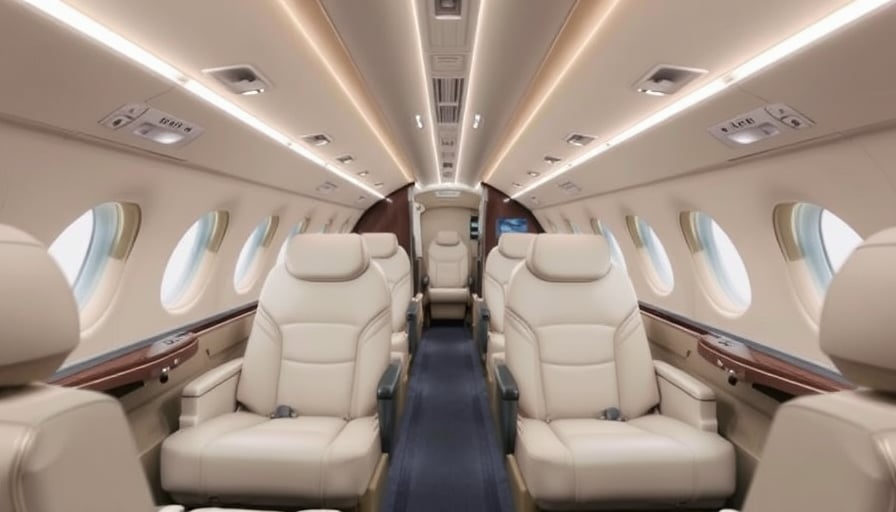
Bombardier’s Global 8000 Receives EU Certification, Cementing Its Position in the Ultra‑Long‑Range Jet Market
Bombardier Inc. has announced that its flagship Global 8000 business jet has obtained certification from the European Union Aviation Safety Agency (EASA). This milestone follows earlier approvals from Transport Canada and the U.S. Federal Aviation Administration (FAA), marking the first time a single aircraft has received a coordinated, multinational safety clearance from all three major regulatory authorities. The certification is a critical step toward commercial delivery, positioning the Global 8000 as the fastest civilian aircraft in the world, with a top speed approaching Mach 0.95 and an ultra‑long‑range capability that allows nonstop flights exceeding 10,000 nautical miles.
1. Strategic Significance for Bombardier
The Global 8000 is the culmination of Bombardier’s Global series strategy, which has defined its premium business‑jet portfolio for the past decade. By securing EASA certification, Bombardier not only confirms compliance with the most stringent European air‑worthiness standards but also unlocks access to a market that accounts for roughly 40 % of all business‑jet deliveries.
The aircraft’s performance—combining high speed with extended range—directly addresses a growing demand for time‑critical, long‑haul travel among corporate executives, high‑net‑worth individuals, and diplomatic personnel. This capability reduces the need for intermediate stops, thereby lowering operational costs and environmental impact per flight hour.
2. Industry Dynamics and Competitive Landscape
2.1 Market Drivers
- Globalization of Business Travel: Multinational corporations increasingly require rapid, direct access between key cities, especially in the Asia‑Pacific, Middle East, and North America corridors.
- Post‑Pandemic Recovery: The business‑jet market has rebounded strongly, with an 8–10 % CAGR forecast for 2025–2030, driven by a shift toward private air travel for health and safety reasons.
- Sustainability Pressure: Airlines and operators are under growing scrutiny to reduce carbon footprints. Ultra‑long‑range jets that avoid stopovers can lower emissions per passenger, an advantage in the forthcoming EU “carbon border adjustment” regime.
2.2 Key Competitors
| Manufacturer | Model | Max Speed | Range | Notable Feature |
|---|---|---|---|---|
| Airbus | A350‑10 | Mach 0.85 | 8,700 nm | Eco‑friendly materials |
| Boeing | 787‑9 | Mach 0.85 | 8,700 nm | Advanced composite wing |
| Cessna (Textron) | Citation Sovereign | Mach 0.78 | 3,900 nm | Cost‑effective, high‑volume |
| Embraer | Phenom 300EV | Mach 0.78 | 3,250 nm | Versatile, high‑volume |
Bombardier’s Global 8000 is unique in combining speed, range, and cabin comfort that rivals commercial airliners while maintaining a business‑jet price point. The aircraft’s single‑jet, twin‑engined layout, powered by GE Aviation’s CFM International LEAP turbofans, provides both fuel efficiency and noise compliance with the latest ICAO regulations.
2.3 Regulatory and Supply‑Chain Context
- EASA Certification: Requires adherence to EASA Part‑M for continued airworthiness and EASA Part‑C for initial certification. Bombardier’s ability to meet these rigorous standards demonstrates robust engineering and quality‑control processes.
- Supply Chain Resilience: The COVID‑19 pandemic exposed vulnerabilities in aerospace supply chains. Bombardier has diversified its supplier base for critical components—particularly composite structures and avionics—to mitigate disruptions.
3. Economic Implications
3.1 Capital Expenditure and Financing
The Global 8000’s price point is projected at $70–$80 million, placing it among the most expensive business jets in its class. Bombardier’s financing partnerships with European and North American banks are expected to support a $12 billion sales pipeline in 2025–2027, reflecting confidence from corporate fleets and private owners.
3.2 Operational Cost Efficiency
The aircraft’s high cruise speed reduces flight times by up to 30 % compared to the Global 7500, lowering fuel consumption per hour. When combined with lower cabin service costs (due to a single‑jet configuration), the total cost of ownership (TCO) is projected to be 15–20 % cheaper per seat compared to comparable ultra‑long‑haul commercial flights.
3.3 Impact on the Global Economy
A more efficient business‑jet fleet accelerates global commerce, particularly for sectors that depend on rapid decision‑making (e.g., finance, technology, energy). Moreover, the jet’s compliance with EU emissions regulations could ease entry into European markets for operators, potentially stimulating regional economic activity in aerospace hubs such as Paris–Charles de Gaulle, Munich, and London Heathrow.
4. Cross‑Sector Connections
- Automotive & Aerospace: Bombardier’s use of advanced composite materials parallels trends in the automotive industry, where lighter, stronger alloys reduce fuel consumption and improve vehicle range. Lessons learned in supply‑chain optimization for aircraft manufacturing could inform large‑scale automotive production.
- Energy & Aviation: The Global 8000’s emphasis on fuel efficiency aligns with global renewable‑energy initiatives. The aviation sector’s transition to sustainable aviation fuels (SAFs) and potential electric‑propulsion technologies may further reduce environmental impact.
- Technology & Data Analytics: Real‑time flight‑path optimization, predictive maintenance, and cabin‑service automation—enabled by advanced avionics and IoT integration—reflect the broader industry shift toward data‑centric operations.
5. Outlook
With the EASA certification now in place, Bombardier is poised to accelerate production and secure first‑time deliveries early in 2026. The Global 8000’s combination of speed, range, and regulatory compliance positions it to become a benchmark for future ultra‑long‑haul business‑jets. Stakeholders—including corporate fleets, private owners, and regulatory bodies—will closely monitor the aircraft’s operational performance, fuel efficiency metrics, and market reception.
As the aviation industry navigates a complex landscape of economic recovery, sustainability mandates, and technological innovation, Bombardier’s Global 8000 exemplifies how rigorous engineering, strategic market positioning, and adaptability can translate into a competitive advantage that transcends individual sectors.