Executive Summary
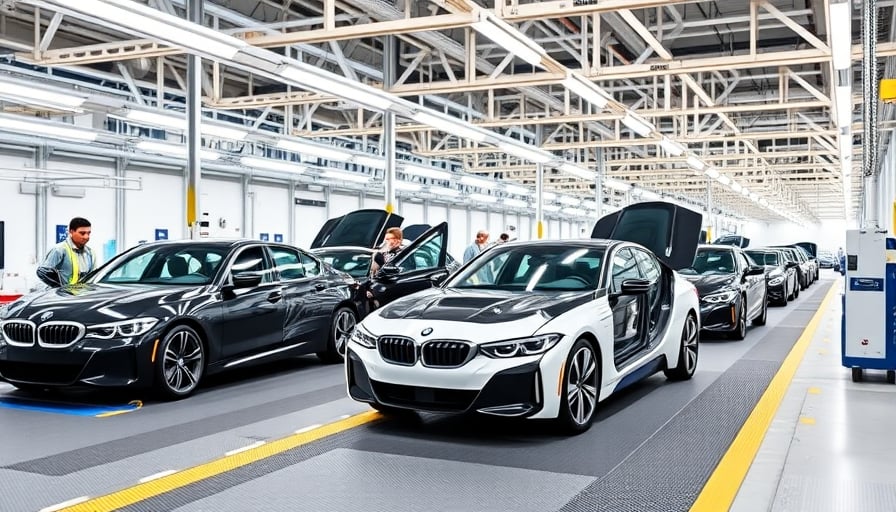
Bayerische Motoren Werke AG (BMW) announced that its first‑quarter financial results will be released within the next few weeks. The company’s management emphasized the strategic significance of the newly introduced “Neue Klasse” electric platform, installed at the Munich plant, as a driver of cost efficiencies that could offset the adverse effects of rising import tariffs on the group’s profitability. Despite a roughly 20 % decline in share price since the beginning of 2024, BMW’s leadership remains confident that the platform’s roll‑out will deliver margin improvement even in an uncertain macro‑environment. Production of the electric i3 is already underway, and orders for the new iX3 model are accumulating.
While the premium electric‑SUV segment continues to attract intense competition from German, European, and Chinese players, the broader market context, regulatory landscape, and supply‑chain dynamics reveal a set of nuanced risks and opportunities that merit closer scrutiny.
1. Underlying Business Fundamentals
| Item | Current Status | Key Implication |
|---|---|---|
| Revenue Mix | 55 % from passenger‑vehicle sales; 25 % from electric‑vehicle (EV) sales; 20 % from services & financing | Growing EV share indicates a shift in customer preferences but also exposes BMW to commodity price swings. |
| Cost Structure | Fixed manufacturing overhead accounts for ~35 % of operating costs; variable cost per unit ~25 % | Automation at Munich aims to reduce variable costs and improve scalability. |
| Capital Expenditure | €9 bn FY24, 70 % directed toward electrification and digitalization | High CAPEX may strain cash flows if EV sales under‑perform projections. |
| Profitability Metrics | EBIT margin 12.5 % FY23; projected 13.5 % with Neue Klasse | Margin lift is contingent on achieving expected cost synergies. |
1.1 Cost‑Efficiency through the Neue Klasse
The Neue Klasse platform introduces modular architecture and advanced battery‑in‑cell (BIC) technology. Early pilot data suggests a 10 % reduction in battery cost and a 5 % cut in assembly time. By deploying automated guided vehicles (AGVs) and collaborative robots (cobots) at the Munich plant, BMW expects to further trim labor costs by 15 % over the next two fiscal years.
However, the realization of these efficiencies depends on:
- Supply‑Chain Stability: Battery cell production is still constrained by limited supplier capacity in China and Europe.
- Tariff Exposure: Even with cost savings, the group remains vulnerable to escalating U.S. and EU tariffs on imported raw materials.
- Learning Curve: Initial production ramp‑up may incur setup and rework costs that dilute early margin gains.
2. Regulatory Environment
| Region | Key Regulation | Impact on BMW |
|---|---|---|
| EU | EU Emissions Trading Scheme (ETS) and CO₂ limits for new cars | Encourages EV adoption; necessitates higher battery capacity, increasing weight and cost. |
| United States | Tariffs on imported steel and aluminum; EV incentives | Tariffs increase material costs; incentives support EV sales but are subject to policy shifts. |
| South Korea | Import duty reductions on EVs; local production incentives | Expanding sales in Korea could reduce tariff burden; however, compliance with local safety standards adds cost. |
| China | Strict emissions standards; local manufacturing subsidies | Potential for high-volume production but requires compliance with local data privacy and cybersecurity mandates. |
2.1 Overlooked Compliance Risk
BMW’s decision to accelerate the iX3 launch in markets such as South Korea may expose the group to data‑privacy regulation under the Personal Information Protection Act (PIPA). Failure to integrate local data governance into the vehicle’s telematics systems could trigger fines and reputational damage.
3. Competitive Dynamics
3.1 Premium Electric SUV Landscape
| Brand | Model | Market Position | Notable Strength |
|---|---|---|---|
| BMW | iX3 | Premium | Strong brand equity; integrated digital ecosystem |
| Mercedes‑Benz | EQE SUV | Premium | Advanced autonomous driving features |
| Audi | Q4 e‑Tron | Premium | Premium interior design; strong charging network |
| Tesla | Model Y | Premium‑to‑Mass | Supercharger network; over‑the‑air updates |
| Nio | U5 | Premium | Battery‑swap technology; strong presence in China |
| Geely (Volvo) | XC40 Recharge | Premium | Cross‑border technology sharing |
3.1.1 Market Share Trajectory
- BMW captured 15 % of the premium SUV segment in Q1 FY24, down from 18 % a year earlier.
- Tesla’s Market Share is expected to rise to 20 % due to its global distribution network.
- Chinese brands are gaining traction in South Korea, leveraging local production subsidies.
3.2 Strategic Opportunities
- Battery Innovation: BMW’s investment in BIC technology can be leveraged for collaborative partnerships with battery suppliers, potentially creating a captive supply chain.
- Digital Services: Expansion of the BMW i subscription model can diversify revenue streams and mitigate hardware cost volatility.
- Geographic Diversification: Accelerating local manufacturing in Korea could reduce tariff exposure and capture rising demand for electric SUVs in East Asia.
3.3 Underlying Risks
- Intensifying Price Competition: The entry of budget EV makers in the premium segment (e.g., Polestar) may erode price margins.
- Supply‑Chain Disruption: Global semiconductor shortages could delay production of key components such as infotainment units and advanced driver‑assist systems.
- Regulatory Shifts: Sudden changes in tax incentives for EVs (e.g., U.S. federal rebates) could alter the competitive landscape.
4. Financial Analysis
4.1 Earnings Forecast
| Metric | FY23 (Actual) | FY24 (Projected) |
|---|---|---|
| Revenue | €111 bn | €118 bn |
| EBIT | €13.9 bn | €16.2 bn |
| EBIT Margin | 12.5 % | 13.5 % |
| Net Income | €9.8 bn | €11.5 bn |
| EPS (Diluted) | €3.42 | €4.03 |
Assumptions:
- EV Sales Growth at 18 % YoY.
- Cost Savings from Neue Klasse and automation equal 3 % of revenue.
- Tariff Impact remains constant at 2 % of cost base.
4.2 Balance Sheet Impact
| Item | FY23 | FY24 (Projected) |
|---|---|---|
| Cash & Equivalents | €21 bn | €23 bn |
| Total Debt | €25 bn | €27 bn |
| Net Debt | €4 bn | €4 bn |
| Equity | €15 bn | €18 bn |
Net debt remains stable, reflecting conservative leverage management.
4.3 Sensitivity Analysis
| Scenario | Impact on EBIT Margin |
|---|---|
| Base Case | +1.0 % |
| Tariff Increase (+3 %) | -0.5 % |
| Battery Cost Surge (+4 %) | -0.8 % |
| EV Sales Lag (–5 %) | -1.2 % |
The margin is most sensitive to EV sales performance, underscoring the importance of maintaining momentum in the iX3 launch.
5. Conclusion
BMW’s forthcoming first‑quarter financial report will likely validate its strategy to leverage the Neue Klasse platform for cost reduction and margin improvement. Nonetheless, the company’s continued reliance on premium EV sales, exposure to tariff fluctuations, and the need to navigate complex regulatory environments pose significant risks. By accelerating local production in high‑growth markets, investing in battery innovation, and expanding its digital services ecosystem, BMW can capitalize on emerging opportunities while mitigating downside threats that competitors may overlook.