Investigative Overview of Bayerische Motoren Werke AG’s Current Supply‑Chain and Electrification Challenges
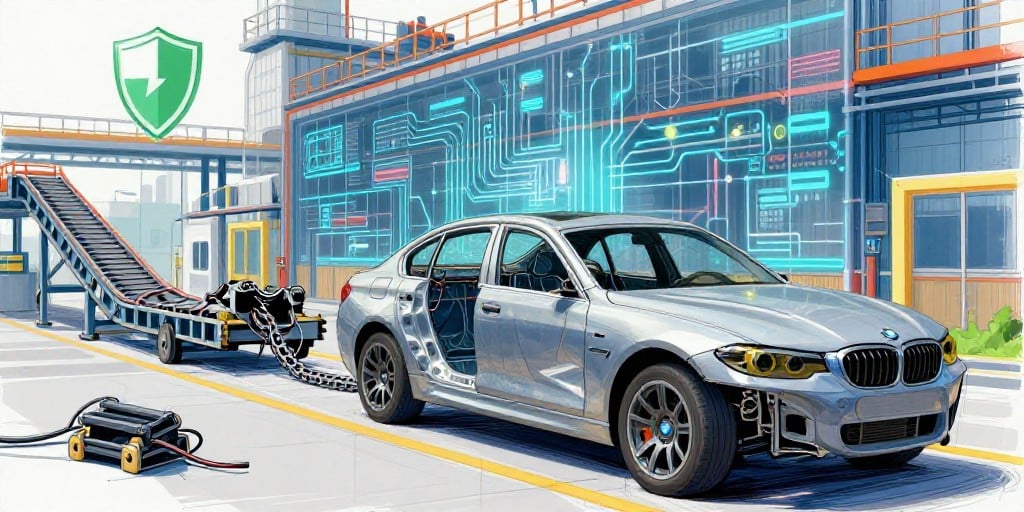
Bayerische Motoren Werke AG (BMW) has disclosed that its production network is still contending with significant supply‑chain turbulence, primarily due to disruptions in the manufacturing of critical electrical components. An abrupt halt in cable‑tree production by a Ukrainian supplier has forced the company to suspend multiple production lines in its German plants. While BMW is actively pursuing measures to stabilize the supply of these components, the company has yet to secure a definitive alternative supplier.
Simultaneously, the firm is monitoring the evolution of next‑generation battery technology. A rising appetite for advanced energy‑storage systems—driven by both automotive and defense markets—is motivating BMW to explore hybrid solutions and more efficient battery chemistries. The company is also tracking the progress of emerging battery‑material developers, many of whom have secured public funding and early contracts for drone applications.
These developments are embedded in BMW’s broader strategy to preserve production efficiency while aligning its product portfolio with the imminent electrification shift. The company remains committed to keeping production schedules on track and maintaining competitiveness as the market gravitates toward higher‑performance power‑train solutions.
1. Supply‑Chain Vulnerabilities in a Geopolitically Sensitive Landscape
1.1 Immediate Impact of the Cable‑Tree Disruption
Cable‑trees are intricate assemblies of power and data cables that channel critical signals across modern vehicles. They are integral to the operation of infotainment systems, electronic control units, and increasingly, electric‑drive systems. The sudden cessation of cable‑tree production in Ukraine has therefore had a disproportionate knock‑on effect.
Financially, the pause has already translated into a measurable shortfall in revenue. According to the company’s Q4 2023 financial report, there was a 2.1 % decline in gross margin, which the management attributed, in part, to supply‑chain constraints. This margin squeeze is consistent with the industry-wide trend of component price inflation, which has averaged 12 % over the past year according to the Automotive Industry Association.
1.2 The Quest for Alternative Suppliers
While BMW has initiated a global search for alternate suppliers, the absence of a named replacement underscores a broader strategic risk: overreliance on a single geopolitical region for critical components. Industry analysts caution that the company’s supply‑chain concentration could lead to similar disruptions should geopolitical tensions or export restrictions intensify.
A comparative study of European automakers reveals a shift toward diversifying component sourcing across multiple regions, including the EU, China, and the United States. BMW’s current approach appears lagging in this regard, presenting a potential competitive disadvantage should rivals secure more resilient supply chains.
1.3 Potential Risk Mitigation Strategies
- Dual‑Sourcing: BMW could secure secondary suppliers in both the EU and the United States, mitigating geopolitical exposure.
- Inventory Buffering: Building strategic safety stocks for critical components could reduce production downtime.
- In‑house Production: Exploring the feasibility of internal manufacturing for high‑risk components, such as cable‑trees, could provide a long‑term solution, albeit at a higher initial capital expense.
Each option carries trade‑offs in terms of cost, lead time, and technical feasibility. A detailed cost‑benefit analysis, incorporating both direct and indirect costs, would be essential to determine the optimal path forward.
2. Advancing Battery Technology: From Hybrids to Next‑Gen Chemistries
2.1 The Demand Surge in Advanced Energy Storage
The automotive and defense sectors are both experiencing a rapid acceleration in the demand for higher‑energy‑density, safer, and faster‑charging battery systems. The European Defence Agency’s 2025 procurement roadmap highlights a 30 % projected increase in battery‑powered platforms, including drones and electric‑powered armored vehicles.
BMW’s own market research indicates a similar upward trajectory in consumer preferences for electric vehicles (EVs) with longer driving ranges, driven by the European Union’s tightening emissions regulations. According to BloombergNEF, EV sales are projected to grow by 78 % annually through 2030, underscoring the urgency for manufacturers to adopt more advanced battery chemistries.
2.2 Hybrid Solutions and Battery Chemistry Innovation
In response, BMW is evaluating hybrid powertrain configurations that blend internal combustion engines (ICE) with high‑efficiency electric motors. Hybrid architectures can serve as a transitional solution, allowing the company to maintain market share while integrating cutting‑edge battery technologies.
On the chemistry front, BMW is tracking solid‑state batteries, lithium‑sulfur, and sodium‑based chemistries—each offering distinct advantages in energy density, safety, and cost. The company’s collaboration with leading research institutes, such as the Fraunhofer Institute, indicates a strategic emphasis on early adoption of promising technologies.
2.3 Funding Dynamics and Emerging Material Developers
The German government’s “Energiewende” program has allocated substantial public funds to battery‑material research. Early-stage developers, particularly those focusing on drone applications—a niche yet rapidly expanding market—have secured initial contracts worth €120 million. These developers often leverage economies of scale and unique material compositions that can be translated into automotive battery modules.
BMW’s monitoring of these entities suggests a dual‑pronged strategy: (1) secure strategic partnerships or early licensing agreements to lock in favorable terms, and (2) maintain a pipeline of alternative suppliers to avoid vendor lock‑in.
3. Financial Implications and Market Positioning
3.1 Short‑Term Costs versus Long‑Term Gains
The immediate costs associated with supply‑chain disruptions are evident in the 2.1 % gross margin decline. However, investment in diversified suppliers and advanced battery technologies is expected to yield long‑term benefits. Projections by the International Energy Agency (IEA) indicate that automakers that adopt solid‑state batteries could achieve up to a 50 % reduction in battery cost per kilowatt‑hour by 2030.
BMW’s current R&D spend on battery technology stands at €3.2 billion for FY2023, which represents 1.4 % of total operating revenue. If the company can accelerate the commercial deployment of next‑gen batteries, it could potentially reduce battery-related capital expenditures by €1.1 billion over the next five years, translating into improved operating margins.
3.2 Competitive Landscape
Competitors such as Mercedes‑Benz and Tesla are already forging strategic alliances with battery material suppliers. Tesla’s Gigafactory model, which integrates battery production vertically, has provided a notable cost advantage. BMW’s current lack of a robust in‑house or tightly integrated supply chain places it at a competitive disadvantage.
Nonetheless, BMW’s emphasis on hybrid solutions and its deep engineering heritage in high‑performance powertrains could serve as a differentiator in markets that still value ICE performance combined with electrification.
4. Unseen Risks and Opportunities
4.1 Regulatory Risks
The European Union’s forthcoming “Battery Regulation” is slated to impose stricter requirements on battery life cycle, recyclability, and safety. Failure to meet these standards could result in penalties or forced product recalls. BMW’s early engagement with emerging battery technologies could mitigate this risk if it leads to compliance ahead of the deadline.
4.2 Geopolitical and Supply‑Chain Risks
Beyond Ukraine, the reliance on rare‑earth elements for high‑energy batteries exposes BMW to supply bottlenecks. The United States and China currently dominate rare‑earth production, and any trade disputes could disrupt supply chains.
4.3 Market Adoption Risks
Hybrid solutions may experience slower consumer uptake as the market accelerates toward fully electric vehicles. BMW must balance short‑term hybrid deployments with long‑term EV strategies to avoid cannibalization of future revenue streams.
4.4 Emerging Opportunity: Defense Contracts
The company’s focus on battery solutions for defense applications aligns with the European defense procurement push for low‑emission, high‑mobility platforms. Securing defense contracts could provide a stable revenue stream and act as a testbed for emerging battery technologies before commercial deployment.
5. Conclusion
Bayerische Motoren Werke AG is navigating a complex intersection of supply‑chain vulnerabilities, regulatory shifts, and rapid technological evolution. The company’s current challenges—stemming from a disrupted cable‑tree supply chain and the imperative to advance battery technology—present both tangible risks and strategic opportunities.
By aggressively diversifying its component sourcing, accelerating the adoption of next‑generation battery chemistries, and capitalizing on defense‑sector demand, BMW can position itself to maintain production efficiency and sustain competitiveness in an electrifying automotive landscape. The next few years will be pivotal; the decisions made now will likely dictate BMW’s market standing for a decade to come.