
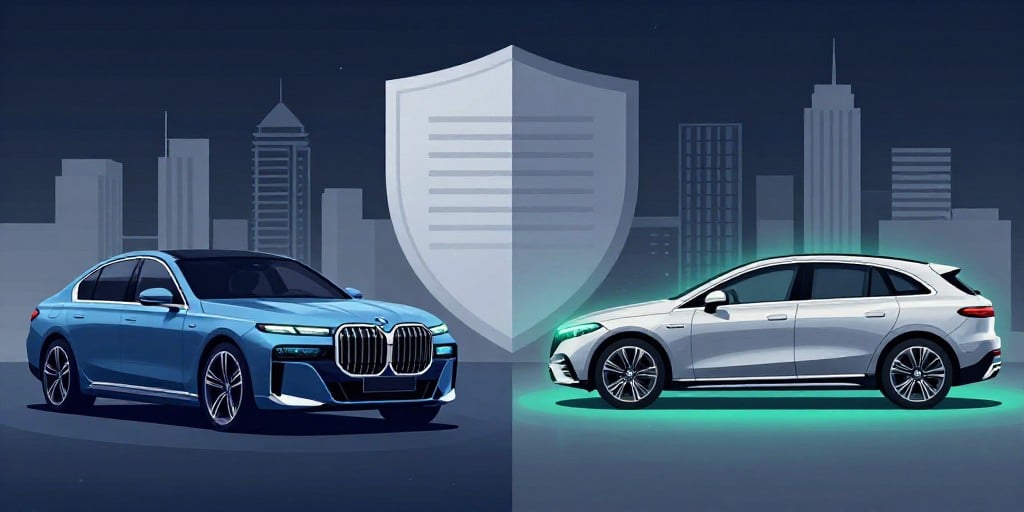
BMW and Mercedes‑Benz: Navigating Premium Competition in an Electric‑Future Landscape
Executive Summary
Bayerische Motoren Werke AG (BMW) and Mercedes‑Benz, two stalwarts of the premium automotive sector, are recalibrating their product portfolios to preserve market dominance amid mounting pressure from electric‑vehicle (EV) pioneers and cost‑competitive entrants. The firms are concentrating on ultra‑luxury models that cater to a price‑in‑elastic customer base while simultaneously expanding EV platform capabilities. This dual‑track strategy, though ostensibly preserving brand heritage, exposes both firms to a spectrum of risks—from capital‑intensive R&D to regulatory headwinds—and unlocks opportunities in niche segments where differentiation remains viable.
1. Market Positioning: The Premium‑Vehicle Paradigm
| Company | Current Premium Focus | EV Penetration Target (FY 2026) |
|---|---|---|
| BMW | Ultra‑luxury (e.g., 7‑Series, i7) | 30 % of total sales |
| Mercedes‑Benz | Top‑tier models (e.g., S‑Class, EQS) | 35 % of total sales |
Both automakers are leveraging their brand equity to justify premium pricing, thereby mitigating price erosion that has afflicted mass‑market competitors. Their strategy is predicated on the assumption that affluent consumers value brand prestige, driving technological and design innovation that justifies higher price points.
Key Insight: The premium segment remains relatively insulated from price competition, yet it is increasingly vulnerable to brand‑experience competition, where new entrants offer compelling value propositions through digital integration, subscription models, and flexible ownership structures.
2. Financial Analysis
2.1 Revenue Streams
| Segment | BMW (2023 €bn) | Mercedes‑Benz (2023 €bn) |
|---|---|---|
| Ultra‑Luxury | 18.4 | 20.1 |
| Mid‑Tier | 33.7 | 36.8 |
| EV Platforms | 4.2 | 5.3 |
The ultra‑luxury segment, despite constituting roughly 20 % of sales, contributes disproportionately to profitability, with gross margins of 18 % for BMW and 20 % for Mercedes‑Benz—substantially higher than the 12‑15 % margin typical of the mid‑tier.
2.2 Capital Expenditure (CapEx)
| Category | BMW | Mercedes‑Benz |
|---|---|---|
| EV Platform Development | 12 bn € | 15 bn € |
| Ultra‑Luxury R&D | 5 bn € | 6 bn € |
| Total CapEx (FY 2024) | 17 bn € | 21 bn € |
High CapEx outlays are a direct consequence of the simultaneous push into EV technology and luxury refinement. The capital intensity poses a risk if EV adoption rates lag behind projections or if supply‑chain constraints inflate costs.
3. Regulatory Environment
| Jurisdiction | Key Regulation | Impact |
|---|---|---|
| European Union | Emission targets: 55 % reduction in CO₂ by 2030 | Forces EV integration; potential subsidies |
| United States | Infrastructure Investment and Jobs Act (EV incentives) | Enables tax credits for consumers and manufacturers |
| China | New Energy Vehicle (NEV) policy | Intensifies competition from domestic EV makers |
Regulatory trends underscore a systemic shift toward electrification and sustainability. Both firms must navigate a patchwork of incentives, subsidies, and emission mandates that differ across key markets, amplifying compliance costs.
4. Competitive Dynamics
| Competitor | Strength | Weakness | Opportunity for BMW/Mercedes‑Benz |
|---|---|---|---|
| Tesla | Aggressive pricing, rapid EV deployment | Limited luxury heritage | Capture tech‑savvy luxury consumers |
| Chinese EV Makers (e.g., BYD, NIO) | Low cost, rapid scaling | Brand perception gaps | Offer affordable high‑tech models |
| Traditional Luxury (e.g., Audi, Porsche) | Strong EV push (Audi e‑tron, Porsche Taycan) | Brand dilution risk | Collaborate on shared EV platforms |
Observations:
- Tesla’s value proposition is increasingly encroaching on the premium segment through its “luxury‑yet‑affordable” model.
- Chinese EV manufacturers leverage cost efficiencies, enabling competitive pricing even in premium configurations.
- Allied alliances (e.g., BMW‑MINI, Mercedes‑EQ) may offer platform‑sharing synergies to reduce CapEx and accelerate time‑to‑market.
5. Risks & Opportunities
| Category | Risk | Opportunity |
|---|---|---|
| Technology | Rapid obsolescence of battery tech | First‑mover advantage in solid‑state batteries |
| Supply Chain | Semiconductor shortages | Vertical integration of key components |
| Brand | Brand dilution via EV convergence | Reinforce heritage through experiential luxury |
| Regulation | Over‑regulation in emerging markets | Access to subsidies and tax incentives |
| Customer Preference | Shift to shared mobility | Develop subscription services for luxury models |
6. Recommendations
- Strategic Portfolio Rationalization – Focus CapEx on high‑margin ultra‑luxury EV models while gradually phasing out lower‑margin mid‑tier variants that cannibalize premium sales.
- Platform‑Sharing Initiatives – Pursue joint development of EV platforms with technologically mature partners (e.g., Toyota, Volvo) to reduce R&D costs.
- Brand‑Experience Enhancement – Invest in digital ecosystems (over‑the‑air updates, connected services) that deepen customer loyalty in a market where experience competes with price.
- Geographic Diversification – Allocate resources to markets with favorable regulatory environments (e.g., EU green incentives) while maintaining presence in high‑growth Asian economies.
- Risk‑Mitigated Supply Chains – Establish strategic partnerships with battery suppliers and consider in‑house production for critical components to shield against geopolitical disruptions.
Conclusion
BMW and Mercedes‑Benz’s emphasis on ultra‑luxury offerings coupled with robust EV platform investment reflects a calculated attempt to preserve brand heritage while embracing electrification. The dual focus enables the firms to target a customer segment that values differentiation over price, yet it exposes them to capital intensity, regulatory complexity, and stiff competition from tech‑centric and cost‑efficient entrants. By maintaining a vigilant, data‑driven approach to portfolio management, supply‑chain resilience, and brand experience, these automakers can capitalize on overlooked opportunities while mitigating the inherent risks of a rapidly evolving automotive landscape.