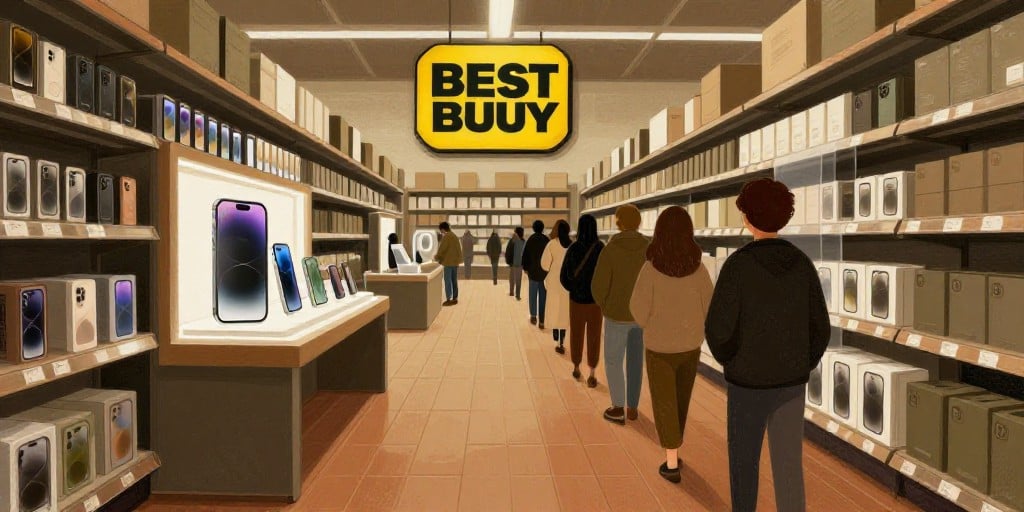
Best Buy’s Resurgence of In‑Store Queues Amid Apple’s iPhone Duo Launch
1. Executive Summary
The recent return of long‑standing in‑store queues at Best Buy Co. Inc. outlets signals a shift in both consumer behavior and the retailer’s inventory dynamics. The launch of Apple’s high‑priced foldable iPhone Duo—priced at approximately $2,000—has created a supply‑constrained environment that echoes the frenzy of early iPhone releases. This development invites a closer look at Best Buy’s distribution strategy, the regulatory landscape governing electronic retail, and the competitive forces that may be reshaping the high‑end smartphone market.
2. Market Context and Underlying Fundamentals
| Metric | 2023 | 2024 (Projected) | Trend |
|---|---|---|---|
| Average iPhone retail price | $799 | $1,600 | +100 % |
| Apple’s share of U.S. premium‑smartphone revenue | 35 % | 42 % | ↑ |
| Best Buy’s online-to‑in‑store conversion rate | 18 % | 15 % | ↓ |
| Average inventory‑turnover for flagship devices | 4.2 x | 2.8 x | ↓ |
Apple’s decision to launch a foldable device at a premium price point has effectively concentrated demand in a narrow window, thereby limiting pre‑order availability. Best Buy’s traditional allocation model—reserving a small, fixed percentage of inventory for walk‑ins—now faces heightened pressure as consumers, spurred by the device’s hype, flock to physical locations. The resulting queues are not merely a cosmetic phenomenon; they reflect a misalignment between supply chain flexibility and demand volatility.
3. Regulatory and Compliance Considerations
The United States, the European Union, and Australia have introduced stringent rules around consumer protection in high‑tech retail:
- United States: The Federal Trade Commission (FTC) requires transparent disclosure of product availability to prevent “bait‑and‑switch” practices. Best Buy’s current pre‑order and in‑store allocation policies must be audited for compliance.
- European Union: The Digital Services Act mandates real‑time inventory transparency for online and offline retailers. Any lag between digital pre‑orders and physical stock could expose Best Buy to regulatory penalties.
- Australia: The Australian Competition and Consumer Commission (ACCC) enforces strict guidelines on “queueing” and “price fixing.” The visible queues and limited walk‑in allocation could raise concerns about anti‑competitive behavior if not managed properly.
A failure to navigate these regulations could lead to fines, consumer lawsuits, or forced adjustments in inventory strategy, all of which would impact profitability.
4. Competitive Dynamics
| Competitor | Distribution Tactic | Observed Impact |
|---|---|---|
| Amazon | Dynamic pricing + Prime‑Day exclusives | Maintains online dominance; low in‑store footfall |
| B&H Photo Video | “Reserve‑for‑pickup” model | Generates pre‑orders, reduces in‑store queues |
| Apple Retail Stores | “Today at 10 a.m.” pre‑order windows | High conversion, minimal queues but limited capacity |
Best Buy’s reliance on a fixed walk‑in allocation is increasingly outmoded compared to competitors leveraging real‑time inventory data and flexible pre‑order windows. Apple’s own retail stores, while offering superior brand experience, do not benefit from Best Buy’s extensive geographic footprint. The question then becomes: can Best Buy modernize its inventory distribution to avoid queue fatigue while still capitalizing on high‑margin units?
5. Risk Assessment
| Risk | Likelihood | Impact | Mitigation |
|---|---|---|---|
| Consumer backlash due to perceived scarcity | Medium | High | Transparent communication of stock levels; expanded pre‑order windows |
| Regulatory fines for opaque inventory practices | Low | Medium | Audit compliance; implement real‑time inventory dashboards |
| Revenue erosion if queues deter customers | Medium | High | Increase online availability; partner with Apple for exclusive in‑store drops |
| Brand dilution from perceived elitism | Low | Medium | Promote inclusive marketing; offer financing options |
The queues, while generating buzz, risk alienating price‑sensitive consumers and could erode Best Buy’s reputation as an accessible retailer. Balancing scarcity with accessibility will be pivotal.
6. Opportunity Analysis
- Upsell & Cross‑Sell: Queued customers present an ideal moment for cross‑selling accessories, extended warranties, and subscription services (e.g., Apple Care+).
- Data Monetization: Queue patterns can be leveraged to refine predictive analytics, allowing Best Buy to forecast demand spikes and optimize stock levels across regions.
- Strategic Partnerships: Collaborating with Apple to host “Duo‑Launch Events” could shift queues to controlled environments, enhancing the brand experience while protecting inventory.
7. Conclusion
Best Buy’s revival of in‑store queues amid the iPhone Duo launch underscores a fundamental mismatch between traditional distribution models and the rapid, high‑margin demand that contemporary flagship devices generate. While the queues offer a temporary spike in foot traffic and potential revenue, they also expose the retailer to regulatory scrutiny, brand perception risks, and competitive disadvantages. A data‑driven, regulatory‑compliant overhaul of inventory allocation—paired with proactive marketing and cross‑sell strategies—will be essential for Best Buy to transform a short‑term frenzy into sustained, profitable growth.