
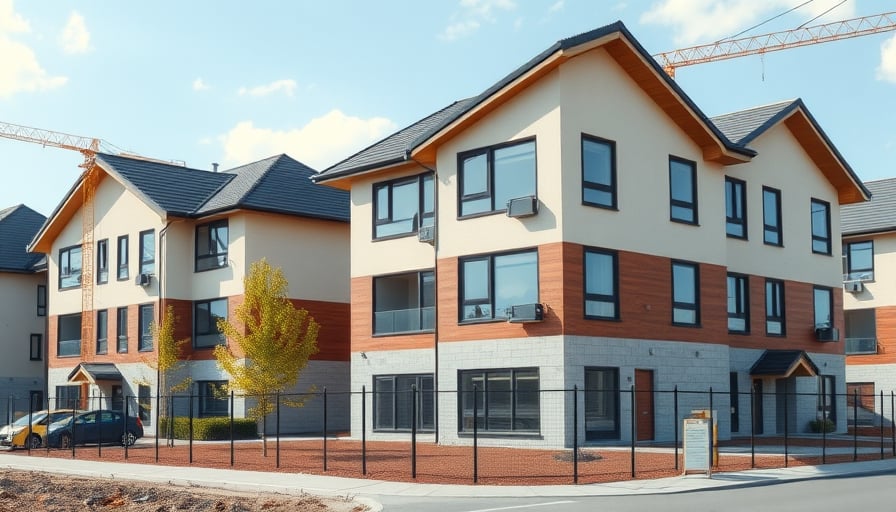
Barratt Redrow PLC’s Upcoming 2026 Earnings Report: Implications for the Residential Real‑Estate Landscape and Broader Consumer‑Goods Trends
Barratt Redrow PLC, the London‑listed developer that commands a significant share of the UK residential‑housing market, is slated to publish its 2026 earnings report early next week. The announcement arrives at a juncture when European equity markets are experiencing a phase of muted momentum, as investors weigh mixed corporate outcomes and anticipate forthcoming U.S. employment data that could shape monetary‑policy expectations.
Short‑Term Market Movements
The FTSE 100’s modest decline over the past fortnight reflects a cautious stance among market participants. Recent earnings disclosures have underscored sectorial resilience in consumer‑goods and retail, while macro‑economic signals—particularly the potential tightening of U.S. policy—have dampened risk appetite. Within this context, Barratt Redrow’s forthcoming performance figures are expected to contribute to the prevailing narrative surrounding the house‑building sector, which is navigating a gradual yet still uncertain demand environment.
- Liquidity and Valuation: Investors will scrutinise the developer’s cash‑flow metrics and debt‑to‑equity profile, as these indicators are crucial for assessing the capacity to fund new projects and absorb potential downturns in home‑price growth.
- Geographic Allocation: The geographic spread of Barratt Redrow’s portfolio—especially its exposure to high‑growth urban corridors versus more price‑sensitive rural sites—will be a key point of analysis, given that consumer spending on housing is highly sensitive to regional economic conditions.
Cross‑Sector Patterns: Consumer‑Goods and Retail Innovation
The residential‑housing market is increasingly intertwined with consumer‑goods trends. As households invest in new homes, they also drive demand for furnishings, appliances, and home‑technology products. Retailers that are adopting omnichannel strategies—integrating brick‑and‑mortar stores with e‑commerce platforms—are positioned to capture the ancillary spend that accompanies property purchase.
- Omnichannel Retailing: The rise of showroom‑online hybrid models has enabled consumers to experience products physically while leveraging the convenience of digital ordering. This dual approach has proven especially effective during periods of economic uncertainty, as customers seek confidence in product quality while remaining price‑conscious.
- Consumer‑Behaviour Shifts: Post‑pandemic buyers exhibit a stronger preference for “smart‑home” solutions and sustainable materials, prompting suppliers to innovate in energy‑efficient appliances and low‑impact construction materials. These shifts are reshaping brand positioning, with premium brands leveraging sustainability narratives to command higher price points.
Long‑Term Industry Transformation
- Supply‑Chain Resilience
- The house‑building sector is re‑evaluating its reliance on just‑in‑time delivery models. A more flexible supply chain, incorporating regionalised sourcing and modular construction, can reduce exposure to global disruptions.
- Digital Integration
- Building information modelling (BIM) and data‑driven project management are becoming standard practice, enabling developers to optimise construction timelines and reduce waste.
- Brand Positioning in a Changing Market
- Developers that align their brand with environmental stewardship—through certifications such as BREEAM or the upcoming net‑zero commitments—are likely to attract a growing segment of eco‑conscious buyers.
Strategic Editorial Perspective
For Barratt Redrow, the 2026 earnings report will not only illuminate current financial health but also signal strategic priorities that may influence the trajectory of the housing market. A clear articulation of investment plans, coupled with a demonstrated commitment to sustainable practices, will reinforce investor confidence and position the company advantageously amid evolving consumer expectations.
Simultaneously, retailers and suppliers that recognise the symbiotic relationship between new‑home construction and household consumption will be better equipped to craft omnichannel experiences that resonate with buyers. By integrating digital touchpoints with experiential retail, brands can enhance customer engagement, drive loyalty, and capture the ancillary spend that follows property transactions.
In sum, the forthcoming earnings release from Barratt Redrow offers a microcosm of the broader dynamics at play across consumer goods and retail. It highlights how shifts in demand, supply‑chain innovation, and brand positioning are interlocking to shape the future of both the residential‑housing sector and the wider retail ecosystem.