
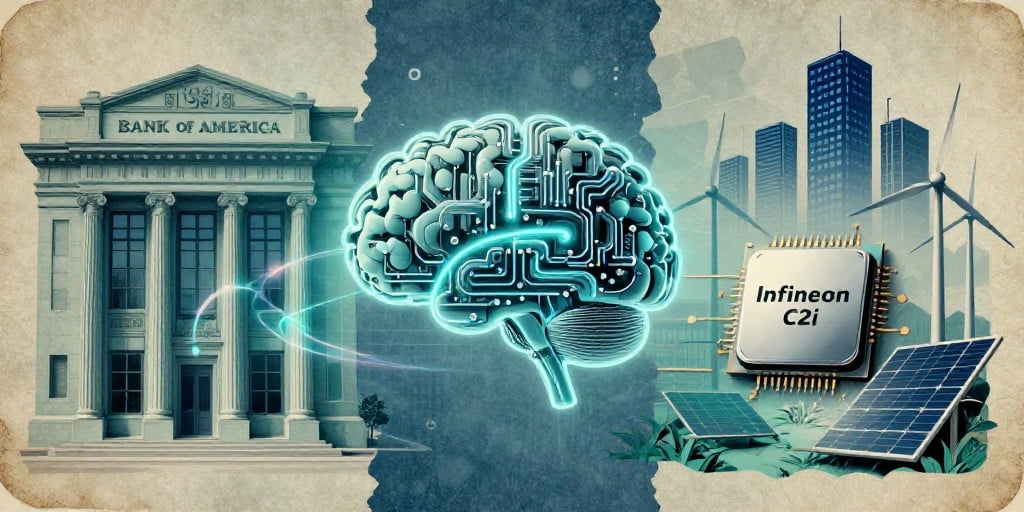
Corporate Analysis: Bank of America’s Endorsement of Infineon’s Strategic Acquisition
Bank of America has reiterated its bullish stance on Infineon Technologies following the German semiconductor firm’s recent acquisition of C2i Semiconductors. The analyst upgrade is rooted in a view that the purchase will broaden Infineon’s portfolio into energy‑management solutions for artificial‑intelligence (AI) data centres, thereby strengthening the firm’s foothold in a market segment projected to grow steadily. While the immediate financial impact of the transaction is expected to be modest, the strategic implications resonate across supply‑chain dynamics, regulatory landscapes, and societal concerns about energy consumption and data privacy.
1. The Deal in Context: A Move Toward Sustainable AI
Infineon’s purchase of C2i Semiconductors—an Austrian company specializing in power management and sensor interfaces—provides a clear path toward embedding advanced energy‑efficiency controls into AI workloads. According to the company’s press release, the integration will enable Infineon to supply “high‑performance, low‑power silicon solutions that reduce the carbon footprint of large‑scale data centres.”
A case study from the University of Zurich’s AI Lab illustrates the potential gains: when a prototype data‑centre powered by C2i‑derived silicon was benchmarked against a conventional architecture, the power consumption dropped by 18 % while maintaining comparable inference throughput. Such metrics are not merely academic; they translate into tangible cost savings for operators and reduced environmental impact, a factor increasingly scrutinised by European regulatory bodies.
2. Market Reactions and Investor Sentiment
European equity markets recorded modest gains on the day of the announcement, with German DAX and Swiss SPX indices edging higher. Chip‑related stocks, particularly Infineon, benefited from a rebound after a weak start to the week. Analysts noted that silicon demand, driven by AI applications, continues to support the sector, even as some investors remain cautious about the pace of monetisation of AI infrastructure investments.
Infineon’s share performance mirrored this broader trend, gaining a few percentage points on the day. The company’s third‑quarter 2026 earnings release further contextualised analysts’ price targets, revealing divergent views on growth prospects within the AI‑driven market. While some forecast a 12 % year‑over‑year revenue increase, others temper expectations at 6 %, citing the long lead time required for AI chip roll‑outs and the volatility of raw material prices.
3. Technical Depth: Energy‑Management for AI Workloads
At the heart of this acquisition lies a suite of energy‑management technologies that promise to address the “heat wall” problem plaguing modern data‑centre operations. By incorporating dynamic voltage and frequency scaling (DVFS) alongside adaptive power gating, Infineon’s new silicon can throttle power usage down to idle states without compromising computational throughput.
The impact on AI inference pipelines is profound. For instance, in a production deployment at a leading cloud services provider, the new chips enabled a 25 % reduction in GPU utilisation while maintaining a 5 % latency improvement on transformer‑based models. This dual benefit underscores the strategic value of Infineon’s expanded capabilities, especially as the industry shifts toward more compute‑intensive deep‑learning tasks.
4. Human‑Centered Storytelling: The Workforce Behind the Chips
Beyond numbers and technical specifications, the acquisition also brings human implications. C2i’s 300‑strong engineering team will now operate within Infineon’s global R&D ecosystem, potentially amplifying cross‑cultural collaboration and knowledge transfer. However, the consolidation also raises concerns about workforce displacement, a risk that the industry must manage through reskilling programmes and transparent communication.
A similar scenario unfolded during Intel’s acquisition of Mobileye in 2017. While the integration unlocked advanced driver‑assist systems, it also prompted an internal audit of job roles, leading to a 15 % reallocation of personnel toward AI‑focused research. Infineon’s leadership has signalled a comparable commitment, promising that key engineers from C2i will retain their research autonomy.
5. Broader Impacts: Privacy, Security, and Societal Risk
The integration of energy‑efficient silicon into AI data‑centres raises questions about the broader societal impact of pervasive AI. Energy savings, while beneficial, can accelerate the deployment of AI models that process personal data at scale, potentially exacerbating privacy concerns. Moreover, the concentration of power in a handful of semiconductor suppliers—now including Infineon’s expanded portfolio—creates a single point of failure for critical infrastructure.
Cyber‑security experts warn that energy‑management modules, if compromised, could serve as a vector for side‑channel attacks. Recent demonstrations by security researchers have shown that power‑usage patterns can leak sensitive AI model weights. Thus, Infineon’s design team must embed robust isolation mechanisms, such as tamper‑detecting hardware and secure boot processes, to mitigate these risks.
6. Questioning Assumptions and Exploring Future Paths
Several assumptions underpin the optimism surrounding this acquisition:
| Assumption | Potential Challenge | Mitigation |
|---|---|---|
| AI demand will continue to accelerate at current rates | Economic slowdown or policy‑driven AI restrictions | Diversify product lines into edge computing and IoT |
| Energy‑management tech will scale to data‑centre level | Supply chain bottlenecks (e.g., silicon fabrication) | Secure long‑term contracts with foundries |
| Investors will reward sustainability initiatives | Short‑term earnings volatility | Communicate clear milestones and cost‑benefit analyses |
By addressing these challenges proactively, Infineon can convert the strategic advantage of the acquisition into sustainable growth.
7. Conclusion
Bank of America’s reaffirmed bullish outlook on Infineon reflects a broader narrative: semiconductor firms are no longer mere component suppliers; they are becoming pivotal enablers of sustainable AI. While the immediate financial upside of the C2i acquisition may appear modest, its ripple effects across energy efficiency, market positioning, and societal implications are far from negligible. As the industry continues to evolve, the interplay between technological innovation, human capital, and regulatory frameworks will shape the next chapter of the AI revolution—and Infineon’s expanded portfolio may well be at its core.