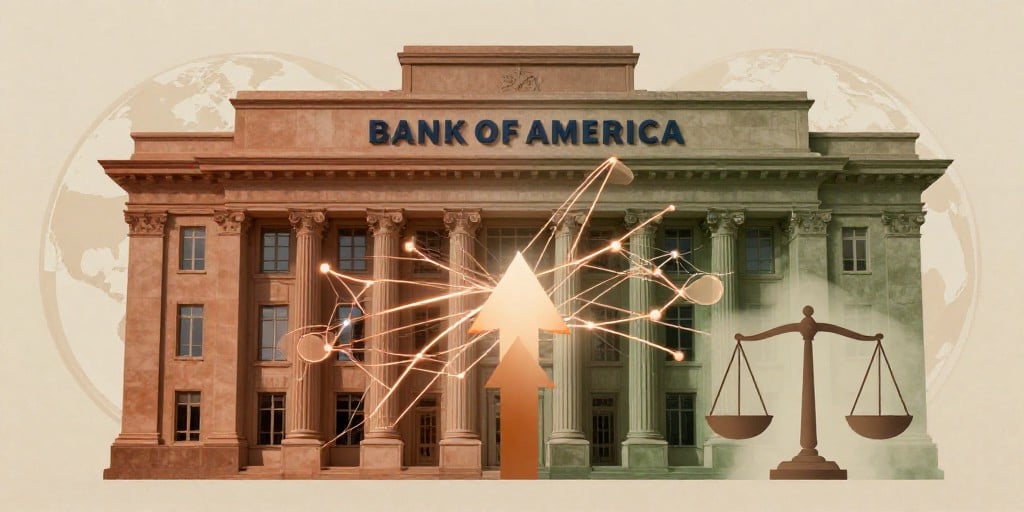
Bank of America Focuses on Digital Banking and Regulatory Innovation Amid Market Volatility
Bank of America’s presence in today’s financial news was largely confined to its scheduled participation in a high‑profile digital banking and regulatory innovation conference and its inclusion in a broader discussion of U.S. banking sector dynamics. No earnings releases, share‑price updates, or dividend announcements were reported on the day.
Conference Participation
A senior executive from Bank of America (BAC) will speak at the Global Digital Banking Forum scheduled for 10:00 a.m. EST on Tuesday. The event, hosted by the International Association of Financial Institutions, aims to dissect the evolving regulatory landscape that governs digital‑only banking platforms, open‑banking APIs, and the integration of artificial‑intelligence‑driven risk‑management tools. BAC’s presentation will likely highlight the bank’s recent investment in a proprietary AI‑powered fraud detection framework that, according to internal projections, could reduce transaction‑related fraud losses by up to 12 % over the next fiscal year.
Market Context and Sector Performance
In the broader market commentary, Bank of America was referenced as part of an analysis of the U.S. banking sector’s health. Analysts emphasized that BAC’s performance is driven by a confluence of factors:
| Factor | Current Metric | Impact on BAC |
|---|---|---|
| Loan Growth | $15.2 billion Q1 2026 growth, 7.8 % YoY | Adds to net interest income (NII) |
| Interest‑Rate Sensitivity | Net Interest Margin (NIM) at 3.68 %, up 0.12 pp | Elevated NIM enhances earnings resilience |
| Asset‑Quality Dynamics | Non‑performing loans (NPL) ratio at 0.57 % | Low NPL ratio signals robust credit underwriting |
| Regulatory Environment | Basel III core capital ratio at 12.4 % | Adequate capital buffer supports growth initiatives |
The bank’s loan portfolio growth is largely driven by a 6.4 % increase in mortgage origination and a 9.2 % rise in commercial real‑estate (CRE) financing. While the rise in short‑term rates has tightened net interest margins across the sector, BAC’s diversified funding mix—combining low‑cost retail deposits with high‑yield corporate bonds—has helped offset margin compression. Moreover, the bank’s Capital Adequacy Ratio (CAR) remains comfortably above the 9 % regulatory minimum, providing a cushion against potential credit losses amid an uncertain rate environment.
Regulatory and Macro‑Economic Pressures
The banking sector’s outlook remains moderately supportive, with analysts noting that banks are navigating a complex matrix of regulatory expectations and macro‑economic forces:
- Federal Reserve Policy: The Fed’s recent tightening cycle has pushed the federal funds rate to 4.75 %, a 50‑basis‑point increase since March 2026. This raises the cost of short‑term borrowing and compresses NIM, but also bolsters the spread between asset yields and liability costs.
- Capital Regulation: The Basel III framework mandates banks to maintain a Total Capital Ratio above 12 %. BAC’s current ratio of 12.4 % places it at the lower end of the sector’s median, suggesting limited room for aggressive leverage increases without regulatory scrutiny.
- Digital Compliance: The SEC’s proposed Digital Asset Reporting Rules could impose additional reporting overhead on institutions engaging in crypto‑asset lending or custody services. BAC’s strategic focus on regulated digital banking is likely a pre‑emptive measure to mitigate compliance risk.
Actionable Insights for Investors and Financial Professionals
- Monitor NIM Trends: Investors should keep a close eye on BAC’s NIM trajectory as the Fed continues to influence short‑term rates. A sustained NIM improvement could signal effective rate‑risk management.
- Assess Loan Mix Exposure: The bank’s growing mortgage and CRE exposure introduces cyclical risk tied to the housing and commercial real‑estate markets. Diversification into consumer credit may offset potential downturns in these segments.
- Watch Capital Utilization: With a CAR near the regulatory threshold, BAC may face constraints on expanding leverage or undertaking large asset‑purchase programs without regulatory approval. Any capital allocation shifts should be scrutinized in earnings releases.
- Evaluate Digital Banking ROI: As the bank presents at the digital banking conference, analysts should evaluate the projected return on investment from its AI fraud detection platform and other digital initiatives, as these may enhance competitive positioning and profitability.
In summary, while Bank of America’s current news cycle is modest, the institution’s focus on digital innovation and robust regulatory compliance positions it favorably within the broader U.S. banking landscape. Market participants should weigh the bank’s loan‑growth dynamics, capital adequacy, and strategic investment in technology against the backdrop of an increasingly rate‑sensitive environment and evolving regulatory expectations.