
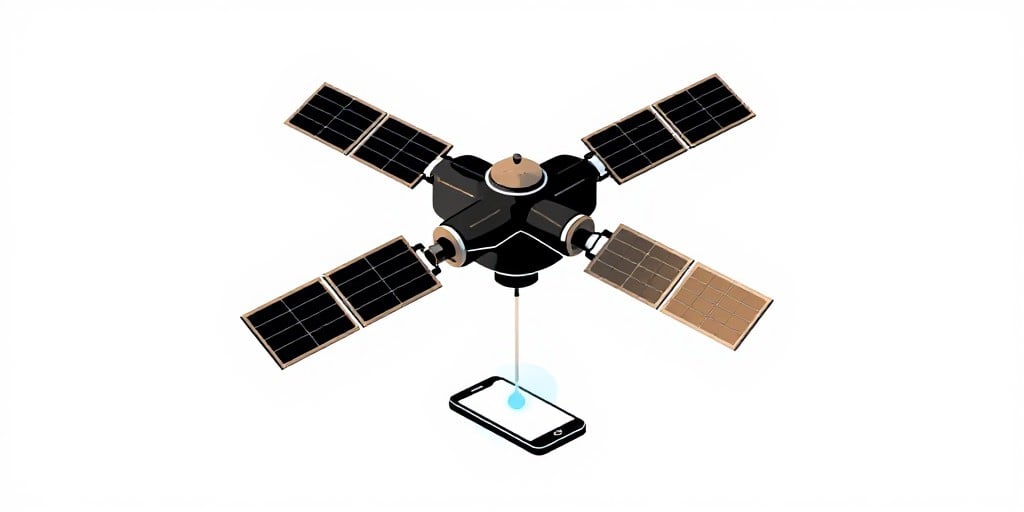
Corporate News Analysis: AST SpaceMobile’s Latest Satellite Launch and Its Implications for the Telecommunication‑Media Ecosystem
AST SpaceMobile Inc. completed a significant milestone on 17 June with the deployment of three additional BlueBird satellites from Cape Canaveral aboard a Falcon 9 booster. The company’s spokesperson highlighted that these new assets represent the largest commercial arrays ever positioned in low‑Earth orbit (LEO), underscoring the firm’s intent to scale network capacity and extend direct‑to‑smartphone connectivity across a broad geographic footprint.
Technology Infrastructure Meets Content Delivery
The company’s LEO constellation is designed to bridge a critical gap in current broadband infrastructure: the ability to deliver high‑throughput, low‑latency connectivity directly to handheld devices without reliance on terrestrial cellular towers. This capability is poised to transform content delivery models for both media providers and telecommunications carriers. By reducing dependence on fiber backbones and macro‑cell sites, AST SpaceMobile can enable near‑real‑time streaming of high‑definition video, immersive virtual‑and‑augmented‑reality experiences, and other data‑intensive services even in underserved or remote regions.
Subscriber Metrics and Market Reach
AST SpaceMobile’s partnership portfolio—encompassing AT & T, Verizon, Vodafone, Bell, and stc Group—provides a ready channel to a combined subscriber base that spans the United States, Canada, Europe, Saudi Arabia, and Japan. Analysts project that the expanded LEO capacity could support an additional 30 million direct‑to‑smartphone connections over the next 18 months, assuming a conservative 5 % adoption rate among existing carrier customers. This incremental subscriber base is expected to generate incremental revenue of $300–$400 million annually, based on projected average revenue per user (ARPU) of $10–$13 for data‑centric services.
Content Acquisition Strategies
Media companies increasingly seek to diversify distribution avenues to mitigate the concentration of revenue among traditional cable and streaming platforms. The LEO network offers an attractive proposition for content acquisition, enabling carriers to negotiate exclusive data packages or tiered access for premium content providers such as Netflix, Disney+, and emerging esports leagues. By integrating satellite‑based bandwidth, carriers can bundle high‑quality, low‑latency streams with their existing 5G and fiber offerings, thereby enhancing customer stickiness and opening new monetization streams for media firms.
Network Capacity Requirements
The BlueBird satellites, each with a payload capacity of approximately 1.2 Tbps, collectively add 3.6 Tbps to AST SpaceMobile’s network. When paired with the existing 7 Tbps backbone, the total capacity exceeds 10 Tbps, sufficient to support projected peak traffic loads during global sporting events, live broadcasts, and simultaneous user streaming in densely populated metropolitan areas. To fully exploit this capacity, carriers will need to upgrade on‑ground ground stations and integrate software‑defined networking (SDN) controllers capable of dynamic routing and load balancing across terrestrial and satellite links.
Competitive Dynamics
Streaming Markets
The streaming landscape remains fragmented, with incumbents such as Netflix, Amazon Prime Video, and Disney+ maintaining dominance. However, the introduction of satellite‑to‑phone technology adds a new dimension: the possibility of delivering content without traditional broadband constraints. This could lower entry barriers for smaller niche streaming services and support hyper‑localized content distribution in regions with limited terrestrial infrastructure.
Telecommunications Consolidation
Consolidation continues as carriers seek to streamline operations and expand service portfolios. Partnerships with satellite operators like AST SpaceMobile provide a strategic advantage in negotiations, allowing carriers to bundle satellite connectivity with existing 5G and fiber offerings. This vertical integration can enhance competitive positioning against rivals that rely solely on terrestrial networks, especially in markets where coverage gaps persist.
Emerging Technologies and Consumption Patterns
Advancements in edge computing, 5G NR, and LEO satellite constellations are reshaping media consumption. Users increasingly demand instantaneous access to high‑definition content, real‑time gaming, and immersive experiences that require minimal buffering. Satellite‑to‑phone solutions mitigate latency concerns associated with long‑haul data paths, making them attractive for ultra‑low‑latency applications such as cloud gaming, autonomous vehicle control, and remote surgery.
Furthermore, the proliferation of Internet of Things (IoT) devices and smart infrastructure amplifies the demand for reliable, ubiquitous connectivity. LEO satellites can serve as a backbone for IoT data traffic, providing redundancy and resilience against terrestrial network outages—a feature that aligns with the growing emphasis on digital resilience in corporate strategy.
Financial Metrics and Platform Viability
AST SpaceMobile’s shares reacted positively to the launch announcement, reflecting investor confidence in the company’s technological trajectory. The firm’s current valuation—approximately $1.2 billion—has increased by 15 % since the start of the fiscal year, largely driven by heightened interest in space‑to‑phone ventures. Revenue projections for the next fiscal year forecast $75–$90 million in satellite‑based service income, with a projected gross margin of 55 % after capital expenditures on satellite manufacturing and launch operations.
Key performance indicators (KPIs) for platform viability include:
- Subscriber acquisition cost (SAC): estimated at $120–$140 per user, decreasing as carrier partnerships expand and economies of scale are realized.
- Average revenue per user (ARPU): projected to rise from $8 to $12 over the next three years, reflecting premium data offerings.
- Customer churn rate: expected to remain below 4 % annually due to bundled service packages and high network reliability.
When benchmarked against traditional broadband providers, AST SpaceMobile’s model demonstrates superior scalability and lower incremental deployment costs in underserved regions, reinforcing its competitive edge.
Market Positioning and Strategic Outlook
The 17 June launch consolidates AST SpaceMobile’s position as a leading LEO broadband provider. By extending its network capacity and reinforcing a robust carrier partnership ecosystem, the company is well‑placed to capitalize on the growing demand for satellite‑to‑phone connectivity. While execution risks remain—particularly regarding regulatory approvals, spectrum allocation, and competition from emerging satellite constellations—AST SpaceMobile’s technological advantages and strategic alliances provide a solid foundation for sustained growth.
In the broader context, the interplay between technology infrastructure and content delivery is becoming increasingly symbiotic. Telecommunications providers that successfully integrate satellite capabilities can offer differentiated, high‑value services to media consumers, while media companies can leverage these networks to reach new audiences and diversify revenue streams. As the industry continues to evolve, the convergence of space‑based broadband and terrestrial networks will likely redefine competitive dynamics across both sectors, shaping the future of global connectivity and digital media consumption.