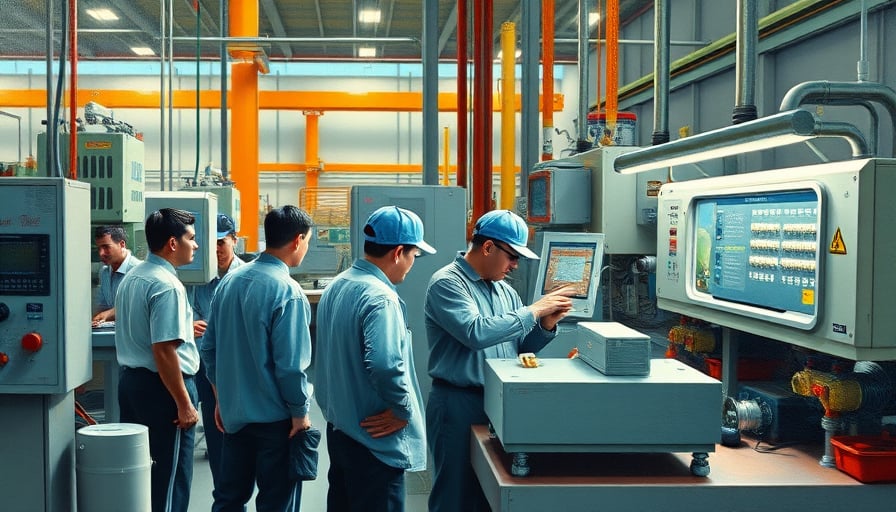
ASML’s High‑NA EUV Tools Transition to Mass Production
Operational Milestone
ASML Holding NV has confirmed that its latest generation of high‑NA extreme ultraviolet (EUV) lithography systems has entered high‑volume production. The company reported that the machines have processed 500,000 wafers and are operating at approximately eighty percent of their targeted uptime. Management has set a target of ninety percent by the end of the calendar year.
This operational upgrade represents a critical inflection point for ASML’s product line. The high‑NA EUV tools are engineered to deliver finer resolution and higher throughput compared to earlier EUV iterations, enabling semiconductor designers to push the limits of device scaling. By achieving a high‑volume production cadence, ASML is signaling its confidence that the technology will be adopted widely across the industry.
Implications for Chip Manufacturing
Industry observers note that the new EUV tools should enable leading chipmakers to streamline production steps and increase throughput. The impact is particularly pronounced for advanced processors designed for artificial‑intelligence workloads, where performance per watt and density are paramount.
- Process Simplification: The higher‑NA EUV system reduces the number of lithographic steps required to pattern a chip, lowering cycle times and defect rates.
- Yield Improvement: Finer resolution translates into tighter tolerances, allowing designers to push the edge of Moore’s Law while maintaining acceptable yields.
- Cost Efficiency: With higher throughput, fabs can amortize the substantial capital expense of EUV tooling over a larger wafer count, reducing the cost per chip.
The confluence of these benefits is expected to accelerate the rollout of next‑generation AI accelerators, edge‑computing processors, and high‑performance GPUs.
Market Reaction and Analyst Consensus
Financial markets have responded positively to ASML’s production milestone. A recent research note from Sanford C. Bernstein restored a “buy” recommendation, citing the company’s continued leadership in lithography technology and the growing demand from AI‑centric chipmakers. Other analysts have upgraded their outlooks to “strong‑buy” or “positive.”
Key points driving analyst optimism include:
- Robust Demand: The AI boom has intensified the need for higher‑performance processors, creating a sustained demand curve for advanced lithography tools.
- Limited Competition: ASML remains the sole provider of commercial EUV systems, cementing its monopoly in a high‑barrier market.
- Capital Allocation: The company’s disciplined capital investment strategy has consistently delivered high returns, reinforcing investor confidence.
The share price has traded near its twelve‑month high, reflecting the market’s endorsement of the company’s growth trajectory.
Strategic Context and Future Outlook
ASML’s high‑NA EUV milestone illustrates a broader trend in the semiconductor ecosystem: the relentless pursuit of smaller, more powerful transistors to satisfy emerging workloads. By reducing the lithography step count and improving yield, the company is effectively lowering the cost of ownership for fabs, thereby encouraging wider adoption of cutting‑edge processes.
Challenges to Conventional Wisdom
- Capital Intensity vs. Demand: Traditional views hold that lithography investments are only justified when the entire supply chain is ready to deploy new nodes. ASML’s successful transition to mass production suggests that even partial adoption can deliver value, especially as AI workloads drive demand for higher transistor densities.
- Supply Chain Resilience: The high‑NA EUV tools’ production success indicates that the company has strengthened its supply chain resilience, a critical factor amid geopolitical uncertainties and raw‑material bottlenecks.
Forward‑Looking Analysis
- Scaling Beyond 7 nm: ASML’s technology roadmap anticipates further iterations that will support sub‑5 nm nodes. The high‑NA EUV’s proven high‑volume readiness positions the company to lead the next wave of scaling.
- Ecosystem Collaboration: Continued collaboration with foundries and device manufacturers will be essential to validate and refine the new EUV process flow.
- Service Expansion: ASML may leverage its expertise to offer consulting and process‑optimization services, further monetizing its intellectual property and deepening customer relationships.
In conclusion, ASML’s high‑NA EUV tools entering high‑volume production marks a pivotal moment for both the company and the broader semiconductor industry. By delivering tangible operational efficiencies and reinforcing its market dominance, ASML is poised to underpin the next generation of AI‑driven technologies while sustaining a compelling growth narrative for investors.