
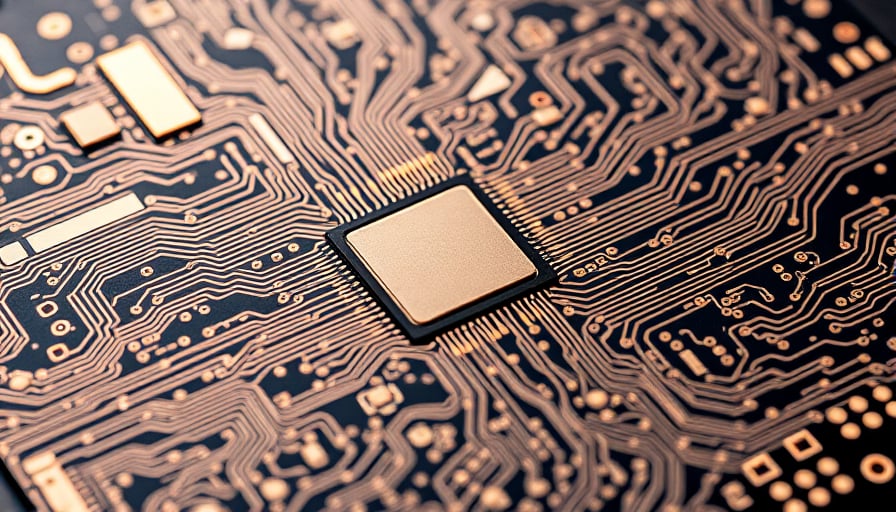
ASML’s Emerging Momentum: A Catalyst for the Global Chip Ecosystem
Executive Summary
As the calendar year approaches its close, ASML Holding NV is experiencing a notable uptick in analyst confidence and institutional interest. The Dutch firm’s flagship technology—extreme ultraviolet (EUV) lithography—continues to underpin the semiconductor industry’s capacity to produce ever more powerful, energy‑efficient chips. While the company’s recent upward revisions in brokerage outlooks are encouraging, a deeper examination reveals broader macro‑economic currents and geopolitical dynamics that will shape ASML’s trajectory in the coming years.
1. The Strategic Value of EUV: Beyond a Single Technology
EUV lithography represents a quantum leap in photolithographic capability, enabling the fabrication of transistors with sub‑10 nm geometries. This advancement is not merely a technical milestone; it is a strategic enabler for several key industries:
- Artificial Intelligence & Machine Learning: High‑performance AI accelerators demand chips with unprecedented transistor density, for which EUV is indispensable.
- Automotive & IoT: The shift toward connected vehicles and smart devices drives a steady need for smaller, power‑efficient processors.
- Quantum Computing & 5G Infrastructure: Emerging applications require bespoke silicon solutions that EUV can produce at scale.
By securing the supply chain for EUV, ASML positions itself as a linchpin in these growth sectors, reinforcing its importance to both European and U.S. policymakers.
2. Analyst Outlooks: A Confluence of Optimism and Prudence
Recent brokerage reports have lifted ASML’s rating from “Hold” to “Buy” or “Strong Buy,” citing:
| Brokerage | New Outlook | Rationale |
|---|---|---|
| Goldman Sachs | Strong Buy | Anticipated EUV capacity expansion and a growing portfolio of customer commitments. |
| Morgan Stanley | Buy | Positive cash‑flow projections tied to the company’s 2025 EUV roll‑out schedule. |
| J.P. Morgan | Buy | Expectation of continued premium pricing due to limited global competition. |
Despite these bullish stances, analysts emphasize the inherent risk of supply chain constraints—particularly in the procurement of highly specialized optics—and the potential impact of geopolitical tensions on customer access to EUV tools. Consequently, while the consensus remains positive, it is tempered by caution regarding macro‑economic volatility.
3. R&D Investment: The Dutch Advantage
ASML’s dominance in research and development is evident, with the company allocating a disproportionate share of its revenue—over 30%—to R&D. In the Netherlands, it remains the largest investment in high‑tech research, supporting a robust ecosystem of universities, startups, and spin‑offs. This concentration yields several competitive advantages:
- Talent Retention: Proximity to Dutch universities attracts top engineering talent.
- Innovation Hubs: Collaboration with local firms accelerates the commercialization of novel lithography concepts, such as multi‑beam EUV and photon‑source improvements.
- Policy Alignment: Dutch government incentives for semiconductor research reinforce ASML’s investment strategy and align corporate goals with national priorities.
These synergies reinforce ASML’s leadership position and safeguard its long‑term innovation pipeline.
4. Geopolitical Dynamics: Challenging Conventional Wisdom
Traditional narratives often portray the semiconductor industry as a purely commercial enterprise. However, ASML’s situation illustrates a more complex reality:
- Dual-Use Technology: EUV equipment can serve both civilian and defense applications, prompting increased scrutiny from export control regimes.
- Supply Chain Resilience: U.S. and European policymakers are prioritizing self‑reliance, which could lead to preferential procurement of ASML’s tools but also to stricter controls on technology transfer.
- Competitive Pressures: While ASML currently enjoys a near‑monopoly on EUV, emerging competitors—such as Japan’s Nikon and Chinese companies—are investing heavily in alternative lithography solutions. This competition may force ASML to accelerate R&D and potentially diversify its product portfolio.
These factors challenge the conventional wisdom that ASML’s dominance is unassailable and highlight the need for strategic flexibility.
5. Forward‑Looking Analysis: Opportunities and Risks
Opportunities
- Capacity Expansion: ASML plans to double its EUV throughput by 2027, potentially capturing a larger share of the growing semiconductor market.
- New Markets: Expansion into automotive and industrial IoT segments could diversify revenue streams.
- Technological Breakthroughs: Continued investment in photon‑source and mask‑defect‑control technologies may extend the life cycle of EUV and delay the emergence of alternative lithography methods.
Risks
- Regulatory Constraints: Heightened export controls may limit access to key customers in certain jurisdictions.
- Supply Chain Bottlenecks: Scarcity of ultra‑pure materials and specialized optics could delay production.
- Competitive Evolution: Rapid advances in alternative lithography (e.g., directed self‑assembly, electron‑beam lithography) could erode EUV’s market dominance sooner than expected.
6. Conclusion: Navigating a Complex Landscape
ASML’s recent resurgence in analyst favor reflects the broader optimism surrounding semiconductor growth. Yet the firm’s fortunes are inextricably linked to a mosaic of technological, economic, and geopolitical forces. By maintaining its R&D leadership, forging strategic alliances within the European high‑tech ecosystem, and proactively addressing emerging competitive threats, ASML can continue to steer the semiconductor industry toward its next evolutionary frontier. As policymakers and investors look to the end of the year and beyond, the company’s ability to adapt to these multifaceted challenges will determine whether it remains the cornerstone of advanced chip manufacturing or cedes ground to a new generation of lithographic innovators.