Corporate News Analysis
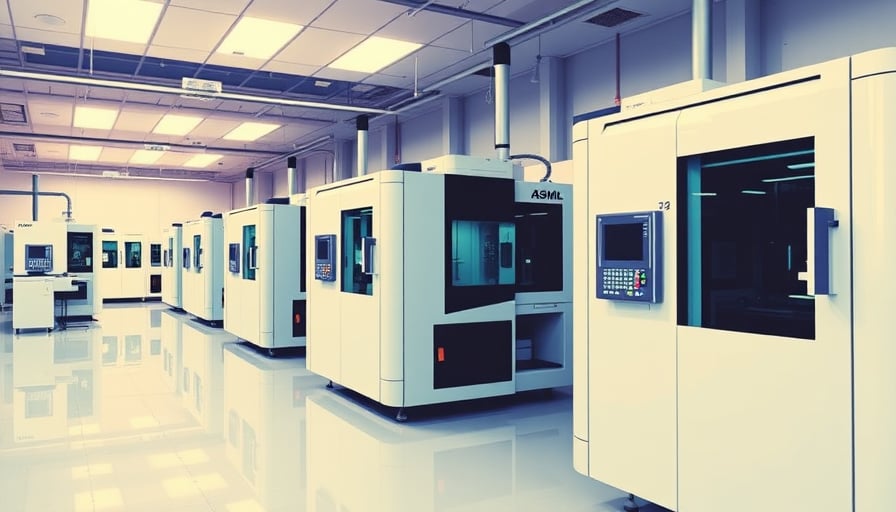
On Tuesday, shares of ASML Holding NV slipped more than 4 % after U.S. lawmakers introduced a bill that could impose additional export restrictions on the Dutch company’s semiconductor equipment. The proposal specifically targets deep‑ultraviolet (DUV) lithography machines and the maintenance services that accompany them—tools that are pivotal for many of China’s leading integrated‑circuit manufacturers.
Market Impact
The decline in ASML’s valuation mirrored a broader downturn in information‑technology (IT) stocks, reflecting investors’ concerns that the new restrictions could curtail a significant portion of the company’s revenue stream. While the Dutch market recorded modest gains in other sectors, European equity indices fell, underscoring the spill‑over effect of geopolitical risk on global markets.
Geopolitical Context
The proposed bill comes at a time of heightened U.S.–China tensions and just before a U.S. deadline for a new agreement on Iran‑related sanctions. In such a climate, investors are particularly sensitive to any policy shifts that could alter the competitive landscape of high‑tech exports. The semiconductor equipment sector, which relies on a complex supply chain and frequent cross‑border collaborations, is especially vulnerable to changes in export controls.
Sectoral Analysis
Semiconductor Equipment
ASML is the world’s largest supplier of extreme‑ultraviolet (EUV) lithography systems, but DUV machines remain a substantial part of its portfolio. If the bill blocks sales and maintenance contracts in China, ASML could lose a sizable share of its revenue, as China accounts for a growing portion of the global chip‑manufacturing market. The restriction would also pressure the entire ecosystem of suppliers and service providers that support DUV equipment.
Competitive Positioning
ASML’s competitors, such as Nikon and Canon, already operate under tighter U.S. export controls. Should the new bill extend similar limitations to ASML, the company’s competitive advantage could diminish, potentially accelerating the shift of Chinese fabs towards domestic suppliers or alternative foreign technologies. However, ASML’s superior EUV technology may still provide a buffer, as EUV systems are not currently covered by the proposed restrictions.
Broader Economic Drivers
Export controls on high‑tech equipment intersect with several macroeconomic themes:
- Supply‑chain Resilience: The restriction highlights the vulnerability of global supply chains to geopolitical shocks, prompting firms to diversify sourcing and production sites.
- Technology Transfer and IP Protection: Limiting sales to China aims to safeguard intellectual property, a concern that resonates across technology sectors, including software, AI, and quantum computing.
- Fiscal Policy and Trade Deficits: Reducing high‑value exports can impact trade balances and government revenue streams, influencing fiscal decisions in both the United States and European Union.
Cross‑Sector Implications
The semiconductor equipment industry’s exposure to export controls reverberates in adjacent sectors:
- Chip Manufacturing: Reduced access to DUV systems may slow capacity expansion, affecting the broader supply of integrated circuits for consumer electronics and automotive electronics.
- Technology Services: Companies offering maintenance, calibration, and software support for lithography equipment may see revenue contractions.
- Finance and Investment: Institutional investors will likely adjust portfolio allocations away from companies with high geopolitical risk, shifting capital toward more stable or diversified tech firms.
Conclusion
The proposed U.S. bill introduces a new layer of uncertainty for ASML Holding NV and the semiconductor equipment industry at large. While the immediate effect is a sharp decline in ASML’s stock price, the long‑term implications depend on the final scope of the restrictions and the company’s ability to adapt its product mix and customer base. As global markets navigate these geopolitical tensions, firms across technology sectors must balance compliance, innovation, and strategic diversification to maintain competitive positioning and safeguard revenue streams.