
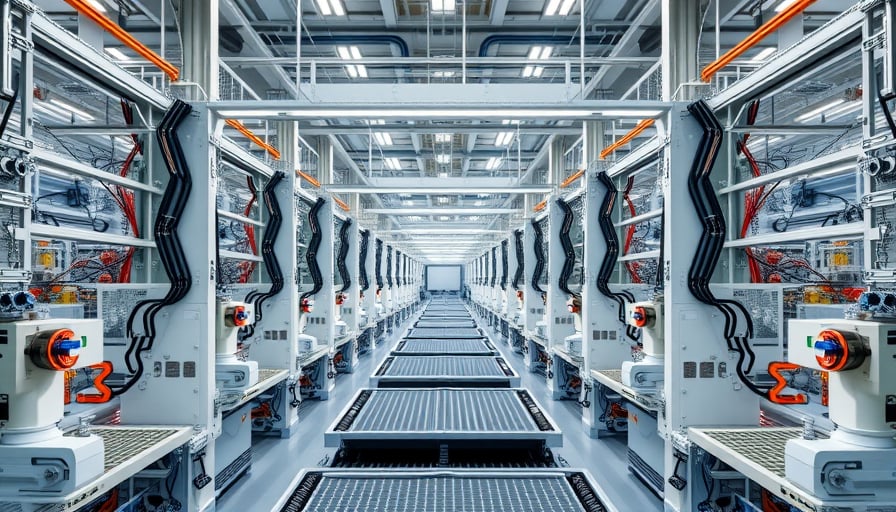
ASML Holding NV: Sustained Momentum Amidst a Semiconductor Technological Surge
ASML Holding NV remains a pivotal force in the global semiconductor supply chain, underpinning the transition to increasingly advanced process nodes. Its recent earnings release—highlighting robust 2025 revenue forecasts and a sizeable share‑repurchase initiative—signals continued confidence in the firm’s cash‑flow generation capabilities and its commitment to delivering shareholder value.
1. Node Progression and Yield Optimization
The industry’s relentless march from 7 nm to sub‑3 nm nodes is a testament to both design ingenuity and manufacturing precision. ASML’s extreme ultraviolet (EUV) lithography systems now enable the patterning of critical layers at 13.5 nm, a capability that would be unfeasible with deep ultraviolet (DUV) tools alone. Yield optimization remains the primary bottleneck as feature sizes shrink:
- Defect Control: At 3 nm, a single defect per million square millimeters can translate into a yield loss exceeding 20 %. ASML’s EUV platforms integrate in‑chip defect inspection and adaptive optics, reducing defect density to sub‑0.5 ppm.
- Process Variability: Advanced process control (APC) tools, coupled with machine‑learning‑driven metrology, help maintain overlay accuracy within ±0.2 nm, essential for maintaining device reliability.
- Stochastic Effects: As lithography approaches the atomic scale, stochastic doping and line‑edge roughness introduce variability. ASML’s multi‑patterning and stochastic lithography solutions mitigate these effects, keeping yield within acceptable bounds.
2. Technical Challenges in Advanced Chip Production
Manufacturing at 3 nm and beyond introduces a suite of technical hurdles that require coordinated hardware, software, and process innovations:
- Photoresist Sensitivity: New chemically amplified resists must balance sensitivity to EUV photons with high‑resolution capability. ASML collaborates with leading photoresist vendors to deliver resists that achieve sub‑10 nm critical dimension (CD) control.
- Mask Fabrication: EUV masks must exhibit perfect reflectivity and defect-free multilayer stacks. ASML’s mask‑making tools now incorporate real‑time defect imaging and in‑situ metrology.
- Thermal Management: Heat dissipation becomes increasingly critical as transistor density rises. ASML’s tools include advanced cooling solutions for lithography wafers, reducing thermal drift and maintaining alignment stability.
3. Capital Equipment Cycles and Foundry Capacity Utilization
The semiconductor capital expenditure cycle is tightly linked to the demand for cutting‑edge lithography tools:
- Equipment Lead Time: Procurement and installation of a 5 nm EUV system can span 3–4 years, including pre‑production validation and supply‑chain alignment. This long lead time necessitates early commitment from foundries.
- Capacity Utilization: ASML’s sales data reveal that foundries operating 3 nm lines are approaching 90 % of lithography capacity. This saturation drives a demand surge for next‑generation EUV systems and complementary equipment such as inline metrology and in‑line pattern‑match scanners.
- Return on Investment: For a typical 3 nm foundry, an EUV system represents a $30–$40 billion investment. The payback period is estimated at 3–4 years, contingent on yield performance and production volume.
4. Interplay Between Design Complexity and Manufacturing Capabilities
The symbiosis between silicon design and fabrication is increasingly intricate:
- Design for Manufacturability (DfM): As nodes shrink, design rules tighten. Integrated circuit designers must account for lithography limits, such as pitch, overlay tolerance, and stochastic variability. ASML’s software ecosystem, including the EDA‑tool integration framework, enables designers to model lithography outcomes early in the design cycle.
- Heterogeneous Integration: The rise of system‑on‑chip (SoC) platforms and heterogeneous integration—combining silicon, III‑V, and 2D materials—exploits ASML’s advanced lithography for precise layer alignment. This opens new markets in AI accelerators and high‑performance computing.
- AI‑Driven Design Automation: Machine‑learning algorithms predict lithography outcomes and optimize mask designs, reducing the number of iterations required for a successful die. These tools, often co‑developed with ASML, accelerate time‑to‑market for new process nodes.
5. Market Dynamics and Investor Confidence
Despite a recent correction after hitting a record high, analysts maintain elevated price targets for ASML. The firm’s premium positioning stems from:
- Monopolistic Technological Edge: ASML remains the sole supplier of EUV lithography equipment capable of pushing beyond 7 nm, granting it a natural monopoly in the high‑end segment.
- Strategic Partnerships: Collaborations with TSMC, Samsung, and global research consortia fortify ASML’s market foothold and secure long‑term contracts.
- Policy Support: European policy makers recognize ASML’s role in sustaining national semiconductor competitiveness, leading to favorable research‑funding environments and potential tax incentives.
6. Conclusion
ASML Holding NV’s financial strategy—underscored by a significant share‑repurchase program—and its continued technological leadership position the company at the forefront of semiconductor innovation. The intricate balance of node progression, yield optimization, and capital‑equipment cycles illustrates a sector that is as much about precision engineering as it is about market economics. As the industry advances toward sub‑2 nm nodes and increasingly complex system‑on‑chip architectures, ASML’s lithography solutions will remain indispensable, reinforcing its standing as a linchpin in the global semiconductor ecosystem.