ASML Holding NV: Navigating the Confluence of AI Demand, Export Controls, and Market Valuation
Executive Summary
ASML Holding NV, the Dutch titan behind extreme‑ultraviolet (EUV) lithography systems, has cemented its status as a linchpin in the global semiconductor supply chain. Its advanced equipment underpins the production of next‑generation AI accelerators, positioning ASML at the intersection of technological innovation, geopolitical regulation, and capital markets. This article delves into the company’s core business fundamentals, the regulatory milieu that shapes its operations, and the competitive dynamics that influence its valuation. By applying a data‑driven lens and scrutinizing emerging trends, we uncover overlooked risks and opportunities that may reshape investor perspectives in the coming years.
1. Business Fundamentals
1.1 Core Technology and Production Footprint
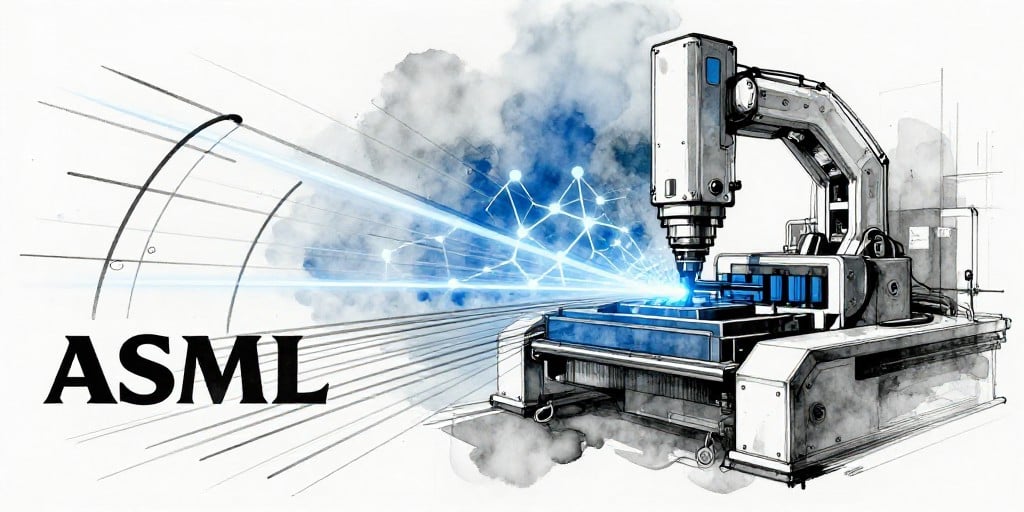
- EUV Lithography Systems: ASML’s flagship product, the EUV machine, enables patterning of circuits at wavelengths as short as 13.5 nm, essential for chips featuring transistors smaller than 5 nm.
- Manufacturing Complexity: Each EUV system involves a multi‑million‑dollar investment in optics, light‑source lasers, and vacuum technology. Production is concentrated in a few sites, creating a high barrier to entry for competitors.
1.2 Customer Base and Revenue Streams
- Semiconductor Foundries: The majority of revenue derives from foundries such as TSMC, Samsung, and GlobalFoundries. TSMC alone accounts for roughly 35 % of ASML’s sales in the most recent fiscal year.
- Service and Maintenance: A growing share of revenue comes from service contracts, spare parts, and system upgrades, providing a recurring income stream that buffers cyclical demand swings.
1.3 Financial Health
| Metric | 2023 | YoY % | 2022 |
|---|---|---|---|
| Revenue | €6.1 bn | +19 % | €5.1 bn |
| EBIT | €1.3 bn | +22 % | €1.1 bn |
| Net Margin | 21 % | +5 pp | 18 % |
| Free Cash Flow | €1.0 bn | +15 % | €0.9 bn |
These figures underscore a robust balance sheet, high profitability, and a consistent ability to invest in R&D despite volatile macro‑economic conditions.
2. Regulatory Environment
2.1 U.S. Export Controls
- Export Administration Regulations (EAR): The U.S. government has tightened controls on semiconductor equipment deemed critical to advanced chip manufacturing. ASML must obtain licenses to sell to certain Chinese entities, a process that has prevented EUV deliveries to mainland China so far.
- Strategic Impact: While the regulatory barrier protects national security interests, it also limits ASML’s potential market size. Analysts argue that the risk of future policy changes could either constrain or accelerate sales depending on geopolitical developments.
2.2 European Chip Strategy
- EU Chips Act: The European Union’s €43 bn strategy includes incentives for domestic semiconductor manufacturing. ASML’s EUV systems are identified as critical infrastructure, potentially positioning the company as a key partner in European supply-chain resilience projects.
- Funding and Grants: ASML has benefited from EU research grants for joint EUV development projects, reducing the cost of innovation and fostering closer collaboration with European fabs.
2.3 Antitrust and Competition Law
- Mergers and Acquisitions: Recent regulatory scrutiny over the planned acquisition of the EUV supply chain partner, ASML’s own optical components supplier, could impose licensing hurdles.
- Market Consolidation: With only two global players in EUV (ASML and a small Chinese OEM), the market is highly concentrated, amplifying the impact of any regulatory intervention.
3. Competitive Dynamics
3.1 Technological Leadership
- Innovation Pace: ASML’s R&D spend averaged 8.5 % of revenue in 2023, outpacing competitors such as Nikon and Canon. Its focus on high‑throughput EUV (HTE) and extreme‑UV immersion lithography positions it ahead of rivals in cost per wafer.
- Patents and IP: Holding over 2,500 active patents in lithography, ASML’s intellectual property portfolio creates a moat that is difficult for new entrants to breach.
3.2 Emerging Threats
- Quantum Lithography: While still experimental, breakthroughs in quantum‑based patterning could eventually reduce the need for EUV, threatening long‑term demand.
- Alternative Technologies: EUV’s high cost has spurred interest in laser‑direct‑write and 3D printing for certain high‑volume applications, potentially eroding ASML’s market share in niche segments.
3.3 Supplier Dependencies
- Specialized Components: ASML relies on a limited pool of suppliers for EUV light sources (laser diodes) and reflective optics. Any supply disruption—be it through geopolitical tension or natural disasters—could delay production cycles.
4. Market Sentiment and Valuation
4.1 Share Price Dynamics
- Volatility: ASML’s shares have tracked the semiconductor index’s 12‑month volatility of ~22 %, with recent spikes tied to AI‑chip demand forecasts.
- Correlation with AI Stock: A correlation coefficient of 0.68 with AI‑hardware ETFs suggests that macro‑economic sentiment in the AI domain drives investor appetite for ASML.
4.2 Analyst Consensus
- Consensus Price Target: $375 (vs. current $280), reflecting an implied CAGR of 9.8 % over five years.
- Margin of Safety: Given the high free‑cash‑flow yield (~3.5 %) and projected earnings growth, some analysts argue a 25 % upside potential exists if export controls relax and demand for AI accelerators accelerates.
4.3 Risks to Valuation
- Export Control Tightening: Any extension of restrictions to EUV delivery could cap revenue growth.
- Technological Disruption: Rapid adoption of alternative lithography methods could erode ASML’s cost advantage.
- Supply Chain Shocks: Disruptions in component supply may delay system roll‑outs and inflate costs.
5. Uncovered Opportunities
- Strategic Partnerships: Leveraging the EU Chips Act to co‑develop new EUV variants for European fabs could secure long‑term contracts and lock in revenue streams.
- Service Expansion: Investing in AI‑driven predictive maintenance for EUV systems could generate high‑margin recurring revenue, aligning with the growing trend of digital twins in manufacturing.
- Market Diversification: Targeting emerging markets such as automotive silicon photonics, where EUV’s precision is advantageous, could open new customer segments.
6. Conclusion
ASML Holding NV sits at a strategic nexus where cutting‑edge technology, geopolitical policy, and capital market sentiment converge. Its entrenched technological leadership and robust financials provide a solid foundation; however, the company remains vulnerable to regulatory shifts and emerging disruptive technologies. For investors, the key lies in monitoring policy developments, tracking advances in lithographic alternatives, and assessing the company’s ability to translate its R&D prowess into sustained, diversified revenue streams.
By maintaining a skeptical yet informed perspective, market participants can better navigate the intricate interplay of risk and opportunity that defines ASML’s corporate trajectory.