
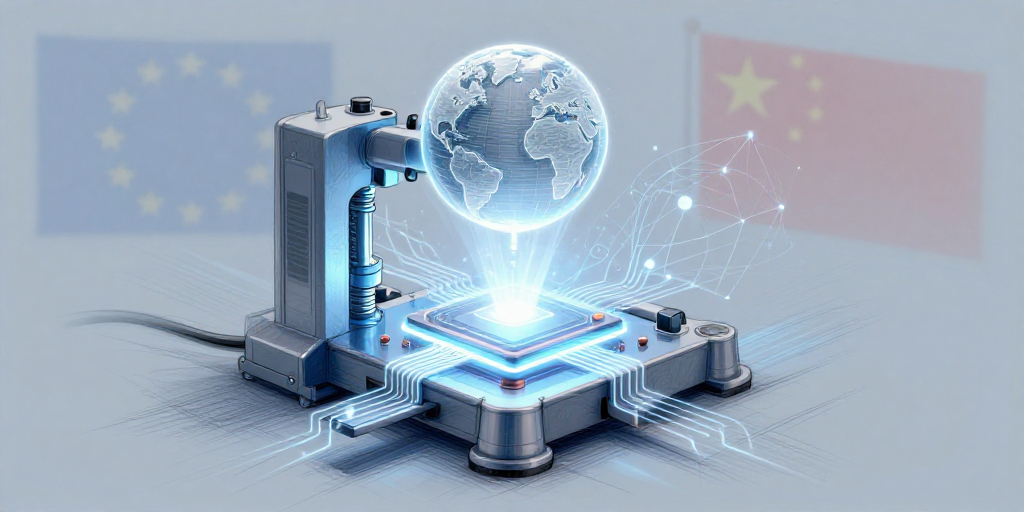
ASML’s Strategic Expansion Amid Regulatory Tight‑Knitting and Market Optimism
1. Executive Summary
ASML Holding NV, the preeminent manufacturer of extreme ultraviolet (EUV) lithography equipment, announced in the first quarter of 2026 that it will ship a minimum of sixty EUV machines—a substantial uptick from the previous year—citing surging demand for artificial‑intelligence (AI) accelerators. Concurrently, U.S. regulatory initiatives such as the MATCH Act threaten to tighten export controls on Dutch and Japanese lithography assets, potentially curbing access for Chinese customers. Despite these geopolitical headwinds, ASML’s revenue outlook has been upgraded to €36–40 billion, and the company has expanded its dividend and share‑buyback programs. European equity indices, notably the Euro Stoxx 50, have experienced modest volatility as investors weigh the interplay between regulatory risk and the sector’s growth prospects.
2. Production Scale‑Up: Meeting AI‑Driven Demand
- EUV Dominance: EUV lithography enables the creation of transistors with gate lengths below 5 nm, a prerequisite for next‑generation AI chips that demand dense, energy‑efficient logic. By committing to at least sixty EUV units, ASML is positioning itself at the nexus of AI hardware development.
- Supply Chain Implications: Each EUV system requires a suite of precision optics, high‑purity gases, and sophisticated control software. The company’s expansion will strain its already complex supply chain, potentially amplifying lead times for critical components such as the 200‑mm mirror substrates fabricated by German partner Zemax.
- Case Study – NVIDIA’s Hopper GPU: NVIDIA’s Hopper architecture, built on a 4 nm process, showcases the necessity of EUV lithography for AI inference workloads. ASML’s machines are integral to this production chain, underscoring how chip‑level demand translates into capital expenditures for equipment suppliers.
3. Regulatory Tightening: The MATCH Act’s Ripple Effects
- Scope of the Legislation: The U.S. MATCH Act mandates that Dutch and Japanese entities align their export controls with U.S. regulations, potentially restricting the supply of deep‑ultraviolet (DUV) lithography equipment and support services to Chinese firms.
- Impact on ASML’s China Exposure: Historically, China has accounted for a substantial share of ASML’s revenue, especially through DUV sales for mature nodes. The new controls are projected to reduce this exposure, a trend already anticipated by the company’s management before any legislative enforcement.
- Technology Transfer Concerns: Limiting DUV access could slow the diffusion of mature process nodes in China, affecting the domestic supply chain for devices that still rely on 28 nm or 20 nm processes. This, in turn, may force Chinese manufacturers to accelerate their shift toward EUV‑enabled nodes, creating a paradoxical increase in demand for ASML’s flagship products.
- Security and Privacy Dimensions: Export controls often aim to mitigate the proliferation of dual‑use technologies that could enhance military capabilities. The intersection of AI hardware and potential defense applications magnifies the scrutiny on lithography equipment, raising questions about how companies balance commercial growth with national security obligations.
4. Financial Outlook and Investor Confidence
- Revenue Forecast Upgrade: ASML’s revised guidance of €36–40 billion for the fiscal year reflects the robustness of EUV orders. The company’s share of EUV sales—roughly two‑thirds of total revenue in Q1—has become a barometer of semiconductor demand.
- Dividend and Share‑Buyback: The escalation of the dividend payout and initiation of a share‑buyback program signal confidence in sustained cash flow generation. This strategy can also serve as a buffer against the volatility introduced by geopolitical risk.
- Risk Assessment: While the company’s earnings outlook is buoyant, investors must scrutinize the cumulative impact of potential export restrictions on the Chinese market, a key growth engine for many tech companies. Historical precedents, such as the U.S. restrictions on Huawei, illustrate that sudden market squeezes can precipitate rapid shifts in supply dynamics.
5. Market Context and Broader Technological Trends
- European Index Volatility: The Euro Stoxx 50’s modest decline amid concerns over banking performance and technology valuations reflects the broader uncertainty. Nevertheless, sectors linked to advanced manufacturing and semiconductors maintain investor interest, positioning ASML as a focal point within the index.
- Technological Confluence: The rise of 5G, autonomous systems, and quantum computing is further driving the need for high‑performance AI chips. Each of these domains relies on lithography tools capable of delivering sub‑10 nm feature sizes.
- Supply Chain Resilience: The pandemic underscored the fragility of semiconductor supply chains. ASML’s production scale‑up can be interpreted as a proactive measure to increase inventory buffers and mitigate disruptions.
6. Societal, Privacy, and Security Implications
- AI Chip Proliferation: As AI accelerators become ubiquitous, concerns about data privacy, surveillance, and algorithmic bias intensify. The hardware that powers these chips—often sourced from ASML’s equipment—plays an indirect yet pivotal role in enabling or constraining the ethical deployment of AI.
- Dual‑Use Dilemma: Semiconductor fabs can be leveraged for both commercial and military applications. Export controls like the MATCH Act aim to limit the latter, yet they also risk stifling innovation in civilian sectors if applied too broadly.
- Job Market Dynamics: Expansion of EUV production may spur new high‑skill employment opportunities in engineering, optics, and materials science. Conversely, restricted access to DUV technology could depress job creation in regions heavily dependent on mature node fabrication.
7. Conclusion
ASML’s strategic production ramp‑up signals confidence in the AI‑driven semiconductor trajectory, yet it sits at the crossroads of complex regulatory environments and geopolitical tensions. While the company’s financial outlook remains optimistic, the broader market must remain vigilant about how export controls, supply chain vulnerabilities, and privacy considerations can reshape the technology landscape. The coming months will test ASML’s agility in navigating these multifaceted challenges and in capitalizing on the opportunities presented by an increasingly data‑centric world.