
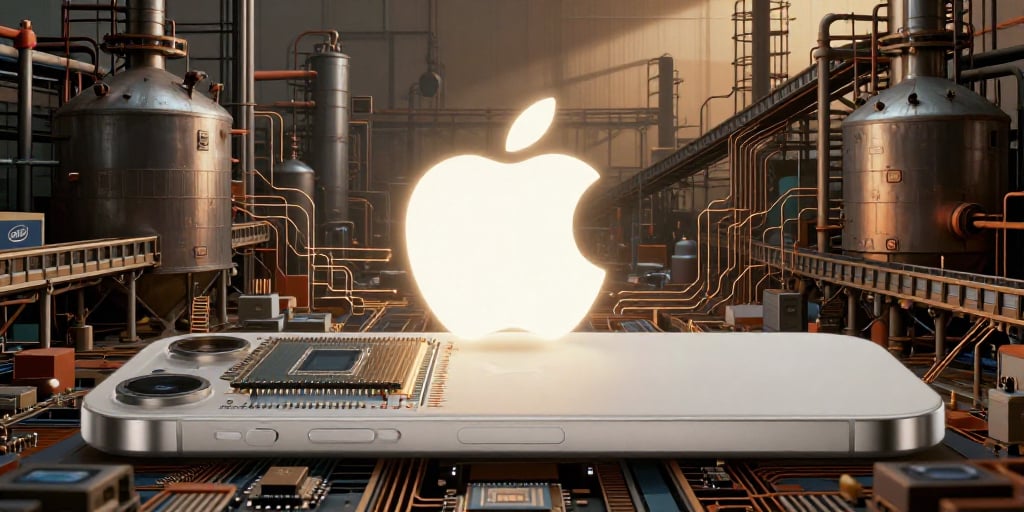
Apple‑Intel Collaboration: A Strategic Shift in Chip Manufacturing
Apple Inc. has reportedly entered a preliminary partnership with Intel Corp. to allow the semiconductor giant to fabricate select Apple devices. The arrangement, announced in the wake of investor‑driven speculation, has already influenced market sentiment, with Intel’s shares experiencing a significant uptick shortly after the disclosure.
Technical Overview of the Partnership
- Manufacturing Scope: Intel is slated to produce a subset of Apple’s silicon‑based products, potentially including the latest M‑series processors and select iPad models. While the exact product mix remains undisclosed, industry insiders suggest the focus will be on high‑volume devices where Intel’s 14‑nanometer (nm) and upcoming 10‑nm process nodes can deliver competitive performance-to‑power ratios.
- Process Technology: Intel’s 14‑nm “Enhanced” line has historically achieved a 30% improvement in transistor density over its predecessor, while the newer 10‑nm “Extreme” architecture promises 40% higher performance per watt. Apple’s existing silicon fabrication on TSMC’s 5‑nm platform has set a high bar for power efficiency; Intel’s technology may bridge the gap in the near term.
- Supply‑Chain Redundancy: By leveraging Intel’s fab capacity, Apple can mitigate risk from TSMC’s capacity constraints and geopolitical tensions in East Asia. Diversification also provides Apple with a fallback option if its current partners face disruptions.
Market Reaction and Analyst Insights
- Intel’s Share Price: Following the announcement, Intel’s stock surged approximately 5.8% on the Nasdaq, reflecting investor optimism about new revenue streams and potential synergies with Apple’s ecosystem.
- Valuation Impact: Bloomberg analysts noted that Intel’s price‑to‑earnings (P/E) ratio has tightened from 15.3x to 13.8x, suggesting a re‑evaluation of the company’s growth prospects. Apple’s own P/E, at 24.5x, remains more modest, underscoring Apple’s disciplined capital allocation.
- Industry Commentary: Former TSMC executive David Wang commented, “If Intel can reliably produce high‑performance silicon that meets Apple’s stringent power and thermal requirements, this partnership could redefine the competitive landscape in the high‑end PC and mobile markets.”
Strategic Implications for Apple
- Supply‑Chain Decentralization: The partnership signals Apple’s intent to reduce overreliance on any single foundry. This aligns with the broader industry trend of multi‑fab sourcing, especially amid the U.S. “CHIPS Act” incentives for domestic semiconductor manufacturing.
- Accelerated Product Rollouts: With Intel’s capacity in the U.S., Apple may shorten lead times for certain models, a critical factor for devices tied to fiscal year releases.
- Cost Management: While Intel’s process nodes are not as mature as TSMC’s 5‑nm, economies of scale in large‑volume production could offset the higher per‑chip cost, providing Apple with a cost‑effective alternative for less power‑critical devices.
App Store Policy Update in Brazil
In parallel with the manufacturing news, Apple has revised its App Store guidelines to regulate betting applications in Brazil. The update, part of Apple’s broader compliance effort in emerging markets, imposes stricter age verification and gambling‑related content controls.
- Regulatory Context: Brazil’s National Electoral Council (CNE) and Ministry of Justice have tightened regulations on online betting, requiring operators to obtain licensing and adhere to consumer protection standards.
- Apple’s Compliance Measures: The new policy mandates that betting apps provide robust user authentication, display real‑time risk warnings, and restrict in‑app purchases for minors. Apps failing to meet these criteria will be removed from the store.
- Industry Reaction: Digital‑gaming firms, such as Bet365 and GVC Holdings, have expressed concerns that the tighter controls could dampen revenue streams in a rapidly growing Latin American market.
Actionable Takeaways for IT Decision‑Makers
| Decision Area | Recommendation | Rationale |
|---|---|---|
| Vendor Diversification | Evaluate Intel’s fabrication capabilities for next‑generation devices. | Reduces dependency on single foundry, mitigates geopolitical risk. |
| Supply‑Chain Planning | Incorporate dual‑fab scenarios in forecasting models. | Enhances resilience and flexibility in component sourcing. |
| Regulatory Compliance | Align internal policies with App Store betting app requirements. | Avoids sanctions, ensures smooth app deployment across regions. |
| Cost Analysis | Perform a detailed cost‑benefit analysis comparing Intel vs. TSMC for specific product lines. | Optimizes capital allocation and maintains price competitiveness. |
| Security & Quality Assurance | Implement rigorous testing to validate performance and thermal characteristics of Intel‑produced silicon. | Ensures Apple’s quality standards and user experience remain uncompromised. |
Conclusion
Apple’s engagement with Intel marks a notable pivot toward a more diversified and resilient manufacturing strategy, while the App Store policy overhaul underscores the company’s commitment to regulatory compliance in key markets. For IT leaders and software professionals, the dual developments necessitate a reassessment of supply‑chain models, regulatory frameworks, and product‑development roadmaps to capitalize on the emerging opportunities and mitigate associated risks.