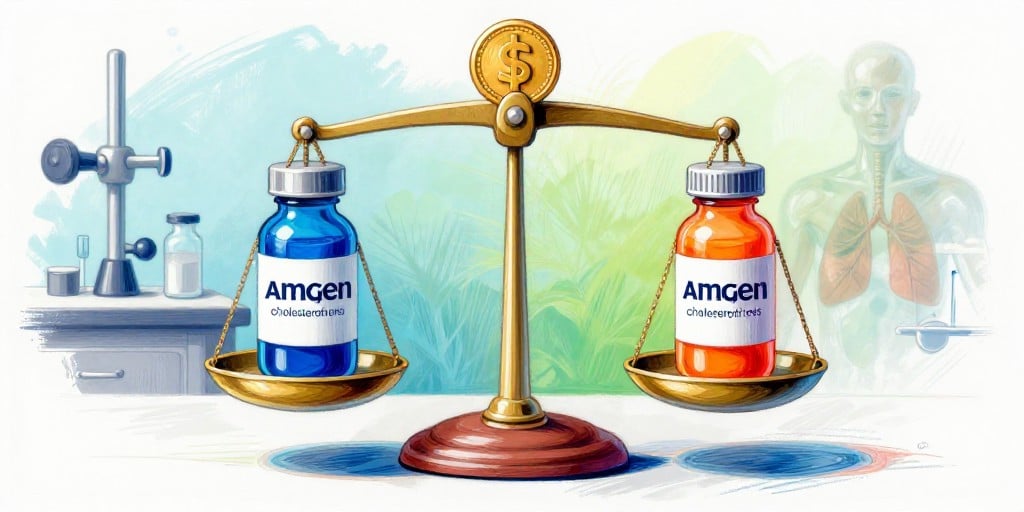
Amgen Inc. Q3 Results: A Balanced Outlook Amid Competitive Contrasts
Amgen Inc. announced a moderate rise in third‑quarter revenue, largely attributable to the sustained performance of its flagship cholesterol‑lowering therapy and a newly approved lung‑cancer drug. The company also reported encouraging progress on an experimental weight‑loss candidate that is presently in the later stages of clinical development. While these developments underscore the robustness of Amgen’s core portfolio, analysts caution that the company’s broader expansion is still contingent on the commercial viability of its pipeline assets.
Revenue Dynamics and Product Contributions
- Cholesterol‑Lowering Therapy: The drug continues to drive revenue, reflecting persistent demand among patients and prescribers. Amgen’s marketing strategy—focused on differentiated patient education and payer negotiations—has mitigated competitive pressures from biosimilars.
- Lung‑Cancer Therapy: The therapy’s approval in key markets has added a new, high‑margin revenue stream. However, the competitive landscape for immuno‑oncology agents is intensifying, with several entrants pursuing similar mechanisms of action.
- Experimental Weight‑Loss Candidate: The candidate’s advancement to Phase 2 underscores Amgen’s commitment to diversification beyond cardiovascular and oncology. Early efficacy signals are promising, but the path to regulatory approval will depend on long‑term safety data and the ability to navigate the stringent FDA requirements for obesity therapeutics.
Cash‑Flow Health and Capital Allocation
Amgen highlighted a sustained improvement in liquidity, with operating cash outflows decreasing relative to the prior year. This trend is indicative of:
- Working‑Capital Efficiency: The company has tightened inventory turnover and accelerated receivables collection, thereby freeing cash that can be redirected to research and development (R&D).
- R&D Investment: Despite a healthier cash position, Amgen remains heavily invested in its pipeline, allocating roughly 13 % of revenue to R&D in the third quarter. This figure aligns with industry averages for late‑stage biotech firms but remains a significant driver of future capital needs.
The balance sheet still reflects a notable debt load, with long‑term liabilities comprising approximately 25 % of total assets. Analysts advise continued monitoring of leverage ratios, especially as Amgen pursues additional acquisitions or high‑cost clinical programs.
Comparative Industry Snapshot
Amgen’s performance must be contextualized against peers exhibiting divergent trajectories:
- Peer A: Reported a sharp revenue surge driven by newly commercialized diabetes and obesity therapies. This growth underscores the market’s appetite for metabolic treatments and highlights the potential of biomarker‑driven drug development. However, the company’s cost base has risen sharply, raising questions about margin sustainability.
- Peer B: Experienced a revenue decline but emphasized milestones in its clinical pipeline. While immediate financial metrics are weaker, the company’s focus on late‑stage trials could position it for a future upside if the products reach market approval.
These contrasting paths illustrate the heterogeneity in how biotechnology firms translate scientific advances into cash flow. Amgen’s strategy, which leans on established revenues while cautiously investing in the pipeline, represents a middle‑ground approach that balances risk and reward.
Emerging Trends and Risks
- Regulatory Scrutiny on Obesity Drugs: Recent FDA guidance tightening efficacy and safety endpoints for anti‑obesity agents could delay approval for Amgen’s experimental candidate.
- Patent Lifecycle Challenges: The cholesterol‑lowering therapy’s key patents are nearing expiration, potentially exposing Amgen to generic competition. Strategic planning for product line extension or complementary indications will be essential.
- Market Consolidation: The oncology space is increasingly consolidating, with larger firms acquiring niche biologics. Amgen’s ability to maintain its market share will depend on continued innovation and strategic partnerships.
Opportunities
- Portfolio Diversification: Success of the weight‑loss candidate could open a new, high‑growth market segment.
- Strategic Partnerships: Collaborations with specialty pharma or biotech firms could accelerate the development of pipeline assets while sharing risk.
- Geographic Expansion: Leveraging existing sales channels to penetrate emerging markets, particularly in Asia and Latin America, may offset patent‑expiration pressures.
Conclusion
Amgen’s third‑quarter results reaffirm its capacity to generate steady top‑line growth from a mature product base while maintaining a disciplined focus on pipeline development. The company’s improved cash‑flow position provides a buffer against the inherent risks of high‑cost R&D, yet the presence of significant debt warrants careful leverage management. When benchmarked against peers, Amgen’s balanced approach—combining reliable revenue streams with selective investment in next‑generation therapies—positions it to navigate an increasingly competitive and regulatory‑tightened biotechnology landscape.