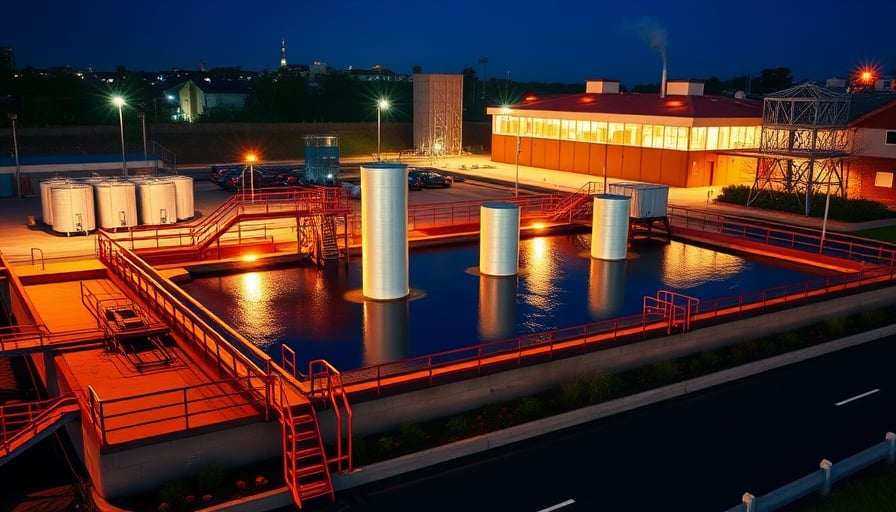
Corporate News – Analysis of American Water Works Co. Inc.’s Strategic Positioning and Implications for Utility Modernization
American Water Works Co. Inc. (NYSE: AWK) remains the largest regulated water and wastewater utility in the United States. Recent public disclosures highlight a dual focus on community enrichment through the American Water Charitable Foundation and on targeted infrastructure upgrades across its subsidiaries, notably the replacement of aging water mains in Lexington, Kentucky. While these actions primarily concern water supply systems, they carry significant parallels to the broader trajectory of utility modernization, offering insights into the evolving interplay between service reliability, regulatory frameworks, and investment strategies that also affect power generation, transmission, and distribution.
1. Infrastructure Investment as a Catalyst for Grid‑Like Resilience
The Lexington water‑main replacement project exemplifies a systematic approach to asset renewal that echoes strategies used in electric power systems to bolster grid stability. Replacing corroded or aged pipelines improves hydraulic reliability, reduces leak‑related losses, and enhances pressure management—functions analogous to reinforcing transmission corridors to mitigate voltage sags and maintain system inertia. By adopting a data‑driven asset management model—tracking pipe age, material fatigue, and pressure profiles—American Water can predict failure points and schedule proactive repairs, thereby reducing unplanned service disruptions. In power utilities, similar predictive maintenance practices, enabled by SCADA and advanced sensors, underpin efforts to prevent cascading outages and to support higher penetration of intermittent renewable resources.
2. Regulatory and Rate‑Structure Considerations
Regulated utilities operate under rate‑of‑return frameworks that balance investor returns with public protection. American Water’s recent capital expenditures, funded through rate‑based financing, illustrate how regulatory approval processes govern asset upgrades. In the electric sector, the American Public Power Association (APPA) and the Federal Energy Regulatory Commission (FERC) oversee analogous rate‑setting mechanisms for transmission and distribution utilities. Both sectors face pressure to adjust tariff structures to accommodate the higher costs of modernizing critical infrastructure—whether that be underground water mains or smart grid components such as voltage regulators, phase‑shifters, and distributed energy resource (DER) interconnectors.
The transition to renewable energy sources imposes new reliability requirements, necessitating investment in flexible transmission assets, such as HVDC links, and in dynamic distribution systems equipped with energy storage. These costs are typically allocated through performance‑based ratemaking, where utilities earn a margin tied to the reliability improvements delivered. American Water’s experience with rate‑based funding demonstrates a proven model that could inform how electric utilities structure investments in grid‑resilience technologies, ensuring that public funds are deployed efficiently while maintaining affordability.
3. Economic Impacts and Consumer Costs
Infrastructure upgrades invariably generate short‑term price increases for consumers. In the water sector, American Water’s investments translate into modest rate hikes that are capped by regulatory oversight to protect low‑income households. Similarly, electric utilities face scrutiny over how renewable integration costs—such as new wind turbines, solar farms, and associated transmission upgrades—are recouped. The challenge lies in spreading these costs over the lifetime of the assets, ensuring that rates remain transparent and justifiable.
A key insight from American Water’s strategy is the importance of aligning investment timelines with service demand projections. By integrating advanced modeling tools that forecast demographic shifts, climate‑driven water demand, and storm‑water management needs, the company can justify capital projects that yield long‑term economic benefits. Electric utilities can adopt comparable modeling frameworks to project peak demand, renewable output variability, and asset depreciation, thereby refining their rate‑design models to reflect true system costs without imposing undue burden on consumers.
4. Technological Integration and the Energy Transition
The American Water Charitable Foundation’s philanthropic outreach—particularly its partnership with the American Red Cross—highlights a broader commitment to resilience, a concept that extends beyond water to the entire energy ecosystem. Enhancing public safety through disaster relief initiatives parallels efforts by electric utilities to deploy microgrids and battery storage to maintain service during extreme weather events. Both sectors can leverage common technologies, such as IoT sensors, machine‑learning analytics, and distributed control algorithms, to detect and respond to system stresses in real time.
Moreover, the water industry’s experience with large‑scale water‑quality monitoring and treatment informs strategies for power utilities seeking to manage contamination risks in critical infrastructure. Cross‑sector collaboration on cybersecurity protocols, data interoperability, and emergency response planning could accelerate the deployment of resilient, high‑efficiency systems that support the broader energy transition.
5. Conclusion
American Water Works Co. Inc.’s recent focus on community support and systematic infrastructure renewal offers a compelling case study for utilities across sectors. By embracing predictive maintenance, rate‑of‑return financing, and technologically driven asset management, the company sets a benchmark for balancing reliability, regulatory compliance, and consumer affordability. These principles are directly applicable to power generation, transmission, and distribution utilities as they navigate the challenges of renewable integration, grid stability, and the capital intensity of modernization efforts. The cross‑industry lessons underscore the importance of a holistic, data‑driven approach to infrastructure investment—a strategy that is essential for achieving a secure, sustainable, and economically viable energy future.