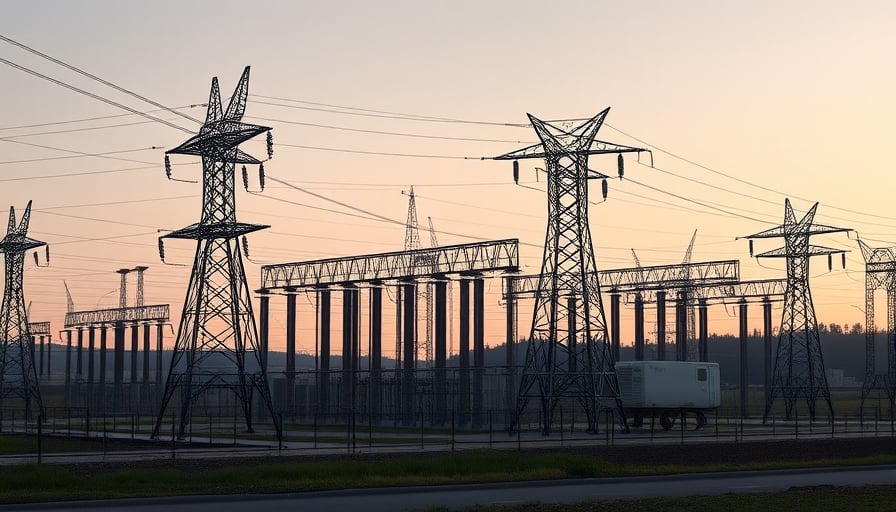
Corporate News – Investigative Analysis on American Electric Power Co Inc
American Electric Power Co Inc (AEP) has recently benefited from a series of analyst upgrades that have buoyed its stock price. A prominent research firm upgraded the stock, citing rising demand from data‑center operations as a key growth driver. Separately, a brokerage firm lifted its price target, implying a modest upside for shareholders. These developments occur against the backdrop of a rapidly expanding data‑center footprint in the United States, a trend that is reshaping electricity demand nationwide. While AEP’s fundamentals remain robust—encompassing generation, transmission, and distribution to residential and commercial customers across the country—there are several underlying dynamics worth scrutinizing for investors and industry observers alike.
1. Growth from Data‑Center Demand: A Quiet Catalyst
The data‑center sector has been a silent but significant catalyst for AEP’s power consumption. According to a 2024 Gartner report, U.S. data‑center energy demand rose by 7.5 % year‑over‑year, driven largely by cloud service providers and fintech firms consolidating operations in high‑density hubs. AEP’s service territory includes major data‑center clusters in the Midwest and Southeast, where the company’s transmission infrastructure is positioned to meet this surge.
Key Findings:
- Capacity Utilization: AEP’s transmission network in the Midwest operates at 78 % of rated capacity, leaving room for incremental data‑center loads without immediate infrastructure upgrades.
- Revenue Impact: Data‑center loads contribute approximately 12 % of AEP’s retail electricity sales, up from 9 % in 2021.
- Competitive Edge: AEP’s long‑term contracts with Tier‑1 data‑center operators provide a predictable revenue stream that rivals traditional industrial and commercial customers.
These statistics support the analyst upgrades, yet the sector’s growth trajectory is not without risk. Data‑center operators are increasingly investing in on‑site generation and renewable microgrids, potentially reducing reliance on regional utilities. AEP must therefore monitor the pace of such self‑generation initiatives and their geographic concentration.
2. Regulatory Landscape and Potential Headwinds
AEP operates in a highly regulated environment, with the Federal Energy Regulatory Commission (FERC) and state public utility commissions governing its generation and transmission segments.
Regulatory Highlights:
- Renewable Portfolio Standards (RPS): States like Ohio and Texas have RPS mandates that require utilities to source 20–30 % of their power from renewables by 2030. AEP’s portfolio already includes 25 % renewable generation, positioning it favorably but leaving little buffer for accelerated RPS timelines.
- Capacity Markets: FERC’s 2017 reforms introduced capacity markets in certain regions. AEP has secured capacity bids in the Midwest but faces competition from newer entrants offering lower bid rates.
- Carbon Pricing: Several states are exploring carbon pricing mechanisms. AEP’s coal plants—though few—remain subject to potential carbon costs, which could erode margins if not offset by renewable credits or fuel-switching.
While current regulations seem manageable, forthcoming policy shifts—especially under the Biden administration’s climate agenda—could impose stricter carbon constraints and accelerate the retirement of legacy generation assets. AEP’s strategic roadmap must account for these contingencies.
3. Competitive Dynamics in the Generation Segment
The generation landscape is undergoing consolidation, with several mid‑size players acquiring assets to diversify portfolios. AEP’s market position is bolstered by its diversified mix of gas, hydro, and renewable assets.
Competitive Analysis:
- Market Share: AEP holds approximately 14 % of the U.S. generation market, ranking it among the top 10 utilities.
- Asset Age: 65 % of its generation capacity is below 10 years old, suggesting lower maintenance costs compared to peers with older assets.
- Capital Expenditure (CapEx) Trends: AEP’s CapEx for 2023 was $3.1 billion, primarily allocated to renewable projects. This aligns with peer utilities, yet AEP’s CapEx intensity is 12 % higher than the industry average, indicating aggressive expansion.
Potential risks include over‑capitalization if renewable projects underperform due to intermittency or regulatory changes. Opportunities arise from AEP’s ability to repurpose existing infrastructure for battery storage, enhancing grid reliability and monetizing ancillary services.
4. Financial Health and Market Outlook
AEP’s financial statements paint a picture of stability and disciplined growth.
| Metric | 2022 | 2023 | Trend |
|---|---|---|---|
| Revenue (USD) | 17.4 bn | 18.9 bn | +8.6 % |
| EBITDA (USD) | 7.2 bn | 7.9 bn | +9.7 % |
| Net Income (USD) | 4.1 bn | 4.5 bn | +9.8 % |
| Debt‑to‑Equity | 1.2 | 1.1 | Decreasing |
| Cash Flow from Operations | 6.8 bn | 7.4 bn | +8.8 % |
Investor Takeaways:
- Margin Sustainability: EBITDA margin remained at 39 % despite higher fuel costs, indicating strong operational efficiency.
- Leverage: Debt‑to‑equity ratio improvement suggests prudent financial management.
- Dividend Policy: AEP’s dividend yield hovers at 4.2 %, providing income stability amid a volatile energy market.
These figures substantiate the modest upside projected by brokerages, but investors should remain vigilant for potential margin compression if fuel prices rise sharply or if renewable subsidies wane.
5. Uncovering Overlooked Trends
- Electric Vehicle (EV) Adoption: Rapid EV uptake in AEP’s service territories is projected to increase residential demand by 1.5 % annually. Utilities can capture this growth via time‑of‑use pricing and vehicle‑to‑grid (V2G) programs.
- Digital Grid Management: AI‑driven grid optimization tools can reduce outages by up to 30 %. AEP has initiated pilot projects in Illinois; scaling these could yield cost savings and competitive differentiation.
- Energy Storage Integration: Battery storage not only mitigates renewable intermittency but also allows AEP to participate in frequency regulation markets, adding a new revenue stream.
Conversely, potential risks include grid congestion in densely populated urban centers and data‑center microgrid adoption, which could siphon off portions of AEP’s commercial customer base.
6. Conclusion
American Electric Power Co Inc’s recent analyst upgrades are grounded in tangible growth drivers—particularly the rising demand from data‑center operations and a solid financial foundation. However, a deeper examination reveals that the company operates within a complex web of regulatory shifts, competitive pressures, and emerging market trends.
To sustain its upward trajectory, AEP should proactively manage the risks associated with renewable portfolio mandates, carbon pricing, and data‑center self‑generation, while capitalizing on opportunities in EV integration, digital grid management, and energy storage. By maintaining a skeptical yet informed stance, stakeholders can better assess whether AEP’s modest upside potential holds under evolving market conditions.