
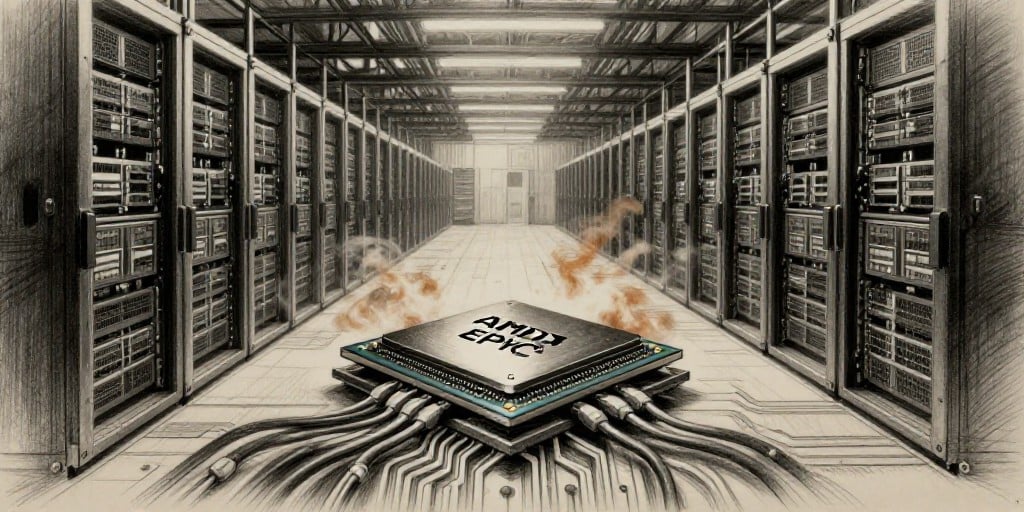
Advanced Micro Devices Inc. (AMD) Demonstrates Robust Momentum in the Data‑Center Segment
Executive Summary
During its most recent shareholders’ meeting, Advanced Micro Devices Inc. (AMD) reported a compelling first‑quarter performance, underscoring significant growth in its data‑center portfolio. CEO Lisa Su highlighted that the server‑processor division contributed more than 50 % of total revenue, a marked improvement over prior periods. The company’s second‑quarter guidance points to continued expansion, driven by elevated demand for EPYC processors and AI‑infrastructure solutions. This upward trajectory reflects a broader shift in the server‑CPU ecosystem, with AMD and Arm progressively eroding Intel’s long‑standing dominance.
Market Context and Competitive Dynamics
The server‑CPU market is projected to expand at a compound annual growth rate of roughly 7–8 % over the next five years, fueled by the proliferation of cloud services, edge computing, and AI workloads. AMD’s strategic focus on high‑core‑count, multithreaded processors positions it to capitalize on workloads that require extensive parallelism, such as large‑scale machine‑learning training and inference pipelines. Analysts note that AMD’s EPYC line, coupled with its recently announced rack‑scale solutions, could diversify revenue streams beyond single‑chip sales, potentially translating into improved earnings scalability.
Arm’s growing presence in the low‑power, high‑density server space further intensifies competition, yet the complementary strengths of AMD’s silicon (high throughput) and Arm’s silicon (energy efficiency) create a heterogeneous ecosystem where each can target distinct market segments. Intel’s gradual decline in market share, attributable to lagging process node advancements and supply‑chain disruptions, has created a vacuum that AMD is actively filling.
Technical Perspective: Semiconductor Innovation and Node Progression
Node Advancement and Yield Optimization
AMD’s current reliance on the 7 nm process (fabricated by TSMC) for its EPYC CPUs underscores the importance of yield optimization at advanced nodes. Transitioning to 5 nm and beyond introduces significant challenges: increased defect density, variability in transistor threshold voltages, and more pronounced short‑channel effects. Yield losses scale with feature size reduction; thus, foundries must invest heavily in defect‑control tools, process monitoring, and statistical process control (SPC) to maintain acceptable output levels. AMD’s partnership with TSMC has reportedly included joint yield‑improvement initiatives, leveraging shared sensor data and defect‑correction workflows to mitigate these risks.
Manufacturing Processes and Technical Challenges
Advanced nodes necessitate a suite of process enhancements:
- EUV Lithography: The adoption of extreme ultraviolet (EUV) lithography has become essential for patterning sub‑20 nm features. However, EUV tool availability is limited, and its high cost translates to elevated capital expenditure (CapEx) for both fabs and foundry customers.
- High‑K Metal Gate (HKMG) and FinFET structures reduce short‑channel effects but introduce stress‑induced variability that must be carefully managed through advanced strain‑engineering techniques.
- Gate‑All‑Around (GAA) transistor architectures promise further scaling but require the development of novel 3‑D integration strategies and robust interconnect solutions.
Yield optimization at these nodes is often constrained by defect clustering phenomena and by the stochastic nature of doping processes, which can lead to local performance hotspots. Advanced statistical modeling and real‑time process monitoring are thus critical to preemptively address such defects.
Capital Equipment Cycles
The capital‑intensive nature of semiconductor manufacturing means that CapEx cycles are long and amortized over multiple production runs. For example, a 7 nm fab can cost upwards of $5 billion, whereas a 5 nm facility may exceed $10 billion. These expenditures are justified by the revenue potential of high‑performance, high‑core‑count CPUs, yet they also impose a liquidity burden on manufacturers and foundries alike. AMD’s business model—outsourcing fabs to TSMC—allows the company to avoid the full capital burden while still benefitting from process node advancements.
Foundry Capacity Utilization
TSMC’s capacity utilization is a key metric for AMD’s supply chain stability. As AMD’s demand for EPYC processors rises, TSMC must balance capacity across multiple customers, including other fab‑less firms such as Apple and NVIDIA. To mitigate supply constraints, AMD has secured dedicated capacity agreements and is exploring secondary fabrication partners (e.g., Samsung) for future process nodes. Moreover, TSMC’s focus on increasing yield efficiency—through better defect repair, enhanced chemical‑mechanical polishing (CMP), and advanced lithography tool integration—ensures that capacity constraints do not translate into significant production bottlenecks.
Interplay Between Design Complexity and Manufacturing Capabilities
Modern server CPUs increasingly embody a multitude of heterogeneous components: high‑performance cores, efficient cores, AI accelerators, memory controllers, and advanced interconnects (PCIe 4.0/5.0, NVMe). Integrating these components on a single die imposes stringent design constraints:
- Thermal Management: Higher core counts lead to increased power density, demanding sophisticated on‑die cooling solutions and adaptive voltage-frequency scaling.
- Signal Integrity: High‑frequency bus interfaces (e.g., DDR5, PCIe 5.0) require meticulous design of shielding, trace impedance, and clock skew management.
- Verification Complexity: The sheer number of transistors and interconnects necessitates automated verification frameworks, formal methods, and AI‑assisted bug detection to reduce design cycle time.
Manufacturing capabilities must evolve in parallel: advanced driver circuits, fine‑pitch metal interconnects, and precise lithography are essential to bring such complex designs to fruition without compromising yield.
Enabling Broader Technological Advances
The convergence of high‑core‑count CPUs, specialized AI accelerators, and low‑power interconnects directly underpins several broader technology trends:
- Edge AI: Efficient, high‑throughput CPUs allow real‑time inference on edge devices, facilitating autonomous systems and IoT applications.
- High‑Performance Computing (HPC): Large‑scale simulations and data analytics benefit from dense multithreaded CPUs, accelerating scientific discovery and financial modeling.
- Cloud Infrastructure: Data‑center operators require energy‑efficient, scalable compute platforms to manage the rising demand for cloud services while curbing operational costs.
AMD’s continued focus on scaling process nodes, improving yields, and integrating advanced features positions it as a key enabler in these domains.
Conclusion
AMD’s recent performance and forward guidance underscore its successful navigation of a highly competitive and technically demanding market. By leveraging advanced semiconductor processes, maintaining robust relationships with leading foundries, and continually innovating in CPU architecture, AMD is poised to sustain its leadership in the data‑center segment. The company’s strategic emphasis on node progression, yield optimization, and supply‑chain resilience will be critical as the semiconductor industry advances toward even smaller feature sizes and increasingly complex chip designs.