
Advanced Micro Devices (AMD) Prepares for “Advancing AI 2026” Conference Amid Positive Market Signals
Advanced Micro Devices (AMD) is positioning itself at the center of the high‑performance computing landscape as it gears up to host the “Advancing AI 2026” event in San Francisco on July 22–23. The two‑day conference will host more than 100 sessions covering architecture, software, and ecosystem partners, with a keynote address expected from CEO Lisa Su. Her remarks are anticipated to outline AMD’s strategy for scaling its AI‑enabled silicon and software stack—an essential component for companies looking to accelerate workloads such as machine‑learning inference, large‑language‑model training, and high‑performance scientific simulations.
New Hardware Capabilities and Market Position
AMD’s recent product announcements underscore its competitive positioning in the $900 billion semiconductor market. Key highlights include:
| Product | Generation | Process Node | Target Applications |
|---|---|---|---|
| Zen 6 server CPUs | 6th‑gen core | 5 nm (TSMC) | General‑purpose compute, data‑center workloads |
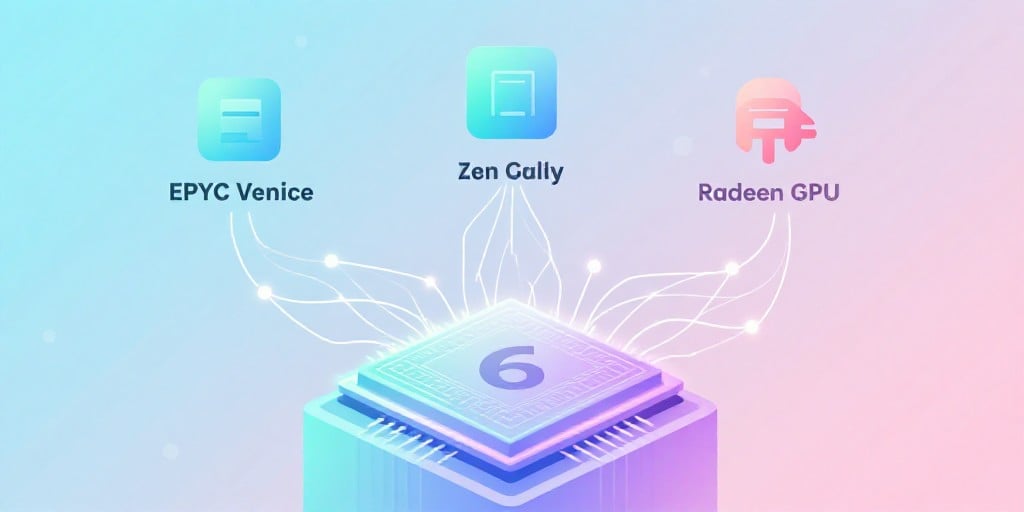
| EPYC “Venice” processors | EPYC 7003‑series | 2 nm (TSMC) | AI inference, mixed‑precision workloads, GPU‑accelerated clusters |
| GPU lineup (Radeon PRO W6000 series) | 4th‑gen RDNA 3 | 3 nm (TSMC) | Gaming, professional graphics, AI training |
The Zen 6 architecture introduces a 64‑core configuration with a 3.0 GHz base frequency, delivering a 20 % uplift in instructions‑per‑cycle (IPC) relative to Zen 5. EPYC Venice, built on TSMC’s 2 nm process, boasts up to 2.8 TFLOPs of mixed‑precision performance, positioning it as a viable alternative to Nvidia’s H100 for data‑center operators.
Export‑Control Developments and Global Supply Chain Dynamics
Parallel to AMD’s product roadmap, the export‑control environment for high‑end AI chips has begun to ease. Reuters reported that three Chinese firms—including a ZTE unit and a server maker—secured U.S. approvals to acquire Nvidia’s H200 and AMD‑equivalent accelerators. The approvals are significant for several reasons:
- Demand Resurgence: China represents one of the largest AI markets worldwide. The clearance of export licenses removes a key barrier, potentially reigniting demand for advanced AI accelerators.
- Supply‑Chain Certainty: While shipment volumes remain modest, the clearing of regulatory reviews reduces uncertainty for both chipmakers and their Chinese partners, smoothing the path for future orders.
- Competitive Landscape: For AMD, these approvals could translate into higher sales volumes if Chinese data‑center operators pivot toward AMD’s EPYC Venice and Radeon GPUs in lieu of Nvidia’s H200.
Industry analysts suggest that this shift may encourage other export‑control‑restricted entities to apply for licenses, fostering a more predictable procurement environment.
Investor and Analyst Sentiment
AMD’s share price has experienced a notable rally in Q3, reflecting growing confidence in its AI strategy and data‑center penetration. KeyBanc’s analyst John Vinh recently raised AMD’s price target, citing:
- Clean GPU Ramp: Upcoming Radeon GPUs are expected to hit the market in Q4, providing a clear pathway for incremental revenue.
- Customer Pipeline: A growing number of AI‑centric enterprises are integrating AMD silicon into their infrastructure, from Fortune 500 cloud providers to mid‑market edge‑computing vendors.
- Memory and CPU Demand: The continued need for high‑bandwidth memory (HBM) and multi‑core CPUs in data‑center environments supports sustained revenue streams.
Vinh’s optimism is tempered by the broader volatility of the semiconductor sector, where rapid technological cycles and geopolitical tensions can disrupt supply chains. Nevertheless, AMD’s diversified product portfolio and strong developer ecosystem mitigate some of these risks.
Actionable Insights for IT Decision‑Makers
- Evaluate Architecture Fit: For workloads requiring both high‑throughput GPU compute and dense CPU cores, AMD’s EPYC Venice paired with Radeon GPUs offers a balanced solution, especially when HBM capacity is a constraint.
- Plan for Licensing: If operating within jurisdictions subject to U.S. export controls, organizations should monitor license approvals and assess the feasibility of procuring AMD or Nvidia accelerators.
- Monitor Upcoming Releases: The July conference will unveil detailed performance benchmarks and roadmap updates. IT leaders should prioritize session attendance or post‑event briefings to capture early data on Zen 6 and Venice performance in real‑world scenarios.
- Assess Total Cost of Ownership: Beyond raw performance, evaluate energy consumption, silicon cost, and ecosystem support (e.g., driver maturity, software libraries) to ensure long‑term operational efficiency.
Conclusion
AMD’s forthcoming “Advancing AI 2026” event, combined with easing export‑control barriers and positive analyst outlooks, positions the company favorably within an intensely competitive semiconductor landscape. For organizations seeking to harness next‑generation AI capabilities, AMD’s expanding silicon stack offers a compelling blend of performance, scalability, and strategic flexibility. As the market continues to evolve, IT leaders who stay informed of these developments can better align their infrastructure investments with emerging opportunities.