
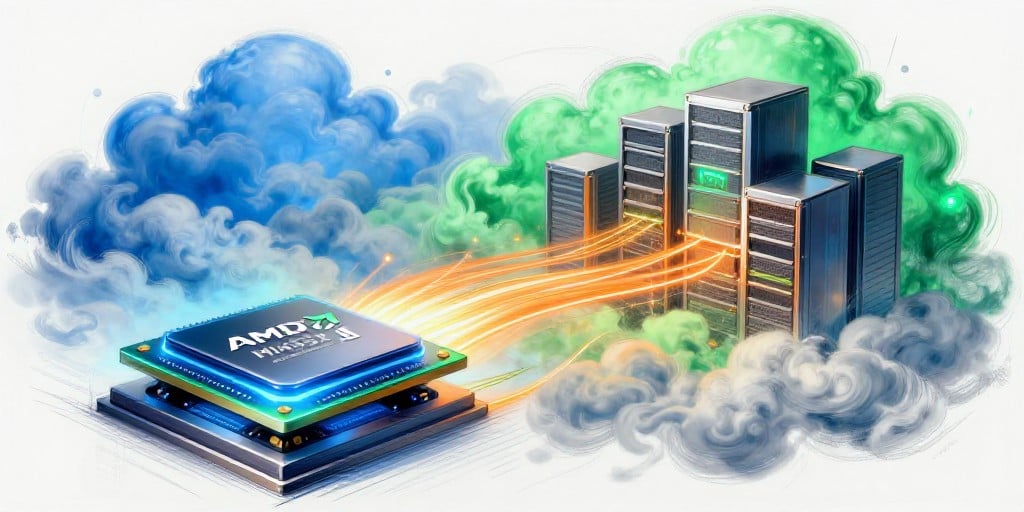
Corporate Analysis of AMD’s Recent Strategic Moves
Executive Summary
Advanced Micro Devices (AMD) has recently attracted heightened investor interest following a bullish market analyst’s remarks and the release of its new AI accelerator, the MI455X. The chipmaker’s stock has risen alongside a broader technology rally that was initially triggered by expectations surrounding Nvidia’s forthcoming earnings. This article examines the underlying business fundamentals, regulatory context, competitive dynamics, and potential risks and opportunities that AMD’s recent developments may create.
1. Market Context and Investor Sentiment
- Technology Rally Triggered by Nvidia: Anticipation of Nvidia’s earnings release has set a bullish tone across semiconductor equities. AMD, as a key competitor in the server CPU and AI accelerator space, has benefitted from this spill‑over effect.
- Analyst Upgrade: A prominent market analyst’s positive comment amplified investor optimism, driving AMD’s share price upward. The upgrade was grounded in AMD’s ability to exceed guidance and its robust revenue growth trajectory.
- Sector‑wide Momentum: Other chipmakers—such as Intel, Qualcomm, and Taiwan Semiconductor Manufacturing Company—also posted gains, indicating a systemic sector confidence rather than a company‑specific anomaly.
2. Product Innovation: The MI455X AI Accelerator
2.1 Technical Specifications
- Memory Capacity: The MI455X incorporates a significantly larger on‑chip memory than its predecessor, facilitating higher data throughput for complex AI workloads.
- Bandwidth Expansion: Enhanced memory bandwidth reduces bottlenecks in training and inference cycles, a critical factor for large‑scale generative AI models.
2.2 Strategic Rationale
- High‑Performance Computing (HPC) Positioning: By expanding memory capacity, AMD positions itself to compete more directly with Nvidia’s Hopper architecture and emerging AI‑dedicated chips from competitors.
- Hybrid Cloud–On‑Premise Appeal: The MI455X’s architecture supports a hybrid deployment model, allowing enterprises to shift workloads between cloud and on‑premise environments. This flexibility aligns with current enterprise IT trends that seek to balance cost, latency, and data sovereignty concerns.
2.3 Financial Impact
- Revenue Projections: AMD’s earnings guidance includes a 12–15 % YoY increase in the AI accelerator segment, driven by early adopters in cloud service providers and large enterprises.
- Margin Considerations: While capital expenditure on R&D is substantial, the MI455X’s high‑margin potential could offset these costs through premium pricing in niche HPC markets.
3. Competitive Dynamics
| Competitor | Core Strength | Recent Moves | Market Share (2024) |
|---|---|---|---|
| Nvidia | AI GPUs & ecosystem | Hopper 3.0 launch, expanded cloud partnerships | 42 % |
| Intel | CPU + AI accelerators | Xe Gen 4, AI inference engines | 24 % |
| Samsung | Memory & process tech | 7 nm HBM3 launch | 15 % |
| AMD | Server CPUs + accelerators | MI455X, hybrid model focus | 19 % |
- Differentiation: AMD’s dual‑focus on CPU and accelerator markets allows cross‑synergy between its EPYC server CPUs and MI series accelerators, potentially creating bundled solutions.
- Threats: Nvidia’s entrenched ecosystem and aggressive R&D pace could erode AMD’s AI market share unless AMD accelerates product differentiation and ecosystem partnerships.
4. Regulatory and Supply‑Chain Considerations
- US Export Controls: The U.S. export‑control regime on high‑performance computing hardware may limit AMD’s ability to sell advanced accelerators to certain foreign customers, affecting revenue forecasts.
- Semiconductor Supply Chain: AMD’s reliance on third‑party foundries (TSMC, Samsung) introduces exposure to geopolitical tensions and capacity constraints, especially during periods of global chip shortages.
5. Potential Risks
- Market Volatility: The semiconductor sector remains sensitive to macro‑economic cycles; a downturn could reduce IT spend, impacting AMD’s sales.
- Technological Obsolescence: Rapid advances in AI model architectures may outpace current hardware capabilities, necessitating continual R&D investment.
- Competitive Pricing Pressure: Nvidia’s scale and pricing power may undercut AMD’s margins in the high‑performance AI segment.
6. Emerging Opportunities
- Hybrid Cloud Adoption: As enterprises increasingly adopt hybrid cloud models, AMD’s MI455X could become a preferred solution for on‑premise inference, driving incremental revenue.
- Enterprise AI Licensing: The company’s emphasis on cost‑saving tools for hybrid workloads positions it to offer value‑added services (e.g., AI cost‑optimization consulting), creating new revenue streams.
- Strategic Partnerships: Collaborations with cloud providers (AWS, Microsoft Azure) and data center operators could accelerate market penetration and create lock‑in effects.
7. Conclusion
AMD’s recent product announcement and positive market reception underscore a strategic pivot towards AI‑centric high‑performance computing. While the chipmaker’s fundamentals appear solid—strong revenue growth, a clear product roadmap, and an expanding ecosystem—the company faces significant competitive and regulatory challenges. Investors and stakeholders should monitor AMD’s ability to convert its technological advantages into sustained market share gains, particularly in the context of evolving AI workloads and the hybrid cloud paradigm.