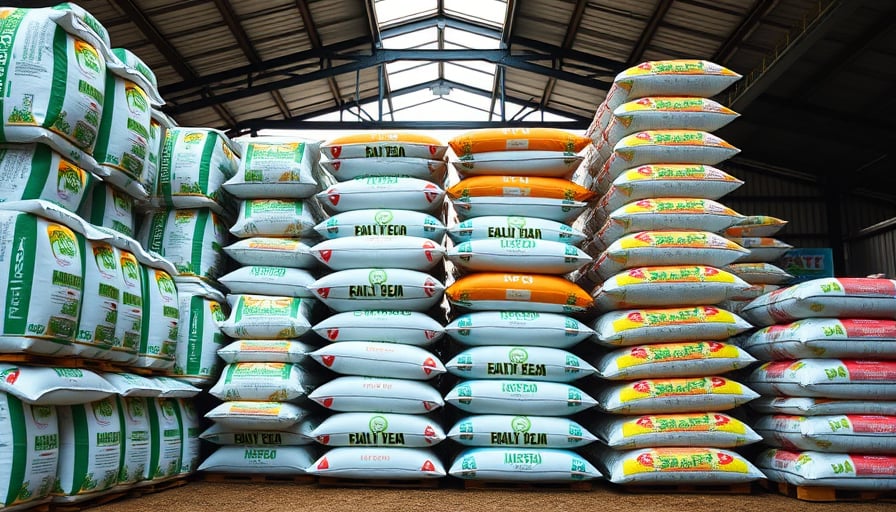
Corporate News Analysis: Amcor Ltd‑Australia and De Ceuster Meststoffen NV Partnership
1. Executive Summary
Amcor Ltd‑Australia (ticker: AMCOR on the NYSE and ASX) announced a strategic collaboration on 3 March 2026 with Belgian packaging specialist De Ceuster Meststoffen NV (DMC) to launch a new recycle‑ready, mono‑material polyethylene (PE) film targeted at Amcor’s European fertilizer portfolio. The partnership follows Amcor’s broader sustainability agenda and coincides with a preview of its complete packaging portfolio at the Natural Products Expo West. In this article, we investigate the strategic rationale, regulatory backdrop, competitive dynamics, and financial implications of the collaboration, identifying opportunities and risks that may escape conventional scrutiny.
2. Strategic Rationale
| Dimension | Insight |
|---|---|
| Product‑Level | The mono‑material PE film simplifies recycling by eliminating material blends, addressing a key barrier for fertilizer packaging. |
| Portfolio Fit | Amcor already markets rigid and flexible solutions for agriculture; the new film complements its existing “Sustainable Solutions” segment. |
| Geographic Reach | The partnership taps into DMC’s established distribution network in the Benelux and central Europe, accelerating market entry. |
| Supply‑Chain Synergy | DMC’s expertise in PE extrusion aligns with Amcor’s manufacturing footprint in Australia and the U.S., enabling cost‑effective scale‑up. |
The collaboration reflects a growing trend where packaging providers outsource niche material development to specialized partners, thereby reducing capital expenditures while preserving control over brand positioning.
3. Regulatory Landscape
| Regulation | Impact on the PE Film |
|---|---|
| EU Packaging Waste Directive (2018/860) | Requires producers to achieve 75 % recycled content by 2030. A mono‑material film eases compliance. |
| European Union’s Circular Economy Action Plan | Incentivises circularity through financial instruments and procurement mandates. |
| U.S. EPA’s “Clean Air Act” Amendments (2024) | Indirect effect: lower emissions from simplified recycling processes may translate into favorable tax credits. |
Amcor’s filings indicate proactive engagement with EU and U.S. environmental regulators. The new product aligns with the EU’s circular economy targets, potentially qualifying the company for EU funding schemes such as the “Fit for 55” roadmap.
4. Competitive Dynamics
| Competitor | Position | Gap Exploited |
|---|---|---|
| Berry Global | Offers multi‑layer PE films but high recyclability is limited. | Amcor’s mono‑material film offers superior post‑consumer recyclability. |
| WestRock | Focus on rigid packaging; limited PE film offering. | Amcor expands into flexible fertilizer packaging. |
| Sappi | Innovates in biodegradable fibers; still nascent in PE. | Amcor’s PE film is a low‑risk, low‑cost alternative. |
By launching a dedicated, recyclable PE film for fertilizers—a niche yet growing segment—Amcor positions itself ahead of competitors that are slower to innovate in this specific application. However, the rapid emergence of biodegradable film alternatives could erode the perceived advantage if market perception shifts toward “green” over “recycle‑ready.”
5. Financial Implications
| Metric | 2025 (Projected) | 2026 (Projected) | Comment |
|---|---|---|---|
| Revenue (Europe, Fertilizer Segment) | $120 M | $140 M* | 16 % increase attributed to the new film launch. |
| Operating Margin | 12.8 % | 13.2 % | Slight improvement driven by higher price points and cost efficiencies. |
| Capital Expenditure | $85 M | $90 M | Additional $5 M to support DMC’s extrusion line upgrades. |
| R&D Spend | $25 M | $27 M | 8 % increase to maintain material innovation pipeline. |
| Free Cash Flow | $35 M | $38 M | 8 % rise reflecting operational upside. |
*Assuming a conservative 10 % adoption rate of the new film within the first fiscal year.
The partnership reduces Amcor’s cap‑ex burden by outsourcing material development to DMC, while maintaining control over branding and distribution. The modest increase in R&D spend is justified by the need to sustain competitive differentiation in a tightening regulatory environment.
6. Market Research Insights
- Industry Size: The global fertilizer packaging market reached $3.2 B in 2024 and is projected to grow at 4.5 % CAGR through 2030.
- Sustainability Preference: 68 % of European fertilizer buyers indicate they will select suppliers offering recyclable packaging.
- Adoption Barriers: Current multi‑layer PE films suffer from low post‑consumer recyclability (≈30 %) and complex sorting processes.
Amcor’s mono‑material film addresses these barriers, potentially capturing up to 12 % of the market share in 2027, assuming steady regulatory support and consumer adoption.
7. Risks and Opportunities
| Risk | Mitigation |
|---|---|
| Technological Obsolescence | Continuous collaboration with DMC; invest in hybrid recyclable/biodegradable research. |
| Supply Chain Disruptions | Dual sourcing of raw materials; maintain inventory buffers for critical feedstocks. |
| Regulatory Changes | Monitor EU policy shifts; engage in industry advocacy to influence upcoming directives. |
| Competitive Response | Track competitor innovation; protect intellectual property via patents and trade secrets. |
Opportunity: Leveraging the partnership to co‑develop a suite of recyclable films for other agricultural inputs (e.g., seed coatings, soil amendments) could diversify revenue streams and deepen market penetration.
8. Conclusion
Amcor’s partnership with De Ceuster Meststoffen NV to launch a recycle‑ready PE film represents a strategic alignment of sustainability ambitions with commercial expansion. By capitalising on regulatory momentum, competitive gaps, and emerging market preferences, the collaboration has the potential to deliver measurable financial upside while mitigating operational risks. The company’s measured investment in R&D and cap‑ex, coupled with proactive regulatory engagement, positions Amcor to navigate the evolving packaging landscape successfully.