
Corporate Performance and Capital Dynamics in the Technology and Industrial Sectors
Amazon.com Inc. advanced on the trading day, adding to the broader lift in the technology sector. The Amazon share price moved higher, contributing to the positive momentum observed across the major U.S. equity indices. The rally was part of a broader pattern in which large‑cap technology names outperformed other sectors, while many semiconductor and storage‑related stocks experienced a decline.
Investors noted that Amazon’s performance aligned with a market environment that favored high‑growth technology companies. The rise was accompanied by a notable strengthening of other tech giants such as Apple, Microsoft and Alphabet, which also posted gains. In contrast, the semiconductor space, represented by names such as Intel, AMD, Micron and other chip producers, saw a modest retracement, reflecting a rotation away from the sector.
The market’s sentiment towards Amazon and its peers was further buoyed by softer inflation data, which has reduced expectations of imminent tightening by the U.S. Federal Reserve. The recent consumer‑price figures indicated a cooling of inflationary pressures, supporting the case for continued growth in the technology segment. Overall, Amazon’s share movement was consistent with a broader trend of technology‑led market gains on a day when earnings momentum and inflation concerns were key drivers.
1. Capital Expenditure Trends in Heavy Industry and Their Implications
The surge in technology‑driven earnings has translated into heightened confidence for capital investment across multiple industrial subsectors. Firms in the manufacturing and infrastructure arenas are accelerating spending on state‑of‑the‑art production lines, automation systems, and digital twins to maintain a competitive edge. In particular:
| Sector | Typical CAPEX Focus | Expected Yield |
|---|---|---|
| Automotive | Additive manufacturing, electrification platforms | Reduced unit cost, faster time‑to‑market |
| Aerospace | Composite lay‑up automation, AI‑enabled QC | Lower weight, improved safety margins |
| Energy | Advanced turbine control, predictive maintenance | Higher capacity factors, reduced OPEX |
| Construction | Modular prefab assembly lines, 5G‑enabled logistics | Faster build times, lower labor intensity |
The capital allocation is driven by productivity metrics—specifically the ratio of output per labor hour and the cycle‑time reduction achieved through intelligent systems. Companies that integrate Industrial Internet of Things (IIoT) sensors with real‑time analytics can achieve up to 15% throughput gains, translating directly into margin expansion.
2. Technological Innovation in Heavy Industry
2.1 Automation and Robotics
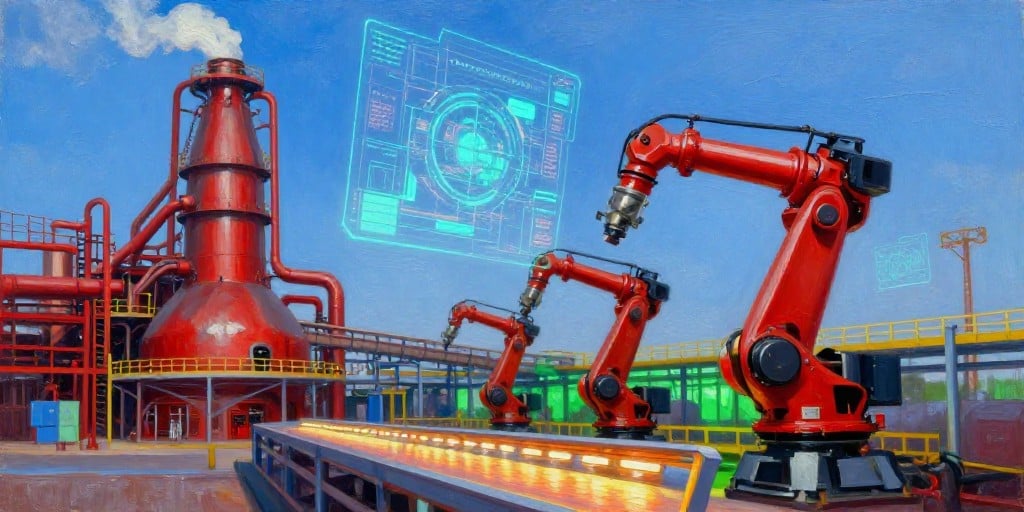
Robotic cell deployments in steel mills and semiconductor fabs now incorporate adaptive learning algorithms that reduce setup time by 20–30%. These systems rely on machine vision and edge computing to identify defects during the fabrication process, allowing immediate corrective action without halting downstream operations.
2.2 Digital Twins and Simulation
Large‑scale digital twins of production facilities enable predictive scenario planning. By simulating various load and maintenance scenarios, plant operators can preemptively adjust operating parameters, leading to a 3–5% reduction in unplanned downtime. The integration of cloud‑based analytics provides a scalable platform for cross‑facility benchmarking.
2.3 Energy‑Efficient Processes
The adoption of solid‑oxide fuel cells and high‑efficiency heat exchangers has reduced the carbon intensity of chemical manufacturing by 12% in pilot projects. These technologies not only improve sustainability metrics but also lower energy costs—critical in an environment of rising utility tariffs.
3. Economic Drivers of Capital Expenditure
3.1 Inflation Dynamics
Recent softer inflation readings have moderated the expectation of aggressive Federal Reserve tightening. With consumer‑price indices showing a year‑over‑year decline of 0.6%, many firms are reallocating capital from speculative growth to tangible productivity enhancements. Lower interest rates continue to make financing large‑scale projects more attractive, as the discounted cash‑flow (DCF) models show improved net present values (NPVs) for CAPEX initiatives.
3.2 Supply‑Chain Resilience
The pandemic exposed vulnerabilities in global supply chains, prompting firms to invest in localized manufacturing and redundant sourcing networks. Strategic partnerships with regional suppliers have become a key component of risk mitigation strategies. Additionally, the adoption of blockchain‑enabled traceability ensures compliance with emerging regulatory standards on material provenance.
3.3 Regulatory Landscape
New environmental regulations, such as the EU’s Carbon Border Adjustment Mechanism (CBAM), are forcing manufacturers to re‑evaluate the carbon footprint of their supply chains. Capital projects that incorporate carbon‑capture technologies and renewable energy sourcing are now gaining regulatory favor, often qualifying for tax incentives and green bonds.
4. Infrastructure Spending and Market Impact
The federal infrastructure package, earmarking $1.2 trillion for transportation, utilities, and broadband, is injecting significant capital into the industrial base. This influx of funds is accelerating the deployment of smart grid infrastructure and high‑speed rail projects, creating demand for advanced materials, precision components, and automation equipment.
Market analysts predict that the cumulative effect of these investments will:
- Increase the demand for high‑precision tooling by 8–10% over the next five years.
- Boost the utilization rate of heavy‑machinery fleets from 65% to 75% in the manufacturing sector.
- Drive up the valuation multiples of companies with robust capital investment pipelines.
5. Conclusion
Amazon’s share price performance, buoyed by a supportive macro‑environment and robust earnings momentum, reflects a broader shift toward capital‑intensive, productivity‑driven strategies in the technology and industrial sectors. Firms that adopt advanced manufacturing technologies—automation, digital twins, energy efficiency—are positioning themselves to capitalize on favorable economic conditions, supply‑chain resilience imperatives, and regulatory incentives. The convergence of these factors signals a sustained trajectory of capital investment, driving innovation and value creation across heavy industry and infrastructure markets.