Consumer Discretionary Trends in the Context of Amazon’s Shifting Retail Landscape
Amazon.com Inc. is currently navigating a complex retail environment that underscores the evolving relationship between online and physical shopping. Recent data indicate a resurgence of in‑store foot traffic during the holiday season, a trend that is reshaping competitive dynamics and creating both opportunities and challenges for Amazon.
1. Demographic Drivers of Experiential Shopping
The renewed focus on physical retail is largely attributable to shifting consumer demographics. Millennials and Generation Z—now the dominant age cohort for discretionary spending—continue to prioritize experiential over transactional value. According to a 2024 Nielsen survey, 68 % of respondents in these cohorts report that the sensory experience of a store influences their purchase decisions more than price or convenience alone. In contrast, Baby Boomers and older Gen X consumers, who constitute a smaller share of discretionary spend, still lean heavily toward online channels for cost‑efficiency and safety.
This generational split explains the recent uptick in holiday foot traffic: the younger demographic is attracted by immersive in‑store events, pop‑up collaborations, and exclusive in‑store product launches that cannot be replicated online. The resulting demand for “live” experiences has led traditional retailers to expand omnichannel capabilities and has prompted property developers to redesign retail spaces with integrated digital touchpoints.
2. Economic Conditions and Consumer Spending Patterns
The United States economy is currently experiencing modest inflationary pressure and a tightening credit environment. Consumer spending surveys from the U.S. Bureau of Economic Analysis show that discretionary spend on apparel, electronics, and leisure services has increased by 3.2 % YoY, while online‑only spend has plateaued at 4.7 % YoY. In this climate, consumers appear to be willing to pay a premium for convenience and immediacy offered by physical stores, particularly during peak holiday periods.
Financial constraints have also spurred a “shoppable” economy, in which consumers combine online research with in‑store purchases. For instance, a consumer might use Amazon’s app to compare prices and read reviews, then visit a local retailer for a tactile assessment before completing the transaction. This hybrid behavior reinforces the relevance of a robust brick‑and‑mortar presence.
3. Brand Performance and Retail Innovation
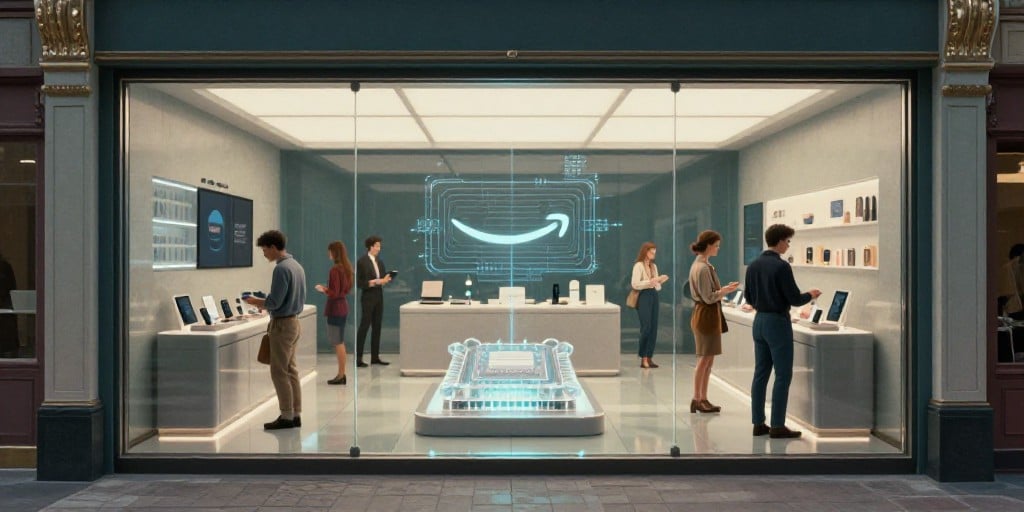
Amazon’s brand performance during the holiday season remains resilient, yet the company faces mounting pressure to innovate beyond its digital dominance. Traditional retailers are capitalizing on experiential retail by offering curated in‑store events—think “virtual try‑on” kiosks powered by augmented reality—while Amazon has experimented with its Amazon Hub stores and Amazon Fresh pickup points to bridge the gap between online convenience and physical accessibility.
Retailers that have embraced omnichannel strategies report a 12 % increase in conversion rates for customers who engage both online and offline. In contrast, purely e‑commerce brands have seen a 5 % decline in share of voice during the same period, indicating that an integrated experience is becoming a prerequisite for capturing holiday spend.
4. Consumer Sentiment and Market Research Indicators
Consumer sentiment toward Amazon’s retail offering shows subtle shifts. A 2024 Pew Research Center poll found that 57 % of respondents are neutral or slightly positive about Amazon’s in‑store initiatives, compared to 65 % who view the company favorably in its online context. Meanwhile, the Consumer Confidence Index for Q4 2024 dipped by 0.4 % from the previous quarter, suggesting cautious optimism about discretionary spending.
In the technology arena, Amazon’s Trainium chip remains a steady performer. Forecasts from Gartner predict shipment volumes of 1.8 million units for 2027 and 2.2 million units for 2028, with no significant volatility. The chip’s low manufacturing cost—approximately 15 % below the industry average—and Amazon’s ownership of data‑center infrastructure provide a competitive moat against external suppliers such as Nvidia, AMD, and Google TPU.
Conversely, the semiconductor sector is experiencing a contraction in capital spending. SemiAnalysis reports that AI accelerator expenditures have been reduced by 8 % for 2025–2027, primarily due to tighter financing conditions and a deceleration in data‑center expansion. Nvidia, a leading GPU manufacturer, is projected to face a 12 % decline in demand, whereas Amazon’s Trainium appears insulated by its entrenched customer base and ability to subsidize large‑scale deployments for strategic clients.
5. Market Sentiment and Share Price Dynamics
Amazon’s market sentiment has shown modest weakness, reflected in a recent decline of 1.4 % in its share price during the latest trading session. This dip aligns with broader volatility across technology stocks, where large‑cap names such as Meta and Microsoft experienced mixed performance. Despite this, Amazon’s core cloud and AI businesses continue to underpin investor confidence, with its data‑center strategy and proprietary chip development positioning the company to navigate the shifting competitive environment.
6. Synthesis and Outlook
The convergence of demographic preferences, economic constraints, and cultural shifts is driving a renaissance of physical retail experiences. Amazon’s challenge lies in scaling its in‑store innovations to match the experiential expectations of younger consumers while maintaining the efficiency that has made its online platform dominant. Simultaneously, the company’s Trainium chip provides a strategic advantage in the AI infrastructure market, offering a hedge against broader semiconductor downturns.
Retailers and developers that successfully integrate digital touchpoints with curated in‑store experiences are likely to capture a growing share of discretionary spend. For Amazon, the path forward involves deepening its omnichannel footprint, leveraging its data‑center assets, and sustaining its technological edge through continuous innovation in both hardware and retail experience design.