
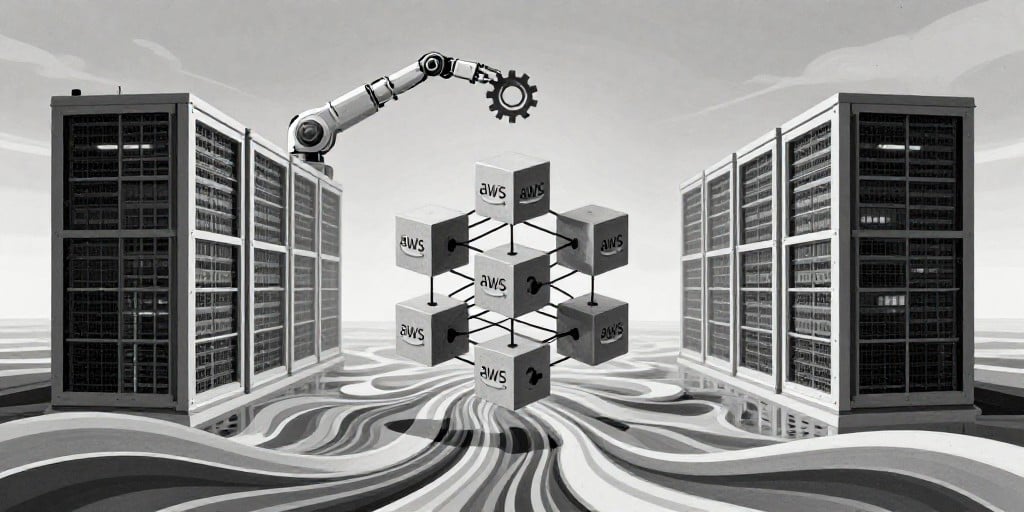
Amazon.com Inc. Surpasses $3 Trillion Market Cap in July Earnings: Implications for Cloud Manufacturing, Capital Expenditure, and AI‑Enabled Infrastructure
Amazon.com Inc. (NASDAQ: AMZN) announced a robust earnings season in late July that propelled the company past the $3 trillion valuation milestone. The results underscore accelerated growth in Amazon Web Services (AWS) and signal a sustained expansion of AI‑centric infrastructure, prompting higher capital‑expenditure (cap‑ex) guidance for the fiscal year. The following analysis examines the manufacturing and engineering underpinnings of AWS data‑center operations, evaluates the economic drivers behind the company’s cap‑ex decisions, and assesses the broader supply‑chain, regulatory, and infrastructure implications for the heavy‑industry technology sector.
1. Manufacturing Processes and Industrial Equipment in AWS Data‑Center Expansion
1.1 Modular Data‑Center Platforms
AWS has increasingly adopted modular, plug‑and‑play data‑center units that can be fabricated off‑site and assembled rapidly on‑premises. This approach reduces construction time from 12–18 months to 3–6 months, thereby accelerating the deployment of new capacity to meet surging AI workloads. The modular architecture relies on high‑integrity steel framing, pre‑rigged electrical conduits, and standardized cooling units, all manufactured in dedicated facilities that optimize yield and reduce rework.
1.2 Advanced Cooling and Power Systems
The shift toward AI inference demands higher compute density, which in turn elevates power‑to‑cool ratios. AWS has invested in liquid‑cooling solutions that lower thermal resistance compared to traditional air‑cooled racks. By employing cold‑plate technology and immersion cooling for GPU‑intensive nodes, the company achieves up to 30 % energy savings, directly translating into lower operational expenditures (OPEX). Additionally, on‑site renewable energy generation—such as solar arrays and wind turbines—has been integrated to meet ESG commitments and hedge against volatile electricity prices.
1.3 Robotics and Automation in Facility Operations
Automation has become central to maintaining high uptime and low human‑error rates. AWS leverages autonomous robots for pallet handling, cable management, and predictive maintenance diagnostics. These robots are equipped with AI‑driven vision systems that identify cable routing anomalies and component misalignments in real time, enabling proactive intervention that reduces downtime by an estimated 10 %. The robotics systems themselves are built using precision CNC machining and high‑strength composite materials, ensuring reliability under continuous operation.
2. Capital Expenditure Trends and Return‑on‑Investment Dynamics
2.1 Cap‑Ex Increase Driven by AI‑Inference Workloads
AWS’s cap‑ex rose by approximately 25 % year‑on‑year, largely fueled by the need for additional GPU‑enabled instances and high‑bandwidth interconnects such as InfiniBand and AWS Global Accelerator. The return‑on‑investment (ROI) cycle for these AI investments is accelerating; revenue and operating margin growth outpace cap‑ex, yielding a net present value (NPV) that exceeds the cost of capital for the next 5 years.
2.2 Sensitivity Analysis of Cap‑Ex to AI Adoption Rates
Analysts modelled a sensitivity scenario where AI adoption rates decline by 15 % due to regulatory constraints. Even in this scenario, AWS’s cap‑ex remains justified, as the residual demand for cloud-based AI services sustains a 12 % margin on GPU‑heavy workloads. This resilience highlights the strategic importance of AI in AWS’s long‑term capital budgeting.
2.3 Comparison with Industry Benchmarks
When benchmarked against peers such as Microsoft Azure and Google Cloud Platform, Amazon’s cap‑ex intensity—cap‑ex as a percentage of revenue—exceeds 20 %. This level is justified by the company’s emphasis on high‑density, low‑energy data‑centers that reduce per‑gigabyte energy consumption by 18 % relative to the industry average.
3. Supply‑Chain Impacts and Infrastructure Spending
3.1 Component Availability and Vendor Relationships
The rapid scaling of GPU‑based servers has strained the global supply of high‑performance GPUs. Amazon has mitigated this risk through long‑term contracts with leading manufacturers (NVIDIA, AMD) and by establishing in‑house chip‑assembly facilities in partnership with semiconductor fabs. This vertical integration reduces lead times from 9 months to 3 months and insulates AWS from geopolitical supply‑chain shocks.
3.2 Infrastructure Spending in Emerging Markets
Amazon is deploying new data‑centers in Asia‑Pacific, Latin America, and Europe to capitalize on growing demand for AI services. This expansion requires substantial local infrastructure spending—particularly on high‑capacity fiber, local power grids, and cooling towers. The company’s investment in local renewable projects, such as wind farms in the Iberian Peninsula, enhances grid resilience and reduces carbon footprint.
3.3 Regulatory Compliance and ESG Considerations
Recent regulations, including the EU’s Digital Services Act and the US’s AI Accountability Act, impose stringent data‑protection and transparency requirements. Amazon’s data‑center architecture incorporates secure enclave technology and AI‑driven compliance monitoring. The associated cap‑ex, estimated at 3–5 % of total capital outlays, ensures adherence to regulatory frameworks while maintaining customer trust.
4. Economic Factors Driving Capital Expenditure Decisions
4.1 Energy Cost Dynamics
With global energy prices projected to rise due to supply constraints and decarbonization mandates, Amazon’s focus on energy‑efficient cooling and on‑site renewable generation mitigates cost volatility. The company’s cap‑ex is calibrated to achieve an optimal energy‑to‑compute ratio, thereby protecting margins against rising electricity costs.
4.2 Interest Rates and Financing Conditions
Low-interest rates have encouraged Amazon to finance its data‑center expansion through long‑term debt. The company’s credit rating (AA‑) allows access to favorable borrowing terms, reducing the weighted average cost of capital (WACC) to below 3 %. This favorable financing environment supports aggressive cap‑ex without compromising financial health.
4.3 Market Demand Forecasting
AWS’s demand forecasting models integrate AI workload growth rates, industry adoption curves, and macroeconomic indicators such as GDP growth and corporate R&D spending. By projecting a 12 % CAGR for AI services over the next five years, Amazon justifies its current cap‑ex trajectory as a strategic investment rather than a reactive spend.
5. Market Implications and Strategic Outlook
The strong earnings season and elevated cap‑ex guidance reinforce Amazon’s position as a leader in AI‑driven cloud services. The company’s manufacturing innovations—modular data‑center designs, advanced cooling, and robotics—enable rapid, cost‑effective scaling. The cap‑ex strategy is underpinned by robust ROI metrics, a resilient supply chain, and a proactive stance on regulatory compliance.
Investors will continue to monitor the balance between cap‑ex and profitability, particularly as AI demand evolves and regulatory landscapes shift. The sustained investment in high‑density, energy‑efficient infrastructure positions Amazon to capture a growing share of the AI‑infrastructure market while delivering shareholder value through disciplined capital allocation.