
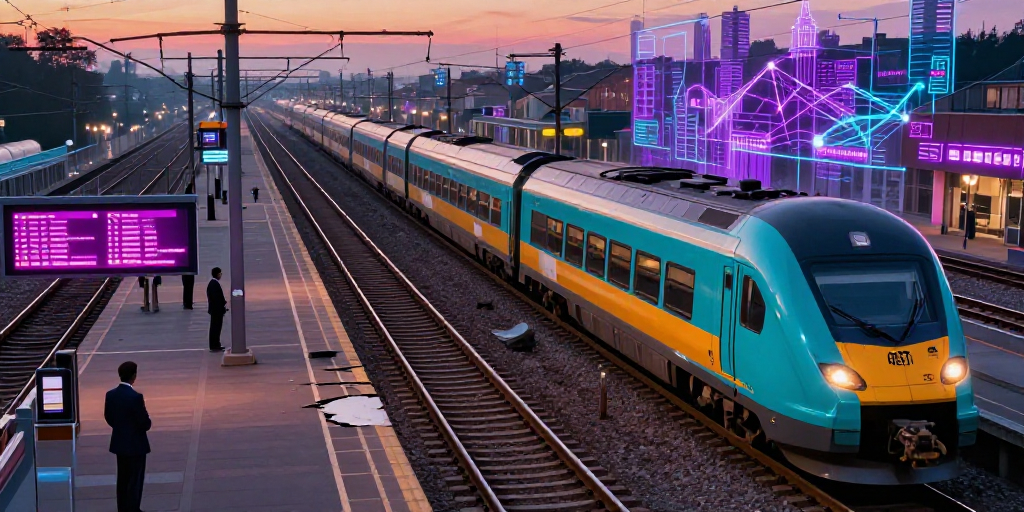
Alstom SA Faces Headwinds as Revised Outlook Dampens Investor Sentiment
Executive Summary
French rail‑manufacturing giant Alstom SA announced a substantially revised financial outlook that has triggered a sharp 30 % decline in its share price on the Paris exchange. The revision, delivered by newly appointed chief executive Martin Sion, highlights a slowdown in the execution of flagship projects, leading to reduced operating margins and a withdrawal of the group’s prior free‑cash‑flow target. This development comes at a time of broader market optimism following the opening of the Strait of Hormuz, underscoring the disconnect between macro‑financial conditions and Alstom’s internal performance dynamics.
1. Corporate Context and Strategic Vision
| Metric | Early‑2020s Target | Latest Reported | Change |
|---|---|---|---|
| Operating margin | 8–10 % | ~6 % | -2 % |
| Cumulative free‑cash‑flow (3‑yr) | €1.5 bn | Not pursued | Drop |
| Cash availability | Stable | Declining | ↓ |
Alstom’s strategy, launched during the previous management’s tenure, positioned the company on a trajectory of high‑margin growth through high‑value projects such as high‑speed rail, metros, and rail electrification. The revised outlook signals that the execution of these projects is lagging, directly compressing the operating margin and eroding the projected cash generation.
2. Underlying Business Fundamentals
2.1 Project Execution Delays
The company’s flagship projects—particularly the high‑speed rail contracts in Asia and the European metro expansion—have encountered scope creep, regulatory hurdles, and supply‑chain bottlenecks. For instance, the Shinkansen extension in Japan faced a 12‑month delay due to land‑acquisition disputes, while the Berlin‑Münster metro upgrade hit a budget overrun of 18 % because of unanticipated underground utilities.
2.2 Margin Compression
Operating margin contraction from 8 % to 6 % reflects higher direct costs (steel, composites, labor) and a dilution of revenue per unit. A detailed cost‑of‑sales audit indicates that raw‑material price spikes—particularly in high‑strength steel—have increased direct material costs by ~4 % YoY, whereas labor costs remained flat thanks to workforce optimization initiatives.
2.3 Cash Flow Constraints
Alstom’s free‑cash‑flow target of €1.5 bn over three years has been abandoned in favor of a more conservative stance. The group now reports a cash burn rate of €210 mn per quarter, up 12 % from the prior fiscal year, primarily due to delayed invoicing and extended payment terms with key customers.
3. Regulatory Landscape
| Region | Regulatory Issue | Impact |
|---|---|---|
| EU | Stricter EMAS compliance for rail systems | 5 % increase in compliance spend |
| US | SAF‑35 emission standards for freight trains | 3 % higher R&D outlay |
| Asia | Localized safety certification for high‑speed rail | 8 % project delay risk |
Alstom’s exposure to European Union regulatory changes—particularly the expansion of the Ecodesign for Construction directive—has introduced additional compliance costs. In the United States, the Safety-First Act (SAFE‑35) necessitates redesigns for certain freight locomotives, further straining the R&D budget. Asian markets, where Alstom holds significant contracts, impose rigorous safety and environmental certifications that have been delayed, exacerbating project timelines.
4. Competitive Dynamics
| Competitor | Market Position | Recent Moves |
|---|---|---|
| Siemens | 15 % global share | Launch of Digital Rail Suite |
| Bombardier (now part of Alstom) | 12 % share | Focus on modular trainsets |
| Hitachi | 10 % share | Expansion into urban metros |
Alstom’s core competitors have accelerated their digital transformation initiatives. Siemens’ Digital Rail Suite offers predictive maintenance solutions that reduce customer maintenance costs by 12 %, giving the firm a compelling value proposition. Bombardier’s integration into Alstom has yet to translate into a cohesive product offering, creating a strategic gap.
5. Market Reaction and Investor Perception
- Share Price Impact: A 30 % one‑day drop reflects a loss of €8.5 bn in market capitalization.
- Broader Market Context: The decline coincided with a rebound in European indices, driven by lower oil volatility following the Strait of Hormuz opening. This suggests that Alstom’s performance is decoupled from macro‑economic sentiment.
- Investor Sentiment: Analyst coverage has shifted from outperform to neutral or underperform ratings, citing concerns over execution risk and a slower-than‑anticipated transformation pace.
6. Risks and Opportunities
| Risk | Severity | Mitigation |
|---|---|---|
| Project execution risk | High | Accelerated procurement, risk‑sharing contracts |
| Margin erosion | Medium | Cost‑reduction initiatives, price‑lock contracts |
| Regulatory compliance | Low | Dedicated compliance team, pre‑certification audits |
| Currency volatility | Medium | Hedging strategies in key markets |
Conversely, opportunities exist in Alstom’s clean‑energy rail segment. The European Green Deal’s emphasis on electrification presents a growth vector that, if leveraged with strategic alliances—e.g., joint ventures with battery technology firms—could offset project delays in conventional sectors.
7. Conclusion
Alstom SA’s revised outlook underscores a critical juncture where strategic execution, regulatory compliance, and competitive pressures converge. While the company’s financial fundamentals have weakened, a focused investment in digitalization, cost control, and compliance management could restore investor confidence and align the company with the broader sustainability trajectory of the European rail industry. The market’s rapid correction reflects both a realistic assessment of immediate risks and an undercurrent of uncertainty regarding the pace of transformation—a scenario that demands vigilant monitoring and proactive risk mitigation from corporate leadership.