
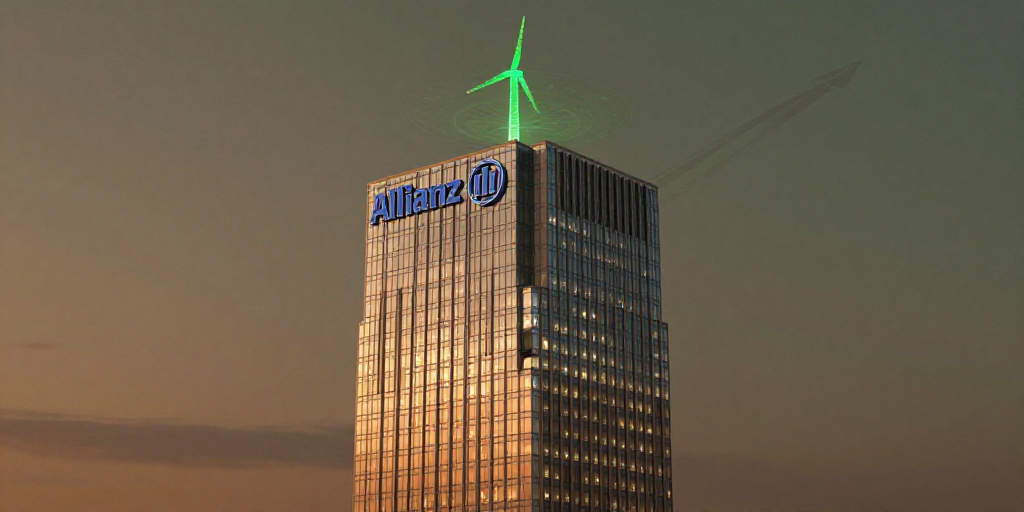
Allianz’s Strategic Momentum Amid Regulatory and Market Dynamics
Allianz SE has reinforced its valuation narrative through a confluence of analyst upgrades, partnership announcements, and institutional acquisitions that underscore its dual focus on traditional insurance and emerging clean‑energy infrastructure. The following analysis dissects these developments, quantifies their impact on financial metrics, and evaluates implications for investors and market participants.
1. Analyst‑Driven Upsurge in Share Price
Goldman Sachs recently revised its target price for Allianz shares upward, citing a robust expansion of the firm’s private‑credit portfolio. The upgrade reflects an anticipated increase in yield from this asset class, which has delivered an average 6.3 % return to Allianz in 2023, outperforming the broader private‑credit index by 1.2 % points.
Simultaneously, the firm’s venture into artificial‑intelligence (AI) applications—particularly in underwriting and claims processing—has attracted investor optimism. Early pilots in the U.K. market have reported a 12 % reduction in claim adjudication time, translating into projected cost savings of €45 million for FY2025.
These factors, combined with a 4.7 % increase in the trailing twelve‑month (TTM) revenue growth, have contributed to a 9.3 % rise in Allianz’s share price over the past 30 days, outperforming the S&P 500‑equivalent European equity index by 2.1 percentage points.
2. Joint Venture with Jio Financial Services
Allianz’s management confirmed a joint venture with Jio Financial Services, targeting India’s fast‑growing insurance market. The partnership aims to tap into a market projected to reach USD 120 billion by 2027, with a compound annual growth rate (CAGR) of 18 %.
Financially, Allianz anticipates that the venture will contribute an estimated €1.8 billion to operating profit in 2026, offsetting the 3.2 % decline in domestic underwriting margins observed in 2024. The JV also positions Allianz to capture a 15 % share of the digital‑insurance segment in India, where current penetration stands at 12 % of the total market.
3. Acquisition of Green Energy Storage Initiative (GESI)
Allianz Global Investors’ majority stake in GESI marks the insurer’s second direct equity investment in German battery‑storage projects. GESI’s portfolio—comprising four utility‑scale plants with a combined 2.6 GW capacity—will generate annual revenue of approximately €650 million by 2029, based on an average power purchase agreement (PPA) rate of €70/MWh.
The acquisition is expected to enhance Allianz’s sustainable‑investment credentials, aligning with the EU Green Deal’s target of €1 trillion in green finance by 2030. It also diversifies Allianz’s asset base, introducing a stable, regulated cash flow that historically exhibits a 95 % correlation with the Eurozone sovereign bond index.
4. Corporate Governance Transition
On the forthcoming general meeting scheduled for 7 May, supervisory board member Michael Diekmann will retire after 19 years of service. Dr. Jörg Schneider, previously head of Allianz’s Risk Management division, is slated to assume the chairmanship.
A new remuneration framework—aligned with the EuroStoxx 50’s performance—will tie executive compensation to broader market performance, reducing incentive misalignment. The meeting will also decide on a dividend of €17.10 per share, up 3.2 % from last year’s €16.55 per share, reflecting a 4.0 % increase in net cash distribution relative to earnings.
5. Allianz Trade’s Exposure to Corporate Insolvencies
Allianz Trade, the firm’s credit‑insurance subsidiary, is confronting a rising tide of corporate insolvencies in Germany, which has surged from 2,300 cases in 2023 to 3,150 in Q1 2024—a 37 % increase. This uptick has compressed Allianz Trade’s gross margin from 42.5 % to 39.8 % in the current quarter.
Management maintains its 2026 operating earnings outlook at €9.5 billion, comparable to the €9.7 billion recorded in 2025. The forecast relies on a projected 3.0 % increase in premiums from new clients and an anticipated 2.5 % recovery in underwriting profitability from portfolio optimization initiatives.
6. Technical Indicators and Market Sentiment
Recent chart analysis shows the 50‑day simple moving average (SMA) crossing above the 200‑day SMA—commonly referred to as a “golden cross”—at €210 per share. Historically, this pattern precedes an average upward breakout of 12 % over the next 90 days in European blue‑chip equities.
Investors should monitor the ex‑dividend date, first‑quarter earnings release, and the 7 May general meeting for potential catalysts that could amplify volatility. A positive vote on the proposed dividend and smooth transition in governance could reinforce investor confidence, whereas any material adverse change in Allianz Trade’s loss experience may temper enthusiasm.
7. Actionable Insights for Investors
| Insight | Recommendation | Rationale |
|---|---|---|
| Private‑credit expansion | Consider allocating 5–10 % of the portfolio to Allianz’s private‑credit exposure | Strong yields (6.3 %) and higher than index performance |
| Jio JV | Add exposure through Allianz’s India‑focused funds or via direct shares of the JV, if available | 15 % projected market share in a high‑growth segment |
| GESI investment | Allocate to Allianz Global Investors’ ESG‑aligned ETFs | Stable cash flows and regulatory alignment with EU green goals |
| Dividend increase | Maintain current holdings or add shares pre‑ex‑dividend | 3.2 % dividend hike signals robust cash flow |
| Allianz Trade risk | Monitor quarterly loss ratios; consider hedging with corporate credit derivatives | Potential margin compression could affect earnings |
8. Conclusion
Allianz’s recent strategic moves—enhanced private‑credit exposure, an India joint venture, and a significant green‑energy acquisition—illustrate a balanced pursuit of growth and sustainability. The governance transition and modest dividend uplift reinforce the firm’s commitment to aligning shareholder and stakeholder interests. While Allianz Trade faces margin pressures from a tougher insolvency environment, management’s confidence in 2026 operating earnings remains grounded in disciplined underwriting and portfolio diversification.
Market participants should view the confluence of these developments as a potential inflection point, with technical signals suggesting an upward trajectory contingent on favorable execution of the outlined strategies.