
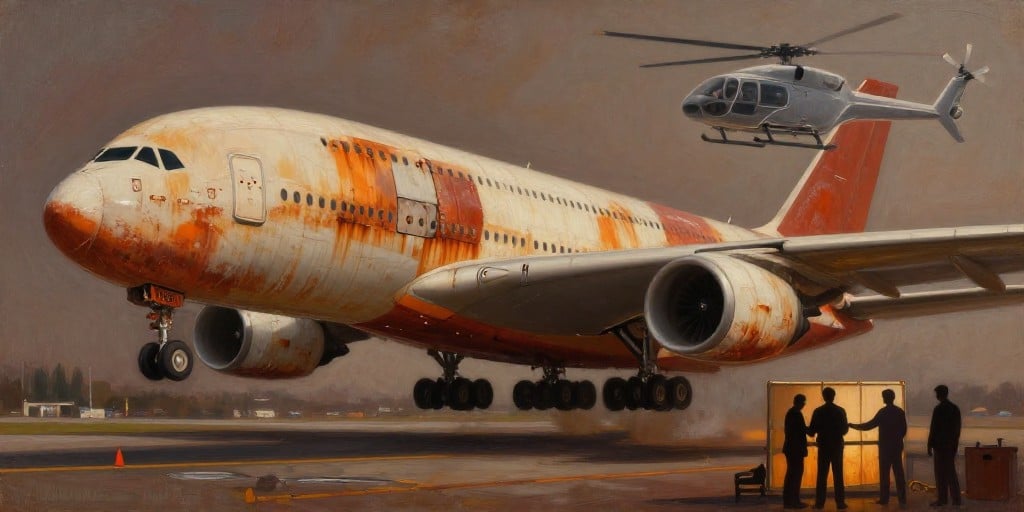
Regulatory Scrutiny and the Legacy A380 Fleet
Airbus SE’s recent announcement that the European Aviation Safety Agency (EASA) has discovered cracks in the wings of the A380 underscores a persistent vulnerability in one of the company’s most iconic aircraft. The directive mandates that sixteen aircraft – fifteen operated by Emirates and one by Qantas – undergo immediate inspections. Five of these planes must be examined before their next scheduled flight; the remaining eleven will be inspected after a specified number of flight cycles.
Business Fundamentals
The A380 was conceived as a high‑capacity solution for congested hubs. Production ceased in 2021 after a dramatic drop in orders, leaving a fleet of roughly 200 aircraft. Despite the lack of new units, airlines continue to rely on the A380 for long‑haul operations, and any maintenance directive has a direct impact on operating costs and revenue management.
The mandatory inspection raises several financial considerations:
| Metric | Current Impact | Projected Impact |
|---|---|---|
| Direct inspection cost | €10‑12 million (estimated per aircraft) | €160‑190 million total |
| Grounding period | 2–4 weeks per aircraft | Reduced throughput, potential revenue loss |
| Insurance premiums | Likely increase | Long‑term cost escalation |
Assuming each inspected aircraft incurs an average cost of €11 million and a grounding period of three weeks, the cumulative direct cost already approaches €170 million. In addition, airlines may face indirect losses from schedule disruptions, customer dissatisfaction, and potential renegotiation of slot allocations at congested airports.
Regulatory Environment
EASA’s directive is a classic example of proactive safety oversight. While the agency has not yet issued a grounding directive for the entire A380 fleet, the cracks found in a high‑profile aircraft suggest that other operators may face similar mandates if the issue is systemic. The regulatory risk is amplified by the fact that the A380’s design is approaching 30 years of service life, and many of its critical components are aging beyond original warranty periods.
From a compliance standpoint, Airbus must:
- Provide detailed root‑cause analysis to justify the need for further inspections.
- Offer remedial action plans that meet EASA’s safety margins.
- Coordinate with airlines to minimize operational disruption while maintaining safety.
The agency’s stringent timelines – inspections within days for some aircraft – may pressure Airbus to expedite its internal investigations, potentially affecting the company’s broader product support commitments.
Competitive Dynamics
The A380’s retirement has opened the market for large‑capacity alternatives such as the Boeing 777‑8, the Airbus A350‑1000, and the emerging 787‑10. Emirates and Qantas already operate a diversified fleet, but the A380 remains a critical part of their network strategy. An extended grounding period could shift customer preferences toward more fuel‑efficient models, accelerating fleet renewal.
Airbus’s focus on the A350 and A220 families – as evidenced by its partnership with 3M for cabin insulation – suggests a strategic pivot to lighter, more efficient airframes. Nonetheless, the A380’s safety issues may erode confidence in Airbus’s legacy product line and potentially impact the brand’s perceived reliability among other legacy aircraft operators.
Emerging Innovation in the Helicopter Segment
Airbus Helicopters’ unveiling of an unmanned helicopter prototype at Berlin’s ILA airshow signals a deliberate entry into the growing autonomous rotorcraft market. The prototype is intended for series production over the next decade, with a specific version already in development for the U.S. Marine Corps and a separate European variant.
Market Opportunity
Unmanned aerial systems (UAS) for military and commercial applications are projected to grow at a CAGR of 14% from 2024 to 2030, driven by:
- Logistics and supply chain automation in conflict zones.
- Search and rescue operations over remote or hazardous environments.
- Infrastructure inspection (bridges, pipelines, wind farms).
Airbus Helicopters’ positioning allows it to capitalize on a niche that blends proven rotorcraft expertise with emerging autonomy technology. By targeting defense contracts, the company can secure a stable revenue stream while gradually transitioning to commercial UAS markets.
Competitive Threats
Key competitors include Bell Helicopter, Leonardo, and Sikorsky, all of whom have begun developing autonomous platforms. Airbus’s advantage lies in its established manufacturing network and existing military partnerships, but it must overcome potential regulatory hurdles around flight autonomy and data security.
Strategic Partnership with 3M on the A220
Airbus’s long‑term supply agreement with 3M for advanced thermal and acoustic insulation on the A220 cabin reflects a broader strategy to incorporate high‑performance materials into its newer airframes. By improving cabin noise and thermal efficiency, Airbus addresses passenger comfort concerns that have become increasingly critical in a post‑pandemic aviation environment.
Technical Benefits
- Reduced cabin noise by up to 2 dB, enhancing passenger satisfaction.
- Improved thermal efficiency, contributing to lower fuel burn and reduced CO₂ emissions.
- Weight savings through composite insulation materials, positively impacting range and payload.
Financial Impact
The agreement positions Airbus to:
- Differentiate its product line in a crowded market where airlines prioritize operational cost savings.
- Secure a long‑term revenue stream from 3M, mitigating raw material cost volatility.
- Strengthen its supplier network, aligning with Airbus’s “Strategic Partnerships” initiative.
Overlooked Risks and Opportunities
| Risk | Opportunity |
|---|---|
| A380 maintenance backlog may erode confidence in Airbus’s legacy support. | Autonomous helicopter market offers a new revenue stream with high margin potential. |
| Regulatory tightening could necessitate expensive retrofits or fleet retirements. | Material partnership could be leveraged across multiple Airbus families, generating cross‑sell potential. |
| Competitive displacement of A380 by newer models may force airlines to accelerate fleet renewal. | Extended product life cycle of A380 for niche markets (e.g., cargo, VIP) can create niche profitability. |
| Supply chain constraints for inspection parts may delay compliance. | Data analytics from maintenance can inform predictive maintenance programs for future models. |
Conclusion
Airbus SE is navigating a complex landscape where regulatory compliance for a legacy platform intersects with aggressive innovation in new product segments. The EASA directive on the A380 exposes potential systemic weaknesses that could reverberate across the operator base, raising significant financial and reputational stakes. Simultaneously, Airbus is strategically investing in unmanned rotorcraft and material science partnerships to future‑proof its portfolio.
Stakeholders must monitor how Airbus balances the immediate costs of the A380 inspections against its long‑term growth plans in the A350, A220, and emerging unmanned helicopter markets. A proactive approach to risk mitigation, coupled with a clear communication strategy around safety and innovation, will be essential for maintaining investor confidence and preserving market leadership in the rapidly evolving aerospace sector.