
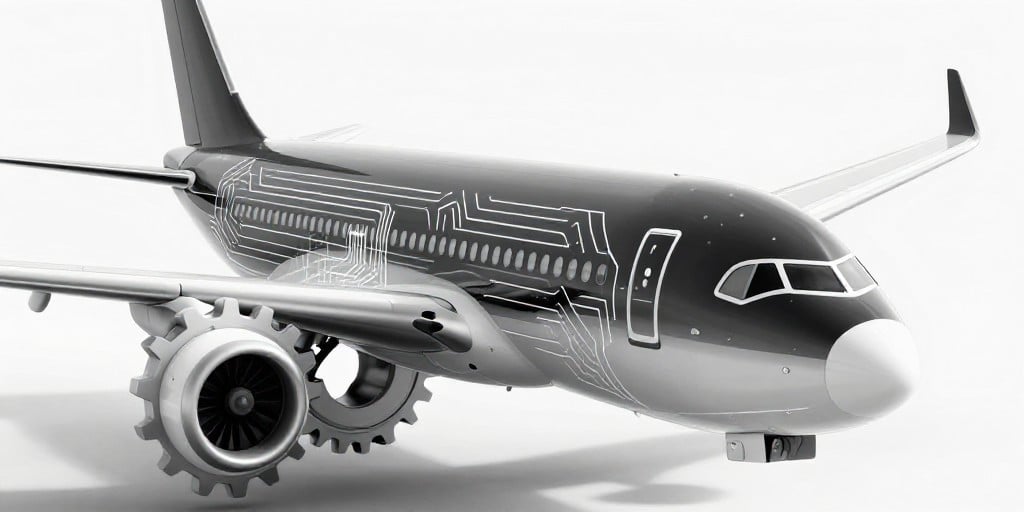
Corporate News – Airbus SE and the Strategic Integration of Artificial Intelligence in Aerospace Manufacturing
Airbus SE’s share price remained broadly stable during the latest trading session, with a modest uptick recorded in the XETRA market. The European aerospace manufacturer’s collaboration with French artificial‑intelligence firm Mistral AI has been highlighted in several reports, underscoring the company’s strategy to integrate advanced AI tools into aircraft design, documentation, and testing processes across its civil, military and space‑flight divisions. Analysts note that the partnership is intended to streamline complex workflows and support engineering teams throughout development and certification phases.
1. Technical Implications for Manufacturing Processes
| Area | Traditional Approach | AI‑Augmented Approach | Expected Productivity Impact |
|---|---|---|---|
| Computer‑Aided Design (CAD) | Manual parameter tuning, iterative simulation runs | Generative design algorithms, rapid multi‑objective optimization | 15–20 % reduction in design cycle time |
| Structural Analysis | Finite‑element analysis (FEA) with fixed load cases | Data‑driven surrogate models accelerating convergence | 10 % increase in analysis throughput |
| Supply‑Chain Planning | Rule‑based scheduling, deterministic lead times | Predictive analytics for demand variability, dynamic routing | 12–18 % improvement in on‑time delivery |
| Quality Assurance | Manual inspection, statistical sampling | Computer‑vision‑enabled defect detection, real‑time monitoring | 8–12 % reduction in defect rates |
The integration of Mistral AI’s models promises to reduce the time spent on iterative design and validation cycles, enabling Airbus to bring new aircraft variants to market more rapidly. By embedding AI across the engineering stack—from concept generation to flight‑worthiness certification—Airbus can anticipate a cumulative productivity lift of 10–15 % over the next five years.
2. Capital Expenditure Trends in Heavy Industry
The aerospace sector is entering a phase of high‑capability, high‑capex investment. Key drivers include:
| Driver | Impact on CapEx | Market Implication |
|---|---|---|
| Regulatory Evolution | Stricter emission and safety standards require new tooling | Increased spend on eco‑friendly engines, lightweight composites |
| Digital Twin Adoption | Investment in high‑performance computing clusters | Shift from physical prototyping to virtual validation |
| Resilience Post‑Pandemic | Redesign of supply chains for flexibility | Capital outlays for regionalized manufacturing hubs |
| Infrastructure Modernization | Upgrading run‑ways, logistics corridors | Long‑term revenue generation through improved throughput |
Airbus’s AI partnership aligns with these trends, as digital twins and predictive analytics form the backbone of modern aircraft production. By leveraging AI to optimize tooling and process parameters, the company positions itself to manage capital costs more effectively while sustaining high throughput levels.
3. Economic Factors Shaping Capital Expenditure Decisions
Eurozone Interest Rates: With European Central Bank policy keeping rates low, borrowing costs remain attractive for large capital projects. Airbus can capitalize on favorable debt terms to finance AI‑driven plant upgrades.
Inflationary Pressures: Material cost volatility prompts a shift toward process efficiencies. AI‑guided process control helps mitigate material waste, buffering against price spikes.
Government Incentives: European Union initiatives, such as Horizon Europe and the Digital Europe Programme, provide subsidies for high‑tech R&D, potentially offsetting a portion of AI implementation costs.
Demand Forecasting: Post‑COVID recovery is uneven across regions. AI‑enhanced demand modeling allows Airbus to align production capacity with realistic market uptake, reducing over‑investment risk.
4. Supply‑Chain and Regulatory Impacts
Supply‑Chain Resilience: AI models predict component failure probabilities and lead‑time disruptions, enabling proactive inventory management. This reduces the likelihood of production stalls due to single‑source dependencies.
Certification Efficiency: AI can automate the generation of compliance documentation for regulatory bodies (e.g., EASA, FAA). By streamlining the certification pipeline, Airbus shortens the time to market for new variants.
Environmental Regulations: AI‑driven optimization of aerodynamic surfaces and propulsion systems supports lower fuel burn and emissions, meeting tightening global environmental mandates.
5. Infrastructure Spending and Market Dynamics
The aerospace manufacturing landscape is heavily infrastructure‑dependent. AI integration can influence infrastructure investment decisions in several ways:
Plant Automation: Advanced robotics and AI‑controlled assembly lines require upgrades to electrical and network infrastructure. Investment in high‑bandwidth, low‑latency networks is critical for real‑time AI feedback loops.
Testing Facilities: AI can reduce the number of physical test flights needed by enhancing simulation fidelity. Consequently, the capital required for flight‑testing infrastructure can be reallocated toward production capacity.
Logistics and Distribution: Predictive AI optimizes shipping routes and dock utilization, influencing the need for new transport hubs or storage facilities.
6. Investor Sentiment and Market Performance
Despite modest declines in broader European indices (CAC 40, Euro STOXX 50, DAX), Airbus’s share price held near the upper end of its daily range, reflecting investor confidence in the AI partnership. The Mistral AI license announcement contributed to a slightly firmer market sentiment, with the company outperforming peers such as Rheinmetall, Infineon, and DHL Group.
Financial analysts emphasize the importance of monitoring the operational impact of AI on cost savings and productivity gains. Should the partnership deliver on its promise, Airbus could become a benchmark for AI integration in heavy industry, further attracting capital investment and potentially justifying higher valuation multiples.
7. Conclusion
Airbus SE’s collaboration with Mistral AI represents a strategic pivot toward data‑centric manufacturing. By embedding AI across design, analysis, and production workflows, the company is poised to achieve significant productivity improvements, reduce capital expenditures, and strengthen supply‑chain resilience. These developments are supported by favorable macroeconomic conditions, regulatory incentives, and a clear trend toward infrastructure modernization in aerospace manufacturing. As investors and industry analysts track the tangible benefits of this partnership, Airbus is likely to continue solidifying its position as a technological leader within the European equities market.