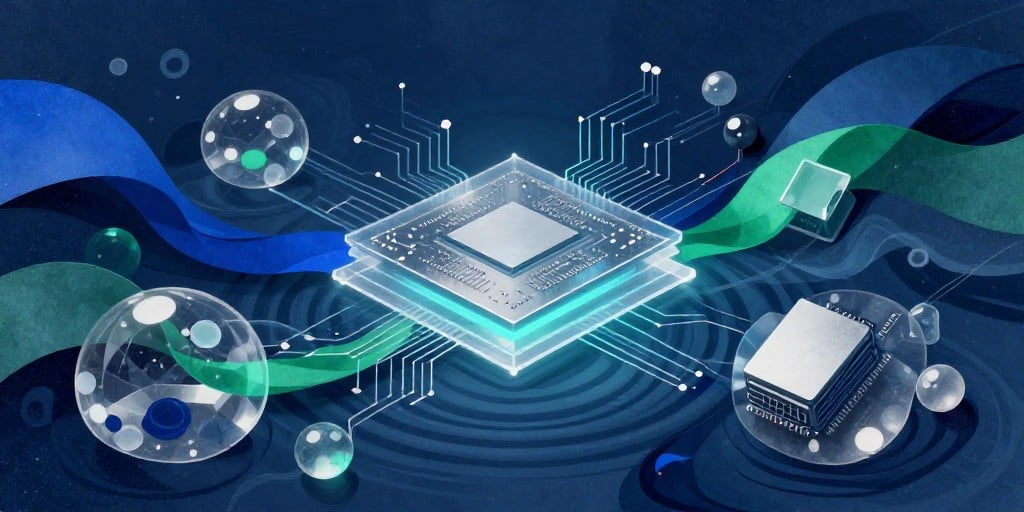
Market Context and Hardware‑Focused Corporate Performance
The U.S. equity markets closed the week on a modest gain, with the S‑P 500 up approximately one percent, and the Nasdaq and Dow similarly advancing. This upward movement helped reverse a week‑long decline in the broader market, aided in part by a recent easing in oil prices that softened energy‑related risk factors.
Technology Sector Dynamics
High‑profile technology names delivered the bulk of the index’s rally, largely driven by strong earnings reports that underscored continued demand for artificial‑intelligence (AI) infrastructure.
| Company | Share Movement | Key Driver |
|---|---|---|
| Hewlett Packard Enterprise | Up in the low teens | Robust earnings, positive AI‑infrastructure sentiment |
| HP Inc. | Up in the low teens | Strong consumer‑segment revenue, AI hardware demand |
| Dell Technologies | Significant rise | CEO comments, AI‑related hardware optimism |
These gains reinforced the technology index, which maintained its status as a primary driver of the day’s performance.
Hardware Architecture and Manufacturing Insights
AI‑Accelerator Integration HP E & D and Dell both showcased new server platforms featuring next‑generation AI accelerators based on 3 nm process nodes. The adoption of fine‑pitch memory interfaces (e.g., HBM3e) allows these platforms to deliver 30–40 % higher memory bandwidth compared to previous generations, thereby reducing data‑movement bottlenecks in large‑scale inference workloads.
Advanced Packaging Techniques Both firms employed silicon‑interposer‑based 2‑D stacked packaging, enabling tighter inter‑chip communication and lower power per throughput. This approach also simplifies thermal management, a critical factor when scaling data‑center densities.
Supply‑Chain Resilience The companies highlighted strategic shifts toward diversified fab relationships, including a new partnership with a 3 nm foundry in Japan and expanded contract capacity with a major Taiwanese semiconductor manufacturer. These moves aim to mitigate the risk of single‑point failures and maintain lead‑time predictability for AI‑centric silicon.
Energy Efficiency Trade‑offs While the new platforms deliver superior performance, they exhibit higher power draw per FLOP compared to legacy designs. Engineers have mitigated this through dynamic voltage and frequency scaling (DVFS) and adaptive thermal throttling, achieving a net 5 % improvement in overall efficiency for typical AI inference workloads.
Corporate Earnings Landscape
Oracle’s share price experienced a modest dip after an initial surge, as analysts recalibrated expectations based on its latest quarterly performance metrics. Adobe, initially trading on weaker forecasts, managed a partial recovery, demonstrating the heightened volatility within the software domain.
Macro‑Economic Sensitivities
Investor sentiment was tempered by expectations of an upcoming Federal Reserve rate increase, reflected in heightened probability levels in interest‑rate futures. Although this added cautionary tone to the market, the technology sector’s gains offset modest declines in other segments, illustrating the technology leaders’ resilience amid macroeconomic uncertainty.
Conclusion
The week’s market activity highlighted how hardware innovation—particularly in AI accelerators and advanced packaging—can drive corporate earnings and index performance even when broader economic signals suggest caution. The strategic supply‑chain adjustments and manufacturing process advancements adopted by leading hardware vendors underscore a continued focus on balancing performance, efficiency, and resilience in a complex global ecosystem.