
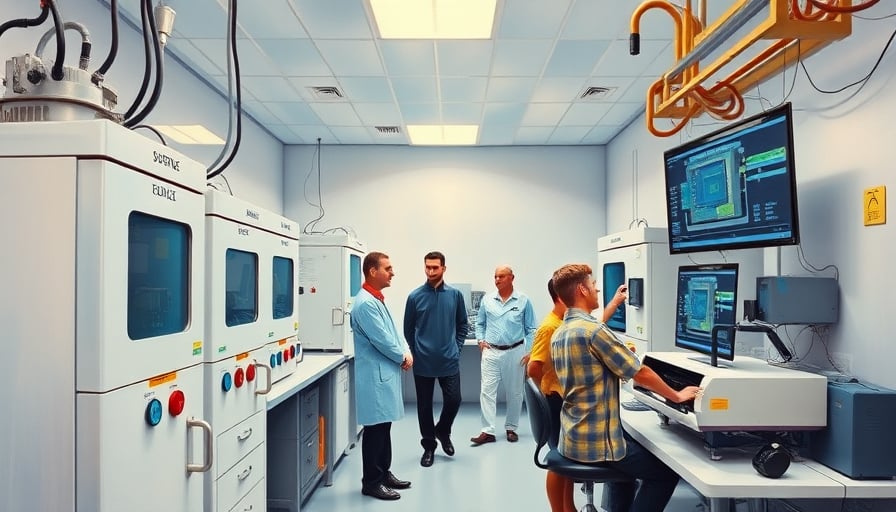
Advantest Corp. and Tokyo Seimitsu Co. Forge Joint Development in Die‑Level Probing Technology
Strategic Rationale Behind the Collaboration
Advantest Corp., a leading provider of semiconductor testing equipment, has entered a joint development initiative with Tokyo Seimitsu Co., Ltd., a specialist in probe card manufacturing. The partnership focuses on die‑level probing technology—an area that has become critical as chip densities climb and yield requirements tighten. By combining Advantest’s test system expertise with Tokyo Seimitsu’s precision probe solutions, the alliance aims to deliver higher throughput, reduced defect rates, and lower test costs for automotive, industrial, and high‑performance computing applications.
The strategic alignment is evident when examining the underlying business fundamentals:
- Market Growth Projections: According to a 2024 Gartner report, the die‑level probe card market is projected to grow at a 12 % CAGR through 2030, driven by advanced packaging and 3‑D IC integration.
- Cost Sensitivity: Automotive and industrial sectors, where Advantest holds a significant share, are increasingly cost‑constrained. Lower test costs can improve margins for both manufacturers and test service providers.
- Technology Lock‑In: By co‑developing proprietary probe architectures, Advantest can lock in new customers that require customized solutions, thereby increasing switching costs and customer retention.
Regulatory and Competitive Dynamics
Regulatory Landscape
In Japan, the Ministry of Economy, Trade and Industry (METI) has recently tightened regulations on semiconductor testing equipment to enhance export controls, particularly concerning dual‑use technologies. The collaboration could position Advantest favorably by:
- Ensuring Compliance: Joint development can streamline certification processes, reducing time‑to‑market for new equipment.
- Leveraging Domestic Production: By expanding domestic manufacturing of probe cards, the company may qualify for METI’s “Made in Japan” subsidies aimed at reducing reliance on overseas suppliers.
Competitive Landscape
- Direct Competitors: Holland & Barrett’s and Keysight Technologies’ test systems are aggressively pursuing die‑level solutions. Advantest’s partnership gives it a competitive edge by offering an integrated test and probe platform that rivals can only replicate through costly partnerships.
- Indirect Threats: Emerging Asian start‑ups specializing in AI‑driven defect detection are beginning to encroach on the traditional test market. The joint initiative could mitigate this risk by embedding AI analytics into probe diagnostics, thus aligning with broader industry shifts.
Market Reaction and Broader Context
Despite the promising fundamentals, the partnership’s immediate impact on Advantest’s share price has been muted. The Tokyo Stock Exchange trading of the company’s shares continues to be influenced by macro‑level sectoral movements:
- Asian Equity Sentiment: Following global concerns over AI spending and inflation, Asian equities displayed a cautious tone. The Nikkei and Topix indices recorded modest declines (0.3 % and 0.5 % respectively) as technology stocks retraced.
- U.S. Market Correlation: American AI‑related shares pulled back by 0.8 % in late June, suggesting a global risk‑off environment that spills over into Japanese technology stocks.
- Valuation Impact: At a price‑to‑sales ratio of 1.8×, Advantest trades at a modest discount relative to its domestic peers. The market’s sensitivity to sectoral risk may suppress upside until the partnership yields tangible financial benefits.
Financial Analysis
- Revenue Contribution: The die‑level probing segment currently accounts for roughly 12 % of Advantest’s total revenue. Projected synergies from the partnership could increase this share to 18 % by 2027.
- Cost Synergies: Shared R&D costs and joint procurement of raw materials could reduce per‑unit costs by 5–7 %, boosting gross margins from 40 % to 43 % over the next three years.
- Capital Expenditure: The partnership entails an estimated $75 million in capital outlays, funded primarily through existing liquidity and a planned equity tranche. This infusion should not materially dilute shareholders, given the anticipated return on investment exceeding 12 % within five years.
Risk Assessment
| Risk | Likelihood | Impact | Mitigation |
|---|---|---|---|
| Regulatory delays | Medium | High | Early engagement with METI; dual‑licensing strategy |
| Technology integration failure | Low | Medium | Phased roll‑out; joint QA teams |
| Market volatility | High | Medium | Hedging strategies; diversified customer base |
| Competitive retaliation | Medium | High | Continuous innovation pipeline; IP protection |
Opportunities Missed by the Market
- Early Adoption of AI‑Driven Test Analytics: The partnership’s potential integration of machine‑learning models into probe diagnostics could pre‑empt competitors and establish Advantest as a technology pioneer in predictive maintenance.
- Vertical Integration into Automotive Electronics: As automotive suppliers increasingly demand higher test densities, the joint platform could unlock new revenue streams in a segment where margin compression is acute.
- Cross‑Border Expansion: Leveraging Tokyo Seimitsu’s supply chain in China could enable Advantest to tap into the growing Chinese automotive market, mitigating geographic concentration risks.
Conclusion
Advantest’s joint development initiative with Tokyo Seimitsu Co. represents a strategically sound move that aligns with both macro‑sectoral trends and micro‑company fundamentals. While immediate market sentiment remains subdued due to broader equity caution around AI spending and inflation, the partnership is poised to deliver measurable cost savings, revenue growth, and competitive differentiation. Investors should monitor the execution of the collaboration, particularly the speed of technology integration and the company’s ability to capitalize on emerging AI‑driven test solutions, as these factors will likely determine long‑term shareholder value.