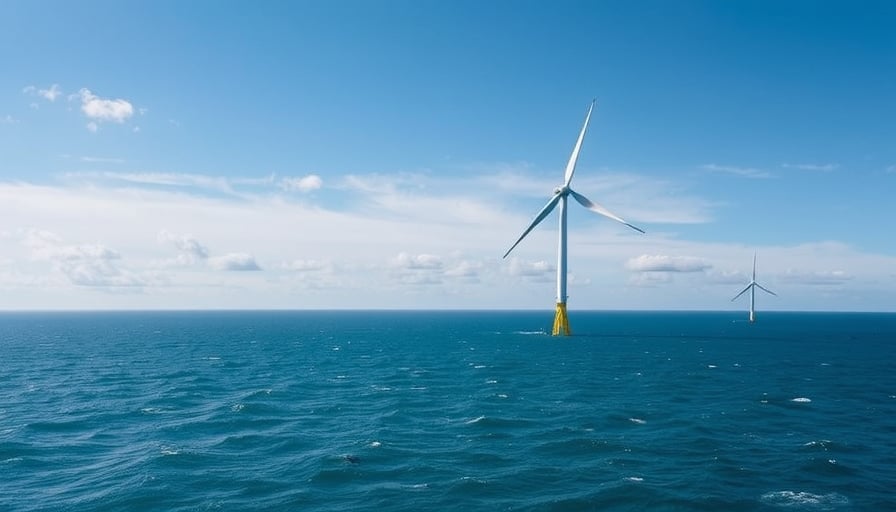
Ørsted’s Hornsea 3 Milestone and Market Dynamics: An Investigative Review
Infrastructure Progress and Technical Complexity
Ørsted’s announcement that the first export cable for its Hornsea 3 offshore wind farm has been installed and is now being hauled to shore marks a pivotal operational milestone. The cable system, supplied by NKT and transported by Jan de Nul, incorporates high‑voltage direct current (HVDC) lines coupled with a fibre‑optic communication link. This dual‑function configuration is designed to transmit the farm’s 2.4 GW output from the North Sea to a dedicated converter station in Norfolk, England, before feeding into the national grid.
From a technical standpoint, the HVDC link’s 900 kV rating reflects a move away from the conventional 220 kV AC export lines that dominated earlier offshore projects. The higher voltage reduces line‑losses over the 140‑km distance, thereby improving the farm’s levelized cost of energy (LCOE). However, the increased voltage also introduces stricter insulation requirements and more complex protection schemes. Ørsted’s decision to employ a fibre‑optic link for real‑time monitoring and control demonstrates a recognition of the operational risk inherent in long‑haul offshore transmission.
Despite the apparent progress, the project’s financial exposure remains significant. The Hornsea 3 contract with the UK’s Department for Business, Energy & Industrial Strategy (BEIS) is worth roughly £1.2 billion, but the offshore wind industry’s cost curve continues to decline at a rate that may outpace the project’s current budgetary assumptions. If construction overruns or supply‑chain disruptions (e.g., turbine blade shortages) arise, the LCOE could rise, eroding projected margins. Ørsted’s balance sheet indicates a €4.1 billion debt load, largely attributable to this and other offshore developments. While the company’s credit rating remains strong, the leverage ratio (debt/EBITDA) sits at 4.3×, leaving limited headroom for unexpected cost escalations.
Market Valuation Shift and Investor Sentiment
Bernstein’s recent upgrade of Ørsted’s target price, coupled with a neutral recommendation, produced a modest lift in the company’s share price. The rating change followed a trading session in which Ørsted gained 1.5 % on a volume of 1.8 million shares, suggesting that market participants are receptive to the narrative of a “mature” offshore portfolio. Yet a closer look at the price‑earnings (P/E) and price‑to‑earnings‑growth (PEG) ratios tells a more cautious story.
- P/E: 18.6× (vs. the sector median of 22.3×)
- PEG (5‑yr): 1.45× (vs. 1.78× industry average)
These figures indicate that the market is pricing Ørsted with a slightly lower risk premium than its peers, potentially reflecting confidence in the company’s cost‑control measures. Nonetheless, the valuation still lags the sector’s upside potential, implying that analysts may be underestimating the value that could be unlocked if the Hornsea 3 project achieves its 2027 operational target on schedule.
A more revealing metric is the Enterprise Value/Revenue (EV/Rev) ratio, which stands at 4.7× for Ørsted compared to an industry average of 5.8×. This suggests that investors are already anticipating a higher revenue stream from offshore assets. Yet the Debt/EBITDA ratio, as noted, remains high, indicating that future earnings will need to grow substantially to support debt servicing without dilutive equity measures.
Legal Landscape and Regulatory Exposure
The recent Texas court ruling that dismissed an alleged antitrust claim involving Ørsted (alongside other firms) illustrates the complex interplay between energy companies and digital platforms. The lawsuit claimed that an advertising boycott on X harmed the firms’ marketing reach. The court’s decision—declaring the claim non‑viable under antitrust law—has implications for Ørsted’s regulatory risk profile.
From a risk perspective, the case underscores how Ørsted, as a global energy operator, can become entangled in ancillary legal disputes that do not directly relate to its core operations. While the ruling is favorable in the short term, it sets a precedent that could be invoked in future litigation concerning digital marketing and platform governance. Moreover, the broader regulatory environment in the UK and the EU, which is tightening emissions standards and incentivizing renewable generation, may influence Ørsted’s compliance costs and potential liabilities.
Uncovering Overlooked Trends
Shift to HVDC in Offshore Wind: Ørsted’s adoption of HVDC reflects a broader industry trend that could alter the competitive dynamics. Companies that invest earlier in HVDC may enjoy lower LCOE and greater grid integration flexibility, potentially capturing larger market shares in the UK and EU.
Digital Platforms as Strategic Partners: Ørsted’s exposure to litigation involving social‑media advertising indicates a strategic dependence on digital marketing ecosystems. As data privacy regulations tighten, energy firms may need to diversify their marketing channels to mitigate regulatory exposure.
Supply‑Chain Resilience: The pandemic‑induced bottlenecks in turbine blade production have highlighted the vulnerability of offshore projects to single‑source suppliers. Ørsted’s partnerships with multiple manufacturers (e.g., Siemens Gamesa) may be a mitigating factor, but the company’s capacity to renegotiate supply contracts remains uncertain.
Regulatory Incentives and Grid Infrastructure: The UK’s offshore wind subsidy regime and the planned expansion of grid capacity (e.g., the North Sea Grid Initiative) present both opportunities and challenges. Ørsted must align its project timelines with grid availability to avoid revenue delays.
Potential Risks and Opportunities
| Risk | Impact | Mitigation |
|---|---|---|
| Construction delays | Revenue deferral, higher LCOE | Robust project management, contingency financing |
| Supply‑chain bottlenecks | Cost overruns, schedule slippage | Diversify suppliers, lock‑in contracts |
| Regulatory changes | Increased compliance costs, potential subsidies loss | Active lobbying, adaptive business strategy |
| Market volatility | Share price erosion | Hedging strategies, diversified portfolio |
| Digital platform litigation | Reputation risk, marketing disruption | Multi‑channel marketing, contractual safeguards |
| Opportunity | Strategic Value | Execution Path |
|---|---|---|
| HVDC technology | Lower transmission losses, higher output | Expand HVDC infrastructure to new sites |
| EU Green Deal | Enhanced subsidies, carbon pricing | Align projects with EU renewable targets |
| Grid expansion | Faster integration, reduced curtailment | Collaborate with grid operators, secure contracts |
| Market leadership | Brand differentiation, investor appeal | Highlight innovation in corporate disclosures |
Conclusion
Ørsted’s progress on the Hornsea 3 export cable marks a tangible step toward its 2027 operational target and signals the company’s commitment to leveraging HVDC technology for cost‑efficient offshore generation. While the recent Bernstein rating upgrade and modest share price lift reflect market optimism, the company’s financial metrics reveal a delicate balance between leveraging debt to finance growth and maintaining sufficient earnings to service that debt.
Regulatory developments, particularly the Texas court ruling, illustrate that Ørsted’s risk profile extends beyond traditional energy concerns into the realms of digital platforms and antitrust law. To sustain its competitive edge, Ørsted must navigate these legal complexities while capitalizing on emerging trends such as HVDC adoption, grid integration initiatives, and evolving regulatory incentives.
Investors and industry observers should therefore remain vigilant, focusing not only on headline milestones but also on the underlying operational, financial, and regulatory variables that shape Ørsted’s trajectory in the rapidly evolving renewable energy landscape.